



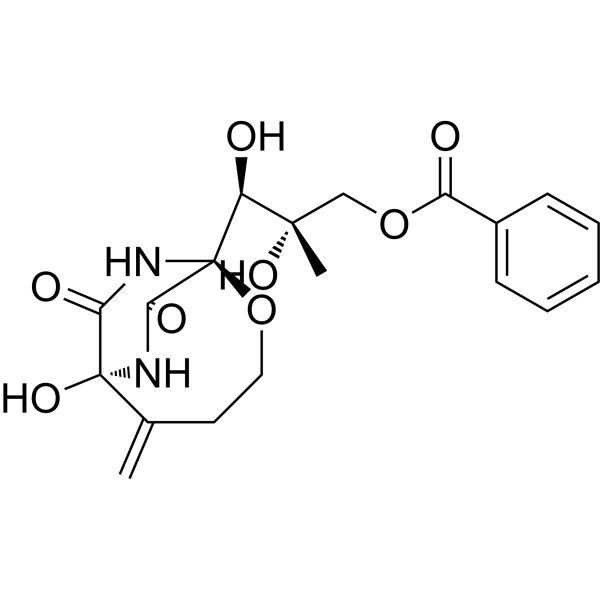
Bicyclomycin benzoate
Based on 2 publication(s) in Google Scholar
Bicyclomycin benzoate is an antibiotic exhibiting activity against a broad spectrum of Gram-negative bacteria and against the Gram-positive bacterium.
Nur für Forschungszwecke. Wir verkaufen nicht an Patienten.
- Reinheit : 99.64%
- CAS. Nr.: 37134-40-0
- Formel: C19H22N2O8
- Molecular Weight:406.39
-
Speicherung:Powder -20°C, 3 years , 4°C, 2 years ; In solvent -80°C, 2 years , -20°C, 1 year

To place orders, for customer services and technical support, please contact: MedChemExpress USA
Tel: 609-228-6898 E-mail: [email protected] [email protected]


-
 Biologische Aktivität
-
Chemical Information
-
Lösungsmittel & Löslichkeit
- Protokoll
- Reinheit & Dokumentation
- Verweise
-
 Help & FAQs




Publications Citing Use of MedChemExpress (MCE) Bicyclomycin benzoate
MoreAlle Antibiotic Isoform-spezifische Produkte anzeigen
More

Biologische Aktivität
Beschreibung
In Vitro
The primary action of bicyclomycin is due to interference with the biosynthesis of lipoprotein and its assembly to peptidoglycan in the cell envelope of E. coli. At the lethal level, bicyclomycin is shown to inhibit the synthesis of RNA and protein in the growing cells of E. coli 15 THU[1]. Bicyclomycin targets the rho transcription termination factor in Escherichia coli. Bicyclomycin is a modest rho inhibitor, can disrupt the rho molecular machinery thereby leading to a catastrophic effect caused by the untimely overproduction of proteins not normally expressed constitutively, thus leading to a toxic effect on the cells[2]. The inhibition of rho poly(C)-stimulated hydrolysis of ATP by bicyclomycin has been found to proceed by a non-competitive, reversible pathway with respect to ATP (Ki=20 μM)[3].
MedChemExpress (MCE) has not independently confirmed the accuracy of these methods. They are for reference only. Further protocols information, click here.
In Vivo
MedChemExpress (MCE) has not independently confirmed the accuracy of these methods. They are for reference only.


Chemical Information
-
CAS. Nr. 37134-40-0
-
Appearance Solid
-
Molecular Weight 406.39
-
Formel C19H22N2O8
-
Color White to off-white
-
SMILES
O[C@H]([C@](NC1=O)(OCCC2=C)C(N[C@]12O)=O)[C@@](C)(O)COC(C3=CC=CC=C3)=O
-
Synonyms
FR2054
-
Versand
Room temperature in continental US; may vary elsewhere.
-
Speicherung
Powder -20°C 3 years 4°C 2 years In solvent -80°C 2 years -20°C 1 year


Publications (2)
-
Journal Impact Factor
-
Most Recent
-
Nat Commun
Extensive diversity in RNA termination and regulation revealed by transcriptome mapping for the Lyme pathogen Borrelia burgdorferi. [Abstract]2023 Jul 4;14(1):3931. PMID: 37402717 -
bioRxiv
Extensive diversity in RNA termination and regulation revealed by transcriptome mapping for the Lyme pathogen B. burgdorferi. [Abstract]2023 Jan 4:2023.01.04.522626. PMID: 36712141


Lösungsmittel & Löslichkeit
In Vitro:
DMSO : 100 mg/mL (246.07 mM; Need ultrasonic; Hygroscopic DMSO has a significant impact on the solubility of product, please use newly opened DMSO)
Please refer to the solubility information to select the appropriate solvent. Once prepared, please aliquot and store the solution to prevent product inactivation from repeated freeze-thaw cycles.
Storage method and period of stock solution: -80°C, 2 years; -20°C, 1 year. When stored at -80°C, please use it within 2 years. When stored at -20°C, please use it within 1 year.
Please refer to the solubility information to select the appropriate solvent. Once prepared, please aliquot and store the solution to prevent product inactivation from repeated freeze-thaw cycles.
Storage method and period of stock solution: -80°C, 2 years; -20°C, 1 year. When stored at -80°C, please use it within 2 years. When stored at -20°C, please use it within 1 year.
Konzentration (Stammlösung) × Volumen (Stammlösung) = Konzentration (Ziellösung) × Volumen (Ziellösung)
In Vivo:
Select the appropriate dissolution method based on your experimental animal and administration route.
- For the following dissolution methods, please ensure to first prepare a clear stock solution using an In Vitro approach and then sequentially add co-solvents:
- To ensure reliable experimental results, the clarified stock solution can be appropriately stored based on storage conditions. As for the working solution for In Vivo experiments, it is recommended to prepare freshly and use it on the same day.
- The percentages shown for the solvents indicate their volumetric ratio in the final prepared solution. If precipitation or phase separation occurs during preparation, heat and/or sonication can be used to aid dissolution.
Add each solvent one by one: 10% DMSO 40% PEG300 5% Tween-80 45% Saline
Solubility: ≥ 2.5 mg/mL (6.15 mM); Clear solution
This protocol yields a clear solution of ≥ 2.5 mg/mL (saturation unknown).
Taking 1 mL working solution as an example, add 100 μL DMSO stock solution (25.0 mg/mL) to 400 μL PEG300, and mix evenly; then add 50 μL Tween-80 and mix evenly; then add 450 μL Saline to adjust the volume to 1 mL.
Preparation of Saline: Dissolve 0.9 g sodium chloride in ddH₂O and dilute to 100 mL to obtain a clear Saline solution.
Add each solvent one by one: 10% DMSO 90% (20% SBE-β-CD in Saline)
Solubility: ≥ 2.5 mg/mL (6.15 mM); Clear solution
This protocol yields a clear solution of ≥ 2.5 mg/mL (saturation unknown).
Taking 1 mL working solution as an example, add 100 μL DMSO stock solution (25.0 mg/mL) to 900 μL 20% SBE-β-CD in Saline, and mix evenly.
Preparation of 20% SBE-β-CD in Saline (4°C, storage for one week): 2 g SBE-β-CD powder is dissolved in 10 mL Saline, completely dissolve until clear.
In Vivo Dissolution Calculator
Please enter the basic information of animal experiments:
-
-
-
-
Recommended: Prepare an additional quantity of animals to account for potential losses during experiments.
Please enter your animal formula composition:
-
%DMSO +
Recommended: Keep the proportion of DMSO in working solution below 2% if your animal is weak.
-
%+
-
+%Tween-80 + +
-
%Saline +
The co-solvents required include: DMSO, . All of co-solvents are available by MedChemExpress (MCE). , Tween 80. All of co-solvents are available by MedChemExpress (MCE).
Working solution concentration: 0.22 mg/mL
Method for preparing stock solution: mg drug dissolved in μL DMSO. Stock solution concentration: mg/mL.
1. Take μL DMSO stock solution;
2. Add μL .
μL , mix evenly;
3. Then add μL Tween 80, mix evenly;
4. Then add μL
Please ensure that the stock solution in the first step is dissolved to a clear state, and add co-solvents in sequence. You can use ultrasonic heating (ultrasonic cleaner, recommended frequency 20-40 kHz), vortexing, etc. to assist dissolution.

Protokoll
-
Gram Staining of Tissue Sections
Gram staining of tissue sections is a histochemical technique used to differentiate Gram-positive and Gram-negative bacteria within histological specimens based on differences in bacterial cell wall structure and dye retention, adapted from classical bacteriological Gram staining into tissue-compatible “histological Gram stain” variants. In tissue applications, modifications of the Brown-Hopps and Brown-Brenn methods are commonly used to improve differentiation of microorganisms embedded within host connective tissue and to reduce overstaining or loss of Gram-negative signal, which are known limitations of earlier approaches. The principle relies on crystal violet-iodine complex retention in Gram-positive organisms and subsequent decolorization and counterstaining steps that allow contrast visualization of Gram-negative organisms against tissue background.


Reinheit & Dokumentation
-
Data Sheet (282 KB)
-
SDS (252 KB)
- English - EN (252 KB)
- Français - FR (252 KB)
- Deutsch - DE (252 KB)
- Norwegian - NO (252 KB)
- Español - ES (252 KB)
- Swedish - SV (252 KB)
- Italian - IT (252 KB)
- Korean - KR (252 KB)
- Portuguese - PT (252 KB)
-
Handling Instructions (2659 KB)
Verweise
[1]. Tanaka N, et al. Mechanism of action of bicyclomycin. J Antibiot (Tokyo). 1976 Feb;29(2):155-68. [Content Brief]
[2]. Kohn H, et al. The molecular basis for the mode of action of bicyclomycin. Curr Drug Targets Infect Disord. 2005 Sep;5(3):273-95. [Content Brief]
[3]. Park HG, et al. Bicyclomycin and dihydrobicyclomycin inhibition kinetics of Escherichia coli rho-dependent transcription termination factor ATPase activity. Arch Biochem Biophys. 1995 Nov 10;323(2):447-54. [Content Brief]
[4]. Nishida M. et al. Bicyclomycin, a new antibiotic. IV. Absorption, excretion and tissue distribution. J Antibiot (Tokyo). 1972 Oct;25(10):594-601. [Content Brief]


Complete Stock Solution Preparation Table
Please refer to the solubility information to select the appropriate solvent. Once prepared, please aliquot and store the solution to prevent product inactivation from repeated freeze-thaw cycles.
Storage method and period of stock solution: -80°C, 2 years; -20°C, 1 year. When stored at -80°C, please use it within 2 years. When stored at -20°C, please use it within 1 year.
| Optional Solvent | Concentration Solvent Mass | 1 mg | 5 mg | 10 mg | 25 mg |
|---|---|---|---|---|---|
| DMSO | 1 mM | 2.4607 mL | 12.3035 mL | 24.6069 mL | 61.5173 mL |
| 5 mM | 0.4921 mL | 2.4607 mL | 4.9214 mL | 12.3035 mL | |
| 10 mM | 0.2461 mL | 1.2303 mL | 2.4607 mL | 6.1517 mL | |
| 15 mM | 0.1640 mL | 0.8202 mL | 1.6405 mL | 4.1012 mL | |
| 20 mM | 0.1230 mL | 0.6152 mL | 1.2303 mL | 3.0759 mL | |
| 25 mM | 0.0984 mL | 0.4921 mL | 0.9843 mL | 2.4607 mL | |
| 30 mM | 0.0820 mL | 0.4101 mL | 0.8202 mL | 2.0506 mL | |
| 40 mM | 0.0615 mL | 0.3076 mL | 0.6152 mL | 1.5379 mL | |
| 50 mM | 0.0492 mL | 0.2461 mL | 0.4921 mL | 1.2303 mL | |
| 60 mM | 0.0410 mL | 0.2051 mL | 0.4101 mL | 1.0253 mL | |
| 80 mM | 0.0308 mL | 0.1538 mL | 0.3076 mL | 0.7690 mL | |
| 100 mM | 0.0246 mL | 0.1230 mL | 0.2461 mL | 0.6152 mL |


Bicyclomycin benzoate Related Classifications
HY-101128 Related Classifications
 Powered by Bioz