



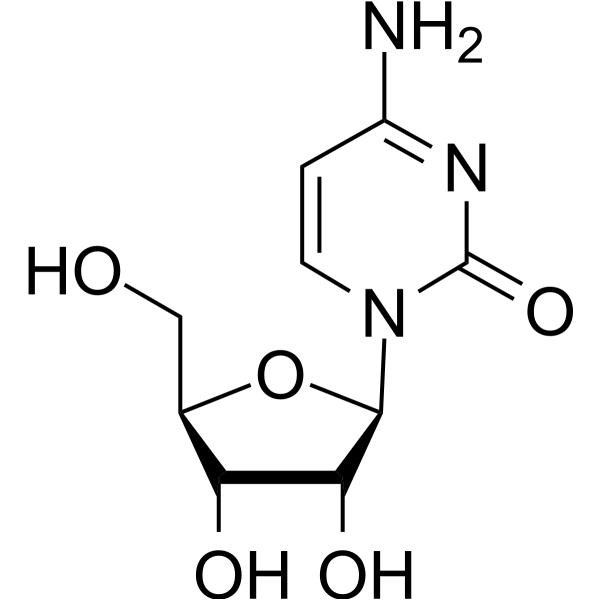
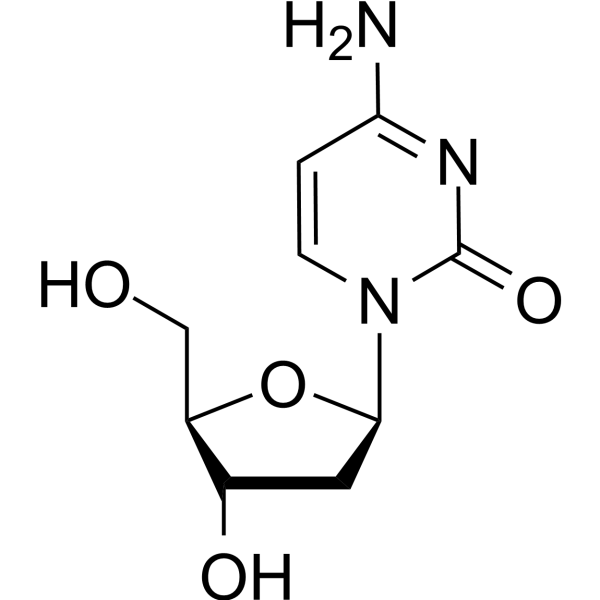
Cytidine
Based on 8 publication(s) in Google Scholar
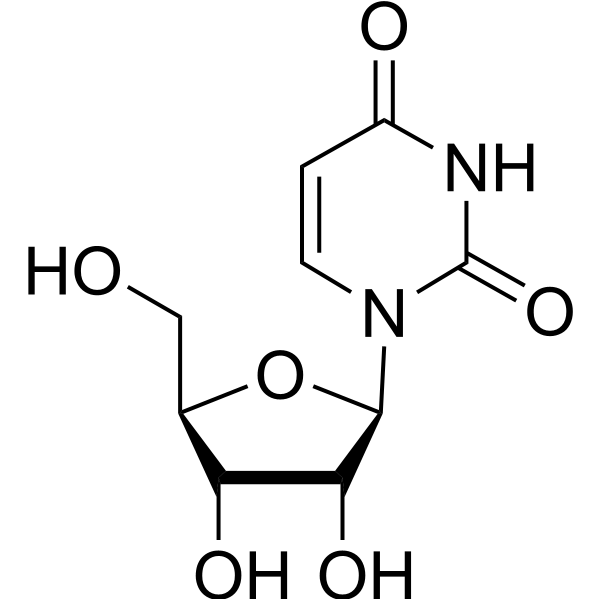
Cytidine is a pyrimidine nucleoside and acts as a component of RNA. Cytidine is a precursor of uridine. Cytidine controls neuronal-glial glutamate cycling, affecting cerebral phospholipid metabolism, catecholamine synthesis, and mitochondrial function.
For research use only. We do not sell to patients.
- Purity: 99.97%
- CAS No.: 65-46-3
- Formula: C9H13N3O5
- Molecular Weight:243.22
-
Storage:Powder -20°C, 3 years , 4°C, 2 years ; In solvent -80°C, 2 years , -20°C, 1 year

To place orders, for customer services and technical support, please contact: MedChemExpress USA
Tel: 609-228-6898 E-mail: [email protected] [email protected]


-
 Biological Activity
-
Chemical Information
-
Solvent & Solubility
- Purity & Documentation
- References
-
 Help & FAQs


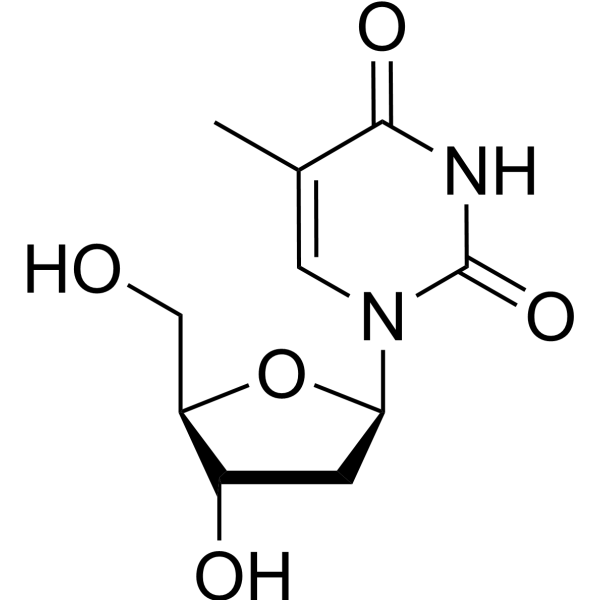
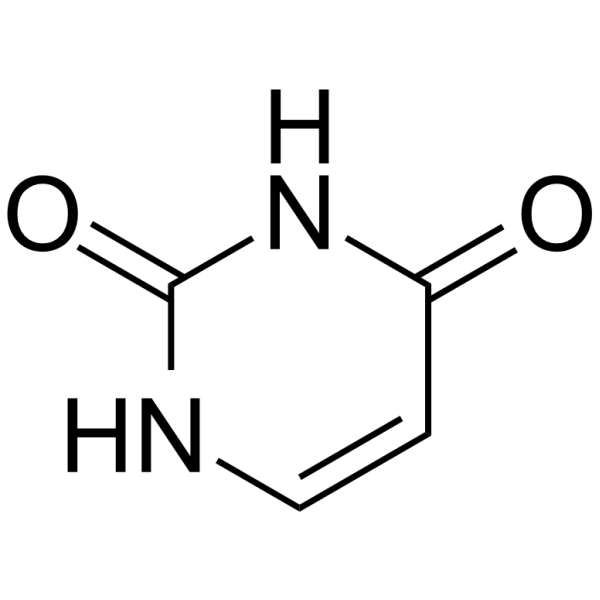

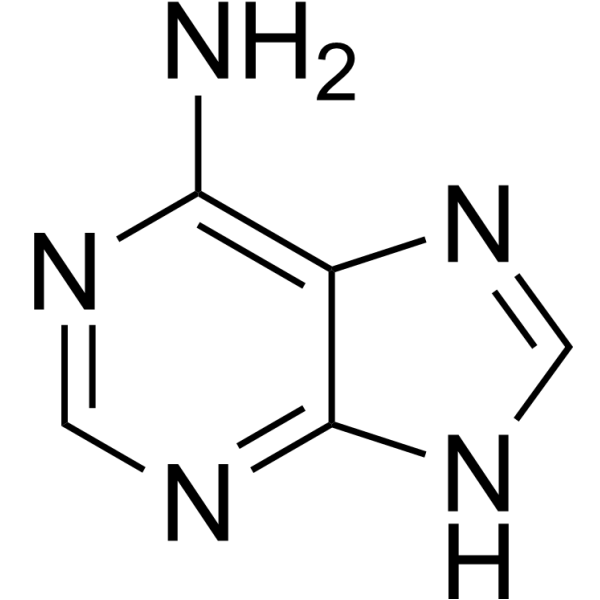
Publications Citing Use of MedChemExpress (MCE) Cytidine
More- Imeta. 2026 Feb 24.
- Nat Mach Intell. 2025 May.
- Information Processing in Agriculture. 2026 Mar 3.
- Molecules. 2023 Apr 11;28(8):3375. [Abstract]
- Mol Med Rep. 2024 Dec;30(6):212. [Abstract]
- J Mol Med (Berl). 2019 Aug;97(8):1183-1193. [Abstract]
- J Pharm Biomed Anal. 2025 Nov 15:265:117026. [Abstract]
- University of Hawaii. 2023 May.
 Customer Validation & Images

-
RT-PCR
-
RT-PCR
-
Cell Proliferation/Viability Assay
-
Cell Migration/Invasion Assay
-
Cell Imaging/Staining
All Endogenous Metabolite Isoforms
More

Biological Activity
|
Microbial Metabolite |
Human Endogenous Metabolite |
|
Cell Line

|
Type | Value | Description | References |
|---|---|---|---|---|
| HOS-TE85 | IC50 |
2.6 μg/mL
Compound: Cytidine
|
Inhibitory effect tested in vitro for the growth of Osteosarcoma MNNG-HOS cell line
Inhibitory effect tested in vitro for the growth of Osteosarcoma MNNG-HOS cell line
|
[PMID: 1895307] |
| KHOS-321H | IC50 |
0.27 μg/mL
Compound: Cytidine
|
Inhibitory effect tested in vitro for the growth of Osteosarcoma KHOS-321H cell line
Inhibitory effect tested in vitro for the growth of Osteosarcoma KHOS-321H cell line
|
[PMID: 1895307] |
| MKN-28 | IC50 |
4.5 μg/mL
Compound: Cytidine
|
Inhibitory effect tested in vitro for the growth of Stomach adenocarcinoma MKN- 28 cell line
Inhibitory effect tested in vitro for the growth of Stomach adenocarcinoma MKN- 28 cell line
|
[PMID: 1895307] |
| NUGC-4 | IC50 |
>100 μg/mL
Compound: Cytidine
|
Inhibitory effect tested in vitro for the growth of Stomach adenocarcinoma NUGC-4 cell line
Inhibitory effect tested in vitro for the growth of Stomach adenocarcinoma NUGC-4 cell line
|
[PMID: 1895307] |
| OST | IC50 |
>100 μg/mL
Compound: Cytidine
|
Inhibitory effect tested in vitro for the growth of Osteosarcoma OST cell line
Inhibitory effect tested in vitro for the growth of Osteosarcoma OST cell line
|
[PMID: 1895307] |
| PC-13 | IC50 |
>100 μg/mL
Compound: Cytidine
|
Inhibitory effect tested in vitro for the growth of Lung adenocarcinoma PC-13 cell line
Inhibitory effect tested in vitro for the growth of Lung adenocarcinoma PC-13 cell line
|
[PMID: 1895307] |
| PC-3 | IC50 |
>100 μg/mL
Compound: Cytidine
|
Inhibitory effect tested in vitro for the growth of Lung adenocarcinoma PC-3 cell line
Inhibitory effect tested in vitro for the growth of Lung adenocarcinoma PC-3 cell line
|
[PMID: 1895307] |
| PC-8 | IC50 |
0.28 μg/mL
Compound: Cytidine
|
Inhibitory effect tested in vitro for the growth of Lung adenocarcinoma PC-8 cell line
Inhibitory effect tested in vitro for the growth of Lung adenocarcinoma PC-8 cell line
|
[PMID: 1895307] |
| PC-9 | IC50 |
1.6 μg/mL
Compound: Cytidine
|
Inhibitory effect tested in vitro for the growth of Lung adenocarcinoma PC-9 cell line
Inhibitory effect tested in vitro for the growth of Lung adenocarcinoma PC-9 cell line
|
[PMID: 1895307] |
| QG-56 | IC50 |
>100 μg/mL
Compound: Cytidine
|
Inhibitory effect tested in vitro for the growth of Lung squamous-cell carcinoma QG-56 cell line
Inhibitory effect tested in vitro for the growth of Lung squamous-cell carcinoma QG-56 cell line
|
[PMID: 1895307] |
| SK-ES1 | IC50 |
0.09 μg/mL
Compound: Cytidine
|
Inhibitory effect tested in vitro for the growth of Osteosarcoma SK-ES-1 cell line
Inhibitory effect tested in vitro for the growth of Osteosarcoma SK-ES-1 cell line
|
[PMID: 1895307] |
| ST-KM-1 | IC50 |
>100 μg/mL
Compound: Cytidine
|
Inhibitory effect tested in vitro for the growth of Stomach adenocarcinoma ST-KM cell line
Inhibitory effect tested in vitro for the growth of Stomach adenocarcinoma ST-KM cell line
|
[PMID: 1895307] |
| SW480 | IC50 |
>100 μg/mL
Compound: Cytidine
|
Inhibitory effect tested in vitro for the growth of colon adenocarcinoma SW-480 cell line
Inhibitory effect tested in vitro for the growth of colon adenocarcinoma SW-480 cell line
|
[PMID: 1895307] |
MedChemExpress (MCE) has not independently confirmed the accuracy of these methods. They are for reference only.


Chemical Information
-
CAS No. 65-46-3
-
Appearance Solid
-
Molecular Weight 243.22
-
Formula C9H13N3O5
-
Color White to off-white
-
SMILES
O[C@H]1[C@@H](O)[C@H](N2C(N=C(N)C=C2)=O)O[C@@H]1CO
-
Synonyms
Cytosine β-D-riboside; Cytosine-1-β-D-ribofuranoside
-
Structure Classification
-
Shipping
Room temperature in continental US; may vary elsewhere.
-
Storage
Powder -20°C 3 years 4°C 2 years In solvent -80°C 2 years -20°C 1 year


Publications (8)
-
Journal Impact Factor
-
Most Recent
-
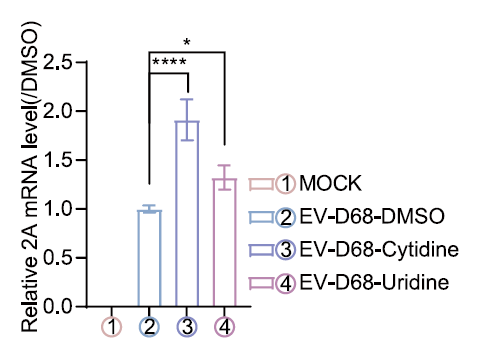
Cytidine purchased from MedChemExpress. Usage Cited in: Imeta. 2026 Feb 24.
Cytidine (15 μM; 12 h) significantly increased the transcription of the viral gene 2A in EV-D68-infected RD cells.
-
-
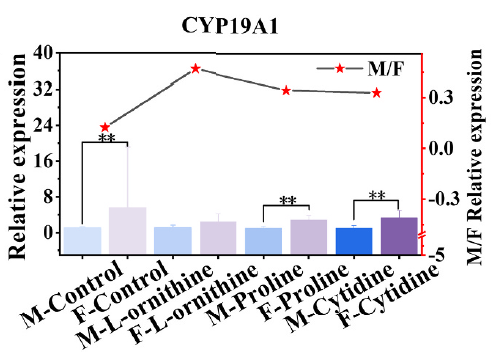
Cytidine purchased from MedChemExpress. Usage Cited in: Information Processing in Agriculture. 2026 Mar 3.
Cytidine (200 μM; 24 h) significantly suppressed CYP19A1 expression in female gonadal cells.
-
Molecules
Untargeted Metabolomics Using UHPLC-HRMS Reveals Metabolic Changes of Fresh-Cut Potato during Browning Process. [Abstract]2023 Apr 11;28(8):3375. PMID: 37110608 -
Mol Med Rep
Causal association between metabolites and upper gastrointestinal tumors: A Mendelian randomization study. [Abstract]2024 Dec;30(6):212. PMID: 39370813 -
J Mol Med (Berl)
2019 Aug;97(8):1183-1193. PMID: 31201471 -
J Pharm Biomed Anal
A novel UHPLC-MS/MS approach for simultaneous quantification of pyrimidine metabolites in human biofluids. [Abstract]2025 Nov 15:265:117026. PMID: 40544701
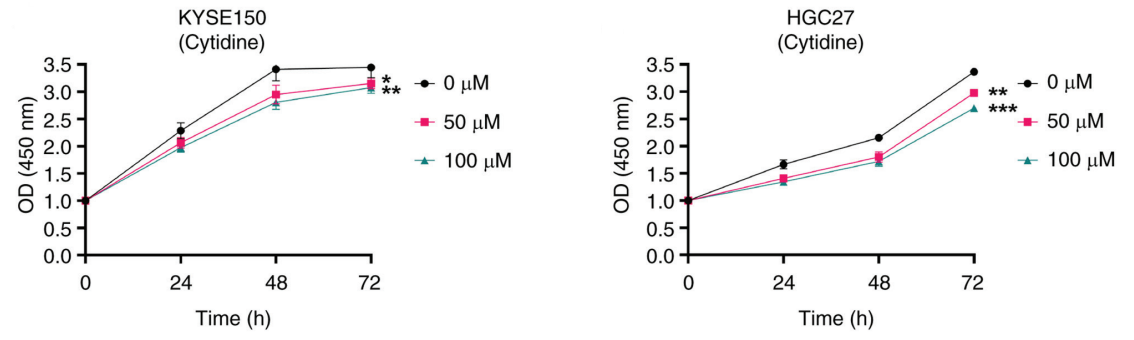
Cytidine purchased from MedChemExpress. Usage Cited in: J Pharm Biomed Anal. 2025 Nov 15:265:117026. [Abstract]
Cytidine (50-100 µM; 72 h) inhibited the proliferation of both EC (KYSE150 cell) and GC (HGC27 cell) cell lines.
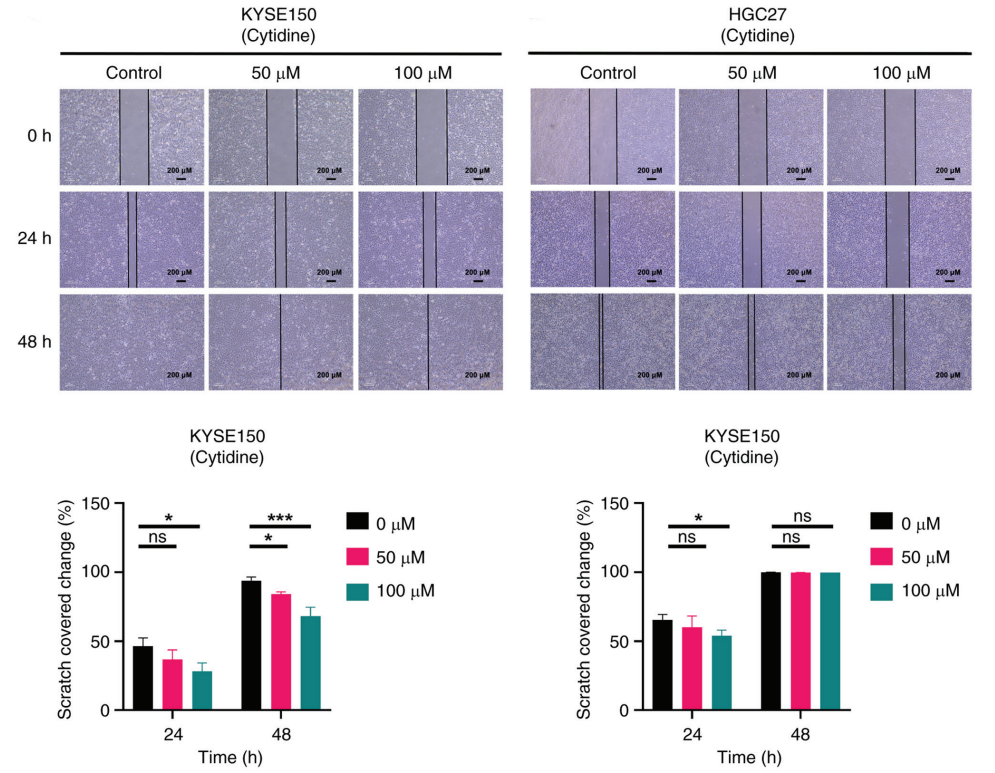
Cytidine purchased from MedChemExpress. Usage Cited in: J Pharm Biomed Anal. 2025 Nov 15:265:117026. [Abstract]
Cytidine (50-100 µM; 72 h) inhibited the migration of both EC (KYSE150 cell) and GC (HGC27 cell) cell lines.
-
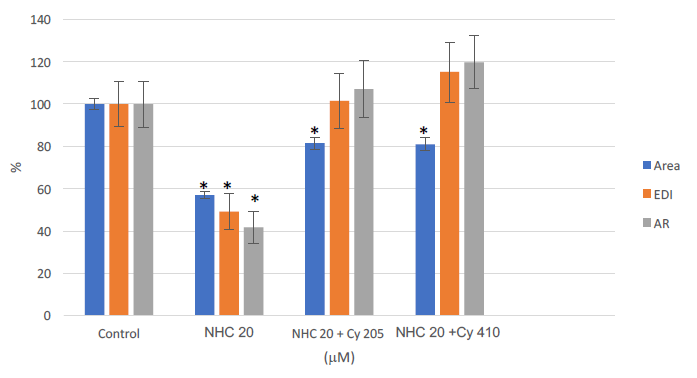
Cytidine purchased from MedChemExpress. Usage Cited in: University of Hawaii. 2023 May.
Cytidine (205-410 µM; 4 d) significantly mitigated the negative effects of NHC on EBs.


Solvent & Solubility
H2O : ≥ 50 mg/mL (205.58 mM)
DMSO : 50 mg/mL (205.58 mM; Need ultrasonic; Hygroscopic DMSO has a significant impact on the solubility of product, please use newly opened DMSO)
* "≥" means soluble, but saturation unknown.
Please refer to the solubility information to select the appropriate solvent. Once prepared, please aliquot and store the solution to prevent product inactivation from repeated freeze-thaw cycles.
Storage method and period of stock solution: -80°C, 2 years; -20°C, 1 year. When stored at -80°C, please use it within 2 years. When stored at -20°C, please use it within 1 year.
* Note: If you choose water as the stock solution, please dilute it to the working solution, then filter and sterilize it with a 0.22 μm filter before use.
Please refer to the solubility information to select the appropriate solvent. Once prepared, please aliquot and store the solution to prevent product inactivation from repeated freeze-thaw cycles.
Storage method and period of stock solution: -80°C, 2 years; -20°C, 1 year. When stored at -80°C, please use it within 2 years. When stored at -20°C, please use it within 1 year.
* Note: If you choose water as the stock solution, please dilute it to the working solution, then filter and sterilize it with a 0.22 μm filter before use.
Concentration (start) × Volume (start) = Concentration (final) × Volume (final)
Select the appropriate dissolution method based on your experimental animal and administration route.
- For the following dissolution methods, please ensure to first prepare a clear stock solution using an In Vitro approach and then sequentially add co-solvents:
- To ensure reliable experimental results, the clarified stock solution can be appropriately stored based on storage conditions. As for the working solution for In Vivo experiments, it is recommended to prepare freshly and use it on the same day.
- The percentages shown for the solvents indicate their volumetric ratio in the final prepared solution. If precipitation or phase separation occurs during preparation, heat and/or sonication can be used to aid dissolution.
Add each solvent one by one: 10% DMSO 40% PEG300 5% Tween-80 45% Saline
Solubility: ≥ 2.5 mg/mL (10.28 mM); Clear solution
This protocol yields a clear solution of ≥ 2.5 mg/mL (saturation unknown).
Taking 1 mL working solution as an example, add 100 μL DMSO stock solution (25.0 mg/mL) to 400 μL PEG300, and mix evenly; then add 50 μL Tween-80 and mix evenly; then add 450 μL Saline to adjust the volume to 1 mL.
Preparation of Saline: Dissolve 0.9 g sodium chloride in ddH₂O and dilute to 100 mL to obtain a clear Saline solution.
Add each solvent one by one: 10% DMSO 90% (20% SBE-β-CD in Saline)
Solubility: ≥ 2.5 mg/mL (10.28 mM); Clear solution
This protocol yields a clear solution of ≥ 2.5 mg/mL (saturation unknown).
Taking 1 mL working solution as an example, add 100 μL DMSO stock solution (25.0 mg/mL) to 900 μL 20% SBE-β-CD in Saline, and mix evenly.
Preparation of 20% SBE-β-CD in Saline (4°C, storage for one week): 2 g SBE-β-CD powder is dissolved in 10 mL Saline, completely dissolve until clear.
For the following dissolution methods, please prepare the working solution directly:
It is recommended to prepare fresh solutions and use them promptly within a short period of time.
The percentages shown for the solvents indicate their volumetric ratio in the final prepared solution. If precipitation or phase separation occurs during preparation, heat and/or sonication can be used to aid dissolution.
Add each solvent one by one: PBS
Solubility: 100 mg/mL (411.15 mM); Clear solution; Need ultrasonic
Please enter the basic information of animal experiments:
-
-
-
-
Recommended: Prepare an additional quantity of animals to account for potential losses during experiments.
Working solution concentration: 0.22 mg/mL
This product has good water solubility, please refer to the measured solubility data in water/PBS/Saline for details.


Purity & Documentation
-
Data Sheet (277 KB)
-
SDS (396 KB)
- English - EN (396 KB)
- Français - FR (396 KB)
- Deutsch - DE (396 KB)
- Norwegian - NO (396 KB)
- Español - ES (396 KB)
- Swedish - SV (396 KB)
- Italian - IT (396 KB)
- Korean - KR (396 KB)
- Portuguese - PT (396 KB)
-
Handling Instructions (2659 KB)
References
[1]. Jonas DA, et al. Safety considerations of DNA in food. Ann Nutr Metab. 2001;45(6):235-54. [Content Brief]
[2]. Wurtman RJ, et al. Effect of oral CDP-choline on plasma choline and uridine levels in humans. Biochem Pharmacol. 2000 Oct 1;60(7):989-92. [Content Brief]
[3]. Machado-Vieira R, et, al. New therapeutic targets for mood disorders. ScientificWorldJournal. 2010 Apr 13;10:713-26. [Content Brief]


Complete Stock Solution Preparation Table
Please refer to the solubility information to select the appropriate solvent. Once prepared, please aliquot and store the solution to prevent product inactivation from repeated freeze-thaw cycles.
Storage method and period of stock solution: -80°C, 2 years; -20°C, 1 year. When stored at -80°C, please use it within 2 years. When stored at -20°C, please use it within 1 year.
| Optional Solvent | Concentration Solvent Mass | 1 mg | 5 mg | 10 mg | 25 mg |
|---|---|---|---|---|---|
| H2O / DMSO | 1 mM | 4.1115 mL | 20.5575 mL | 41.1150 mL | 102.7876 mL |
| 5 mM | 0.8223 mL | 4.1115 mL | 8.2230 mL | 20.5575 mL | |
| 10 mM | 0.4112 mL | 2.0558 mL | 4.1115 mL | 10.2788 mL | |
| 15 mM | 0.2741 mL | 1.3705 mL | 2.7410 mL | 6.8525 mL | |
| 20 mM | 0.2056 mL | 1.0279 mL | 2.0558 mL | 5.1394 mL | |
| 25 mM | 0.1645 mL | 0.8223 mL | 1.6446 mL | 4.1115 mL | |
| 30 mM | 0.1371 mL | 0.6853 mL | 1.3705 mL | 3.4263 mL | |
| 40 mM | 0.1028 mL | 0.5139 mL | 1.0279 mL | 2.5697 mL | |
| 50 mM | 0.0822 mL | 0.4112 mL | 0.8223 mL | 2.0558 mL | |
| 60 mM | 0.0685 mL | 0.3426 mL | 0.6853 mL | 1.7131 mL | |
| 80 mM | 0.0514 mL | 0.2570 mL | 0.5139 mL | 1.2848 mL | |
| 100 mM | 0.0411 mL | 0.2056 mL | 0.4112 mL | 1.0279 mL |
* Note: If you choose water as the stock solution, please dilute it to the working solution, then filter and sterilize it with a 0.22 μm filter before use.


Cytidine Related Classifications
HY-B0158 Related Classifications
 Powered by Bioz