Cholinesterase (ChE)
Cholinesterase (ChE) is a family of enzymes present in the central nervous system, particularly in nervous tissue, muscle and red cells, which catalyze the hydrolysis of the neurotransmitter acetylcholine into choline and acetic acid, a reaction necessary to allow a cholinergic neuron to return to its resting state after activation. It is one of many important enzymes needed for the proper functioning of the nervous systems of humans.
There are two types: acetylcholinesterase (AChE, acetylcholine hydrolase) and butyrylcholinesterase (BChE, acylcholine acylhydrolase), also known as nonspecific cholinesterase or pseudocholinesterase. AChE is primarily found in the blood on red blood cell membranes, in neuromuscular junctions, and in neural synapses, while BChE is produced in the liver and found primarily in plasma. The difference between the two types of cholinesterase is their relative preferences for substrates: AChE hydrolyzes acetylcholine faster while BChE hydrolyzes butyrylcholine faster.
Cholinesterase (ChE) Isoform Specific Products
All Product Categories
-
Cholinesterase (ChE) Inhibitors
(910)
View all products
-
Cholinesterase (ChE) Agonists
(5)
View all products
-
Cholinesterase (ChE) Antagonists
(10)
View all products
-
Cholinesterase (ChE) Activators
(32)
View all products
-
Cholinesterase (ChE) Modulators
(10)
View all products
-
Cholinesterase (ChE) Chemical
(1)
View all products
-
Cholinesterase (ChE) Inducer
(1)
View all products
-
Cholinesterase (ChE) Controls
(6)
View all products
-
Cholinesterase (ChE) Substrates
(2)
View all products
-
Cholinesterase (ChE) Related Products (1058)
Related Products (1058)

-
Antibodies (2)
-
Cholinesterase (ChE) Isoform Comparison
-
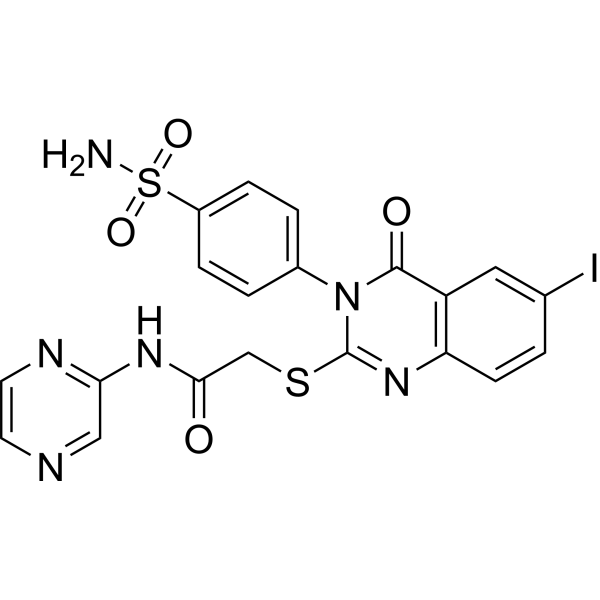
Z164597606
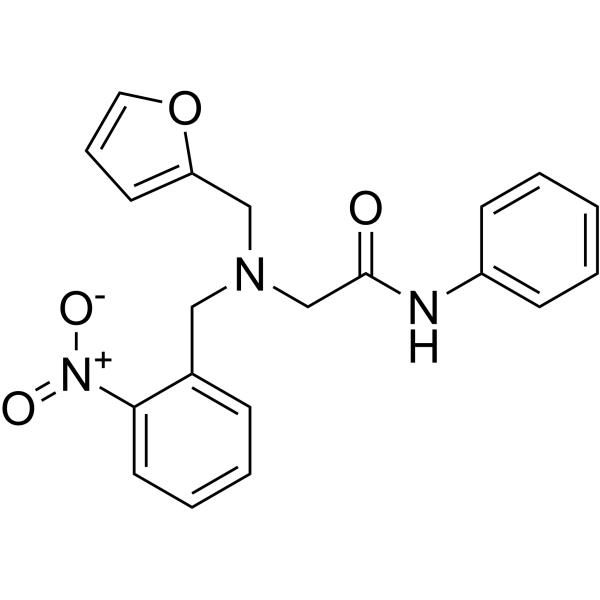 0 ImagesCat. No.: HY-151405CAS No.: 1050587-57-9
-
AChE/BuChE-IN-7
 0 ImagesCat. No.: HY-178141AChE/BuChE-IN-7 is a dual-action inhibitor with an IC50 valueof 0.15 μM for AChE and 0.7 μM for BuChE, SI of 4.7. AChE/BuChE-IN-7 shows anti-oxidant activity and can mitigate H2O2-induced cytotoxicity. AChE/BuChE-IN-7 has genomic stability and prolonged systemic availability. AChE/BuChE-IN-7 can be used for the research of neurological disease, such as Alzheimer's disease.
-
Trimedoxime
 0 ImagesCat. No.: HY-165600ACAS No.: 56-97-3Synonyms: TMB-4Trimedoxime (TMB-4) is a blood-brain barrier-permeable cholinesterase reactivator. Trimedoxime reactivates cholinesterase inhibited by paraoxon, sarin, tabun and other agents, restricts the breakdown of acetylcholine and alleviates excessive cholinergic stimulation. Trimedoxime reduces mortality and prolongs survival time. Trimedoxime exhibits reactivation efficacy against AChE in rat tissues. Trimedoxime can be used in research related to organophosphate (paraoxon) poisoning and tabun poisoning.


-
AChE-IN-91
 0 ImagesCat. No.: HY-175006CAS No.: 1171708-92-1AChE-IN-91 (Compound 8u) is a AChE inhibitor with an IC50 of 0.05 μM. AChE-IN-91 has significant anticholinesterase activity, promising for neurological diseases like Alzheimer's disease (AD) research.
-
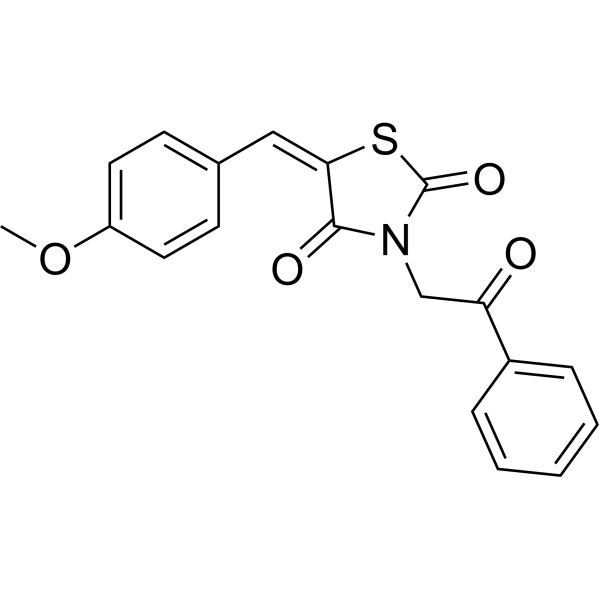
Neuroprotective agent 18
 0 ImagesCat. No.: HY-184935Neuroprotective agent 18 is a potent neuroprotective agent. Neuroprotective agent 18 inhibits the activity of NF-κB thereby significantly downregulating the expression of downstream pro-inflammatory mediators (TNF-α, IL-6) and inflammatory enzymes (COX-2) in the hippocampus. Neuroprotective agent 18 binds to AChE thereby partially inhibiting it and modulating cholinergic neurotransmission. Neuroprotective agent 18 can be used in research on Alzheimer's disease.

-
Demecarium Bromide (Standard)
 0 ImagesCat. No.: HY-B1626ARCAS No.: 56-94-0Synonyms: BC-48 (Standard)Demecarium Bromide (Standard) is the analytical standard of Demecarium Bromide. This product is intended for research and analytical applications. Demecarium Bromide (BC-48) is a potent cholinesterase inhibitor, with an apparent affinity (Kiapp) of 0.15 μM. Demecarium Bromide (BC-48) is used as a glaucoma agent.
-
TFSeB
 0 ImagesCat. No.: HY-174419CAS No.: 3017240-62-6TFSeB is an orally active neuroprotective agent. TFSeB can reduce Streptozotocin (STZ) (HY-13753) induced MAO-B and AChE activity. TFSeB exerts neuroprotective effects by increasing the expression of BCL-2, BDNF, NRF2, and decreasing the expression of BAX. TFSeB can reduce lipid peroxidation (TBARS) and reactive oxygen species (ROS) levels. TFSeB can reduce neuroinflammation. TFSeB can be used for research on Alzheimer’s disease.
-
Sinapine thiocyanate (Standard)
 0 ImagesSinapine (thiocyanate) (Standard) is the analytical standard of Sinapine (thiocyanate). This product is intended for research and analytical applications. Sinapine thiocyanate is an alkaloid isolated from seeds of the cruciferous species. Sinapine thiocyanate exhibits anti-inflammatory, anti-oxidant, anti-tumor, anti-angiogenic and radio-protective effects. Sinapine thiocyanate is also an acetylcholinesterase (AChE) inhibitor and can be used for the research of Alzheimer’s disease, ataxia, myasthenia gravis, and Parkinson’s disease.
-
Fenitrothion-d6
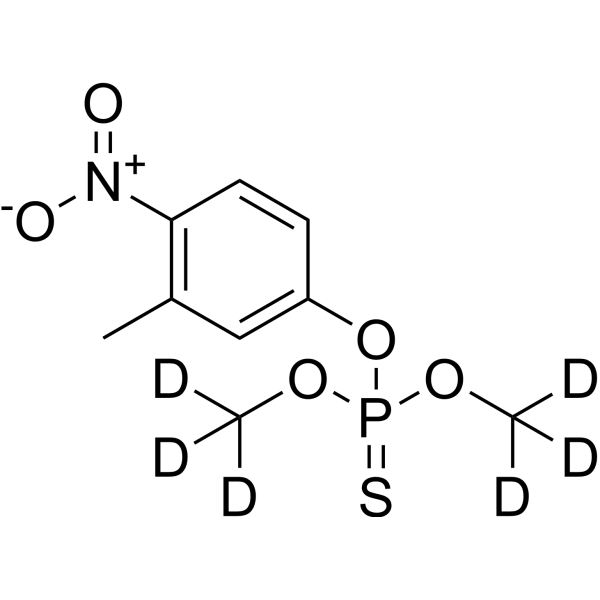 0 ImagesCat. No.: HY-B1885SCAS No.: 203645-59-4Fenitrothion-d6 is the deuterium labeled Fenitrothion (HY-B1885). Fenitrothion is a broad-spectrum and orally active insecticide/acaricide. Fenitrothion inhibits cholinesterase, AMPKα and IRS1/PI3K/AKT. Fenitrothion causes Apoptosis, reduces SOD activity. Fenitrothion shows insecticidal effect against Rhyzopertha dominica and Tribolium castaneum adults. Fenitrothion is widely used in cotton crops, vegetable crops, fruit crops and field crops, especially rice. Fenitrothion can be used for brain and spleen toxicology studies.
-
Isocorydine N-oxide
 0 ImagesCat. No.: HY-N15707CAS No.: 25405-80-5Synonyms: (+)-Isocorydine N-oxideIsocorydine N-oxide ((+)-Isocorydine N-oxide), an alkaloidal, a acetylcholinesterase (AChE) inhibitor. Isocorydine N-oxide can be used for the study of Alzheimer's disease.
-
AChE-IN-109
 0 ImagesCat. No.: HY-181851AChE-IN-109 is a potent mixed-type cholinesterase inhibitor with significantly stronger inhibitory activity against AChE than BChE. AChE-IN-109 has IC50 values of 0.55 μM and 12.45 μM against AChE and BChE, respectively. AChE-IN-109 inhibits cholinesterases through a mixed-type mechanism, binds to both the catalytic active site (CAS) and peripheral anionic site (PAS) of AChE. AChE-IN-109 can be used for the study of Alzheimer’s disease (AD).
-
BChE-IN-41
 0 ImagesCat. No.: HY-174381BChE-IN-41 is a highly selective Butyrylcholinesterase (BChE) inhibitor (IC50 =12 nM, Ki = 6.6 nM). BChE-IN-41 has high brain penetration with a brain-to-plasma ratio of 9.0. BChE-IN-41 has pro-cognitive effects on mice with AD-like symptoms induced by Scopolamine (HY-N0296) and Aβ1-42.
-
SBN-284
 0 ImagesCat. No.: HY-159482SBN-284 (compound 3x) is a dual inhibitor of blood-brain permeable Cholinesterases and the NLRP3 inflammasome and is effective against EeAChE, hAChE and eqBChE, the IC50 values of are 0.37, 0.31, 0.29 μM respectively, and the EC50 of NLRP3 inflamm is 1 μM. SBN-284 can be used in Alzheimer's disease research.
-
MAO-IN-6
 0 ImagesCat. No.: HY-172461MAO-IN-6 (Compound 3f) is a BBB permeable and reversible MAO-B inhibitor with an IC50 of 0.09 μM. MAO-IN-6 also exhibits certain inhibitory activities against AChE and BChE, with IC50 values of 4.48 μM and 17.03 μM, respectively. MAO-IN-6 has low cytotoxicity and can be used in the research of Alzheimer's disease.
-
AChE/BACE1/GSK3β-IN-1
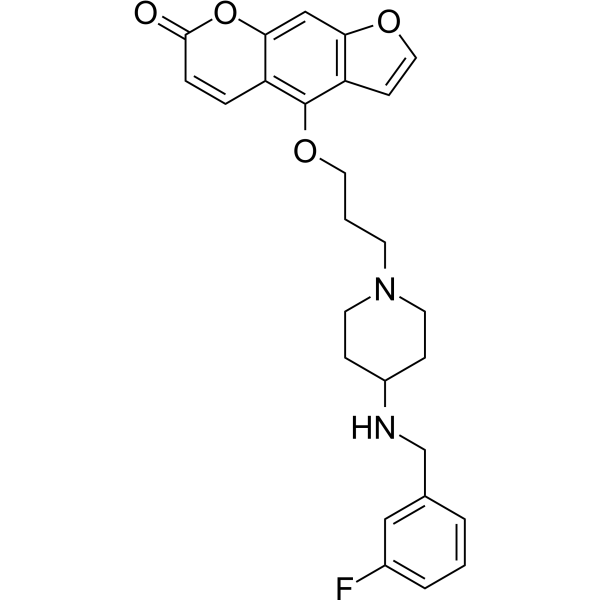 0 ImagesCat. No.: HY-151260CAS No.: 2866066-81-9AChE/BACE1/GSK3β-IN-1 is an orally active triple inhibitor of AChE/BACE1/GSK3β. AChE/BACE1/GSK3β-IN-1 has effective inhibitory activity against AChE, BACE1 and GSK3β with IC50 values of 1.0 μM, 20 μM and 15 μM, respectively. AChE/BACE1/GSK3β-IN-1 has good blood-brain barrier penetrability, suitable bioavailability. AChE/BACE1/GSK3β-IN-1 can be used for the research of Alzheimer's disease (AD).