



Fenitrothion
Based on 2 publication(s) in Google Scholar
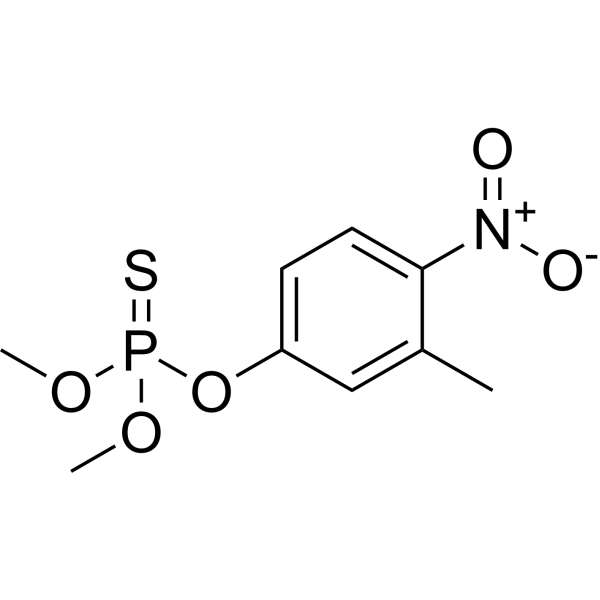
Fenitrothion is a broad-spectrum and orally active insecticide/acaricide. Fenitrothion inhibits cholinesterase, AMPKα and IRS1/PI3K/AKT. Fenitrothion causes Apoptosis, reduces SOD activity. Fenitrothion shows insecticidal effect against Rhyzopertha dominica and Tribolium castaneum adults. Fenitrothion is widely used in cotton crops, vegetable crops, fruit crops and field crops, especially rice. Fenitrothion can be used for brain and spleen toxicology studies.
For research use only. We do not sell to patients.
- Purity : 99.43%
- CAS No.: 122-14-5
- Formula: C9H12NO5PS
- Molecular Weight:277.23
-
Storage:
4°C, stored under nitrogen
* In solvent : -80°C, 6 months; -20°C, 1 month (stored under nitrogen)

To place orders, for customer services and technical support, please contact: MedChemExpress USA
Tel: 609-228-6898 E-mail: [email protected] [email protected]


-
 Biological Activity
-
Chemical Information
-
Solvent & Solubility
- Protocols
- Purity & Documentation
- References
-
 Help & FAQs



Publications Citing Use of MedChemExpress (MCE) Fenitrothion
MoreAll Parasite Isoforms
MoreAll AMPK Isoforms
More

Biological Activity
Description
IC50 & Target
|
Mite |
In Vitro
Fenitrothion (10-100 μM; 2 h) decreases the viability of isolated rat hepatocytes, reduces the activities of antioxidant enzymes such as SOD, GSH-Px and GST in isolated rat hepatocytes[1].
Fenitrothion (45-450 μM; 24 h) induces glucose metabolism disorders in rat liver BRL cells by inhibiting AMPKα and IRS1/PI3K/AKT signaling pathway[2].
Fenitrothion (Fenitrothion emulsion; 0.015 mL/kg of wheat) shows insecticidal effect against Rhyzopertha dominica and Tribolium castaneum adults on stored wheat, and reduces the damaged insect grains and progeny production[3].
MedChemExpress (MCE) has not independently confirmed the accuracy of these methods. They are for reference only.
-
Cell Line:Rat hepatocytes (Buffalo Rat Liver, BRL cells)
-
Concentration:45 μM, 90 μM, 180 μM, 450 μM
-
Incubation Time:24 h
-
Result:Decreased the protein levels of GLUT4 and protein phosphorylation levels in AMPKα, IRS-1, PI3K, and AKT.
Promoted the phosphorylation of GSK-3β.
In Vivo
Fenitrothion (20 mg/kg BW; p.o.; 30 days) causes hematological changes, immunotoxicity, oxidative stress, and apoptosis in the brain and spleen tissues of male Sprague Dawley rats[6].
MedChemExpress (MCE) has not independently confirmed the accuracy of these methods. They are for reference only.
-
Animal Model:Male Sprague Dawley rats of 6 weeks age[6]
-
Dosage:20 mg/kg BW (dissolved in distilled water)
-
Administration:Oral administration (p.o.), per day, 30 days
-
Result:Caused a reduction in the erythrocyte count, leukocytosis, lymphocytosis, and neutrophilia.
Increased the serum levels of LDH, TNF-α, and IL-2, and reduced serum immunoglobulins (IgG & IgM) concentrations.
Inhibited AchE activity, increased brain GABA, serotonin and dopamine levels, and induced oxidative DNA damage.
Caused white pulp depletion in the spleen.


Chemical Information
-
CAS No. 122-14-5
-
Appearance Liquid (Density: 1.3227 g/cm3)
-
Molecular Weight 277.23
-
Formula C9H12NO5PS
-
Color Light yellow to yellow
-
SMILES
S=P(OC)(OC)OC1=CC=C([N+]([O-])=O)C(C)=C1
-
Shipping
Room temperature in continental US; may vary elsewhere.
-
Storage
4°C, stored under nitrogen
* In solvent : -80°C, 6 months; -20°C, 1 month (stored under nitrogen)


Publications (2)
-
Journal Impact Factor
-
Most Recent
-
ACS Environ Au
Machine Learning-Assisted Recognition of Environmental Sulfur-Containing Chemicals in Nontargeted Mass Spectrometry Analysis of Inadequate Mass Resolution. [Abstract]2025 Aug 5;5(6):573-582. PMID: 41277996 -
Anal Chem
Exposome-Scale Investigation of Cl-/Br-Containing Chemicals Using High-Resolution Mass Spectrometry, Multistage Machine Learning, and Cloud Computing. [Abstract]2025 Jun 3;97(21):11099-11109. PMID: 40401576


Solvent & Solubility
In Vitro:
Ethanol : 100 mg/mL (360.71 mM; Need ultrasonic)
Please refer to the solubility information to select the appropriate solvent. Once prepared, please aliquot and store the solution to prevent product inactivation from repeated freeze-thaw cycles.
Storage method and period of stock solution: -80°C, 6 months; -20°C, 1 month (stored under nitrogen). When stored at -80°C, please use it within 6 months. When stored at -20°C, please use it within 1 month.
Please refer to the solubility information to select the appropriate solvent. Once prepared, please aliquot and store the solution to prevent product inactivation from repeated freeze-thaw cycles.
Storage method and period of stock solution: -80°C, 6 months; -20°C, 1 month (stored under nitrogen). When stored at -80°C, please use it within 6 months. When stored at -20°C, please use it within 1 month.
Concentration (start) × Volume (start) = Concentration (final) × Volume (final)
In Vivo:
Select the appropriate dissolution method based on your experimental animal and administration route.
- For the following dissolution methods, please ensure to first prepare a clear stock solution using an In Vitro approach and then sequentially add co-solvents:
- To ensure reliable experimental results, the clarified stock solution can be appropriately stored based on storage conditions. As for the working solution for In Vivo experiments, it is recommended to prepare freshly and use it on the same day.
- The percentages shown for the solvents indicate their volumetric ratio in the final prepared solution. If precipitation or phase separation occurs during preparation, heat and/or sonication can be used to aid dissolution.
Add each solvent one by one: 10% EtOH 40% PEG300 5% Tween-80 45% Saline
Solubility: ≥ 2.5 mg/mL (9.02 mM); Clear solution
This protocol yields a clear solution of ≥ 2.5 mg/mL (saturation unknown).
Taking 1 mL working solution as an example, add 100 μL EtOH stock solution (25.0 mg/mL) to 400 μL PEG300, and mix evenly; then add 50 μL Tween-80 and mix evenly; then add 450 μL Saline to adjust the volume to 1 mL.
Preparation of Saline: Dissolve 0.9 g sodium chloride in ddH₂O and dilute to 100 mL to obtain a clear Saline solution.
Add each solvent one by one: 10% EtOH 90% (20% SBE-β-CD in Saline)
Solubility: ≥ 2.5 mg/mL (9.02 mM); Clear solution
This protocol yields a clear solution of ≥ 2.5 mg/mL (saturation unknown).
Taking 1 mL working solution as an example, add 100 μL EtOH stock solution (25.0 mg/mL) to 900 μL 20% SBE-β-CD in Saline, and mix evenly.
Preparation of 20% SBE-β-CD in Saline (4°C, storage for one week): 2 g SBE-β-CD powder is dissolved in 10 mL Saline, completely dissolve until clear.
In Vivo Dissolution Calculator
Please enter the basic information of animal experiments:
-
-
-
-
Recommended: Prepare an additional quantity of animals to account for potential losses during experiments.
Working solution concentration: 0.22 mg/mL


Purity & Documentation
-
Data Sheet (281 KB)
-
SDS (624 KB)
- English - EN (624 KB)
- Français - FR (624 KB)
- Deutsch - DE (624 KB)
- Norwegian - NO (624 KB)
- Español - ES (624 KB)
- Swedish - SV (624 KB)
- Italian - IT (624 KB)
- Korean - KR (624 KB)
- Portuguese - PT (624 KB)
-
Handling Instructions (2659 KB)
References
[1]. El-Shenawy NS. Effects of insecticides fenitrothion, endosulfan and abamectin on antioxidant parameters of isolated rat hepatocytes. Toxicol In Vitro. 2010 Jun;24(4):1148-57. [Content Brief]
[2]. Guo Y, et al. Fenitrothion induces glucose metabolism disorders in rat liver BRL cells by inhibiting AMPKα and IRS1/PI3K/AKT signaling pathway. Pestic Biochem Physiol. 2024 Sep;204:106098. [Content Brief]
[5]. Li Q, et al. Effect of oral exposure to fenitrothion and 3-methyl-4-nitrophenol on splenic cell populations and histopathological alterations in spleen in Wistar rats. Hum Exp Toxicol. 2011 Jul;30(7):665-74. [Content Brief]
[6]. Alam RT, et al. Amelioration of fenitrothion induced oxidative DNA damage and inactivation of caspase-3 in the brain and spleen tissues of male rats by N-acetylcysteine. Life Sci. 2019 Aug 15;231:116534. [Content Brief]
[7]. Abdel-Ghany R, et al. Impact of Exposure to Fenitrothion on Vital Organs in Rats. J Toxicol. 2016;2016:5609734. [Content Brief]


Complete Stock Solution Preparation Table
Please refer to the solubility information to select the appropriate solvent. Once prepared, please aliquot and store the solution to prevent product inactivation from repeated freeze-thaw cycles.
Storage method and period of stock solution: -80°C, 6 months; -20°C, 1 month (stored under nitrogen). When stored at -80°C, please use it within 6 months. When stored at -20°C, please use it within 1 month.
| Optional Solvent | Concentration Solvent Mass | 1 mg | 5 mg | 10 mg | 25 mg |
|---|---|---|---|---|---|
| Ethanol | 1 mM | 3.6071 mL | 18.0356 mL | 36.0711 mL | 90.1778 mL |
| 5 mM | 0.7214 mL | 3.6071 mL | 7.2142 mL | 18.0356 mL | |
| 10 mM | 0.3607 mL | 1.8036 mL | 3.6071 mL | 9.0178 mL | |
| 15 mM | 0.2405 mL | 1.2024 mL | 2.4047 mL | 6.0119 mL | |
| 20 mM | 0.1804 mL | 0.9018 mL | 1.8036 mL | 4.5089 mL | |
| 25 mM | 0.1443 mL | 0.7214 mL | 1.4428 mL | 3.6071 mL | |
| 30 mM | 0.1202 mL | 0.6012 mL | 1.2024 mL | 3.0059 mL | |
| 40 mM | 0.0902 mL | 0.4509 mL | 0.9018 mL | 2.2544 mL | |
| 50 mM | 0.0721 mL | 0.3607 mL | 0.7214 mL | 1.8036 mL | |
| 60 mM | 0.0601 mL | 0.3006 mL | 0.6012 mL | 1.5030 mL | |
| 80 mM | 0.0451 mL | 0.2254 mL | 0.4509 mL | 1.1272 mL | |
| 100 mM | 0.0361 mL | 0.1804 mL | 0.3607 mL | 0.9018 mL |


Fenitrothion Related Classifications
HY-B1885 Related Classifications
 Powered by Bioz