



CaSR
Calcium-sensing receptor
The extracellular CaSR (calcium-sensing receptor is a unique G protein-coupled receptor (GPCR) activated by extracellular Ca2+ and by other physiological cations including Mg2+, amino acids, and polyamines. CaSR is the most important master controller of the extracellular Ca2+ homeostatic system being expressed at high levels in the parathyroid gland, kidney, gut, and bone, where it regulates parathyroid hormone (PTH) secretion, vitamin D synthesis, and Ca2+ absorption and resorption, respectively. Gain and loss of function mutations in the CaSR are responsible for severe disturbances in extracellular Ca2+ metabolism.
The CaSR stimulates two major signal transduction cascades. The first is the Gq/11-phospholipase C (PLC)-mediated generation of inositol 1,4,5-trisphosphate (IP3), which induces a rapid rise in intracellular calcium (Ca2+i) concentrations. The second is the mitogen-activated protein kinases (MAPKs), such as extracellular signal-regulated kinases 1 and 2 (ERK1/2), which phosphorylate proteins mediating cytosolic signaling and translocate into the nucleus to activate transcription factors involved in cellular proliferation and differentiation. The CaSR has been shown to activate MAPK signaling in a manner that depends on the G proteins Gq/11, and Gi/o, which inhibits cyclic adenosine monophosphate (cAMP) synthesis, and by a potentially G protein-independent mechanism involving β-arrestin types 1 and 2.
All Product Categories
-
CaSR Related Products (76)
Related Products (76)

-
Encaleret sodium
 0 ImagesCat. No.: HY-14401BCAS No.: 787584-62-7Synonyms: CLTX-305 sodium; JTT-305 sodium; MK-5442 sodiumEncaleret (CLTX-305) sodium is an orally active antagonist of the calcium-sensing receptor (CaSR), with an IC50 of 12 nM. Encaleret sodium exerts its effect by inhibiting the excessive activity of functional gain-of-function CaSR variants, and can restore blood calcium levels, promote the secretion of parathyroid hormone, improve magnesium and phosphorus metabolism, and increase urinary calcium excretion. Encaleret sodium can be used in the research of diseases such as osteoporosis and autosomal dominant hypocalcemia type 1.
-
Evocalcet-d4
 0 ImagesCat. No.: HY-17613SSynonyms: KHK7580-d4Evocalcet-d4 (KHK7580-d4) is deuterium labeled Evocalcet. Evocalcet (KHK7580) is an orally active calcium sensing receptor (CaSR) agonist. Evocalcet inhibits the secretion of parathyroid hormone (PTH) from parathyroid gland cells. Evocalcet can be used for the research of hyperparathyroidism.
-
Ligustroflavone (Standard)
 0 ImagesCat. No.: HY-N0546RCAS No.: 260413-62-5Synonyms: Nuezhenoside (Standard)Ligustroflavone (Standard) is the analytical standard of Ligustroflavone (HY-N0546). This product is intended for research and analytical applications. Ligustroflavone is an orally active flavonoid compound. Ligustroflavone can be extracted from Ligustrum lucidum. Ligustroflavone antagonizes the calcium-sensing receptor (CaSR), inhibits the RIPK1/RIPK3/MLKL pathway, and downregulates TGF-β/Smad signaling. Ligustroflavone regulates calcium metabolism, protects bone tissue, reduces cerebral ischemic injury, and inhibits liver fibrosis. Ligustroflavone can be used in the study of diabetic osteoporosis, ischemic stroke, and liver fibrosis.
-
Upacicalcet sodium (Standard)
 0 ImagesCat. No.: HY-109106ARCAS No.: 2052969-18-1Synonyms: SK-1403 (Standard); AJT240 (Standard); PLS240 (Standard)Upacicalcet sodium (Standard) is the analytical standard of Upacicalcet (sodium) (HY-109106A). This product is intended for research and analytical applications. Upacicalcet sodium is a non-peptide calcimimetic that acts as a CaSR agonist (EC50 = 10.8 nM). Upacicalcet sodium reduces serum intact parathyroid hormone (iPTH) and serum Ca2+ levels, reducing hypocalcemia and gastrointestinal complications. Upacicalcet sodium sodium improves vascular calcification and bone disorders in the Adenine (HY-B0152)-induced secondary hyperparathyroidism (SHPT) rat model. Upacicalcet sodium sodium inhibits cortical pore formation and reduces bone fibrosis in rats with chronic Kidney disease (CKd). Upacicalcet sodium is useful for studying SHPT.
-
SB-423562 hydrochloride
 0 ImagesCat. No.: HY-15105ACAS No.: 351490-72-7SB-423562 hydrochloride is a short-acting calcium-sensing receptor (CaR) antagonist. SB-423562 hydrochloride has the potential for osteoporosis research.
-
Cinacalcet-d4 hydrochloride
 0 ImagesCat. No.: HY-W653978CAS No.: 2514927-75-2Synonyms: AMG-073-d4 hydrochlorideCinacalcet-d4 (AMG-073-d4) hydrochlorideis deuterium labeled Cinacalcet (hydrochloride). Cinacalcet hydrochloride (AMG-073 hydrochloride) is an orally active, allosteric agonist of Ca receptor (CaR), used for cardiovascular disease treatment.
-
TAK-075
 0 ImagesCat. No.: HY-171446CAS No.: 667931-33-1TAK-075 is an orally active CaSR antagonist with an IC50 value of 0.94 nM. TAK-075 can stimulate the transient secretion of parathyroid hormone (PTH) in rats and can effectively prevent a significant reduction in PTH secretion caused by the accumulation of active metabolites, maintaining the normal secretion pattern of PTH. TAK-075 can be used in the research of metabolic diseases and osteoporosis.
-
GSK3004774 (Standard)
 0 ImagesCat. No.: HY-107773RCAS No.: 2138814-32-9GSK3004774 (Standard) is the analytical standard of GSK3004774 (HY-107773). This product is intended for research and analytical applications. GSK3004774 is a potent, nonabsorbable agonist of CaSR, with an pEC50 of 7.3, 6.6 and 6.5 for human, mouse and rat CaSR, respectively. GSK3004774 shows an EC50 of 50 nM for human CaSR.
-
Z8554052021
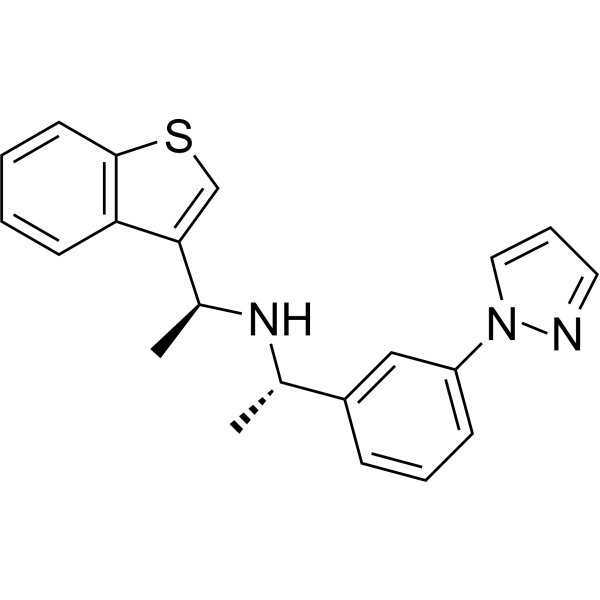 0 ImagesCat. No.: HY-161113CAS No.: 3079395-76-6Z8554052021 (compound 2021) is a potent CaSR and indeed GPCR positive allosteric modulator (PAM) with an EC50 of 3.3 nM. Z8554052021 has the potential for hyperparathyroidism research.
-
NPS-2143 (Standard)
 0 ImagesSynonyms: SB-262470A (Standard)NPS-2143 (Standard) is the analytical standard of NPS-2143 (HY-10007). This product is intended for research and analytical applications. NPS-2143 (SB-262470A), an orally active calcilytic agent, is a selective and potent calcium ion-sensing receptor (CaSR) antagonist. NPS-2143 (SB-262470A) blocks increases in cytoplasmic Ca2+ concentrations (IC50=43 nM) elicited by activating the Ca2+ receptor in HEK 293 cells expressing the human Ca2+ receptor.
-
Calhex 231 hydrochloride (Standard)
 0 ImagesCat. No.: HY-103320ARCAS No.: 2387505-78-2Calhex 231 hydrochloride (Standard) is the analytical standard of Calhex 231 hydrochloride (HY-103320A). This product is intended for research and analytical applications. Calhex 231 hydrochloride is a potent negative allosteric modulator that blocks (IC50 = 0.39 μM) increases in [3H]inositol phosphates elicited by activating the human wild-type CaSR transiently Ca2+-sensing receptor. Calhex 231 hydrochloride can be used in the study of traumatic hemorrhagic shock (THS) and diabetic cardiomyopathy (DCM).
-
NPS-467
 0 ImagesCat. No.: HY-182543CAS No.: 148717-47-9NPS-467 is a calcium-sensing receptor (CaR) activator and stereospecific agent with only its R-enantiomer active. NPS-467 increases the sensitivity of the CaR to activation by extracellular calcium. NPS-467 stimulates stanniocalcin (STC) secretion in trout and induces inhibition of gill calcium transport in trout. NPS-467 has no effect on serum calcitonin levels in trout.
-
Cinacalcet (Standard)
 0 ImagesCat. No.: HY-70037RCAS No.: 226256-56-0Synonyms: AMG 073 (Standard)Cinacalcet (Standard) is the analytical standard of Cinacalcet. This product is intended for research and analytical applications. Cinacalcet (AMG 073) is an orally active, allosteric agonist of Ca receptor (CaR), used for cardiovascular disease research.
-
Strontium Ranelate (Standard)
 0 ImagesSynonyms: Distrontium renelate (Standard); S12911 (Standard)Strontium Ranelate (Standard) is the analytical standard of Strontium Ranelate. This product is intended for research and analytical applications. Strontium Ranelate (S12911) is an antiosteoporotic agent that acts by reducing bone resorption and promoting bone formation, thereby inducing a positive bone balance. Strontium Ranelate can also activate the calcium-sensing receptor (CaSR) in non skeletal cells, resulting in the activation of inositol 1, 4, 5-triphosphate production and mitogen-activated protein kinase signaling.
-
L-Ornithine-1,2-13C2 hydrochloride
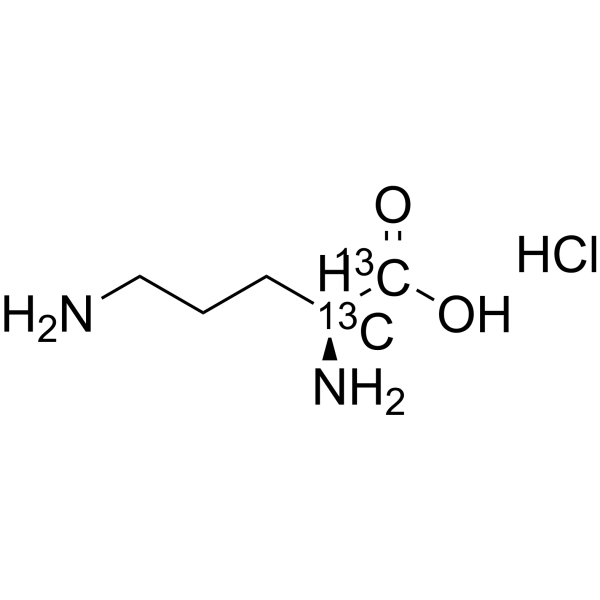 0 ImagesCat. No.: HY-W017018S1CAS No.: 224054-19-7L-Ornithine-1,2-13C2 hydrochloride is the 13C-labeled L-Ornithine hydrochloride (HY-W017018). L-Ornithine hydrochloride is an orally active CaSR and p38 activator. L-Ornithine hydrochloride inhibits ROS and supports urea cycle function. L-Ornithine hydrochloride can be used to study kidney diseases involving proximal tubular cell damage caused by oxidative stress or crystallopathy, as well as research related to anxiety disorders.
-
Lycoperodine-1 (Standard)
 0 ImagesSynonyms: Cyclomethyltryptophan (Standard)Lycoperodine-1 (Standard) is the analytical standard of Lycoperodine-1. This product is intended for research and analytical applications. Lycoperodine-1 (Cyclomethyltryptophan) is an active product that can be isolated from tomato fruits (Lycopersicon sculentum). Lycoperodine-1 act as an agonist of Ca2+ sensing receptors (CaSR).



