



MMP Activator
- 1
- 2
-
Colchicine derivative-1
 0 ImagesCat. No.: HY-182795
Colchicine derivative-1 is a colchicine derivative. Colchicine derivative-1 exhibits cytotoxicity against various cells. Colchicine derivative-1 arrests cancer cells at the G2/M phase of the cell cycle. Colchicine derivative-1 increases the levels of MMP-2, MMP-8, MMP-9, IL-2, IL-6, IL-17A, IL-22, IL-4, and IL-5 in the blood, inhibits the gene expression of hepatic fibrinogen α, β, γ and TGF-β1, and alleviates hepatic fibrosis symptoms in mice. Colchicine derivative-1 has antifibrotic activity and can be used in studies related to hepatic fibrosis.
-
LIFR/GPBAR1 modulator 1
 0 ImagesCat. No.: HY-178477
LIFR/GPBAR1 modulator 1 is an orally active, potent GPBAR1 agonist (EC50 = 0.2 μM) and LIFR inhibitor (IC50 = 7.9 μM). LIFR/GPBAR1 modulator 1 upregulates leukaemia inhibitory factor (LIF)-mediated mRNA expression of LIFR and GPBAR1 and significantly reduces the expression of pro-fibrosis markers (COL1A1, ASMA, and TGFβ), and reduces TIMP1 expression and increases MMP9 expression. LIFR/GPBAR1 modulator 1 can be used for the study of human fibrotic disorders.
-
KAFDITYVRLKF
 0 ImagesCat. No.: HY-P11780CAS No.: 208116-26-1
KAFDITYVRLKF is a selective, competitive integrin αvβ3 binder. KAFDITYVRLKF induces the production of MMP-9. KAFDITYVRLKF blocks monocyte migration, promotes melanoma cell migration, protects neurons, and improves motor and cognitive functions. KAFDITYVRLKF can be used in research related to melanoma and Parkinson's disease.
-
Sorafenib-d3 tosylate
 0 ImagesCat. No.: HY-10201S4CAS No.: 1333386-17-6Synonyms: Donafenib tosylate; Bay 43-9006-d3 tosylate
Sorafenib-d3 (Donafenib) tosylate is the deuterated-labeled Sorafenib tosylate (HY-10201A). Sorafenib (Bay 43-9006) tosylate is a potent oral active multikinase inhibitor. Sorafenib blocks autophosphorylation and activity of receptor tyrosine kinases (VEGFR-2, VEGFR-3) and RAF family kinases, thereby suppressing the RAF/MEK/ERK and PI3K/Akt pathways, inhibiting STAT3 phosphorylation, and selectively inhibiting the MAPK pathway in cancer cells. Sorafenib tosylate induces cell cycle arrest, autophagy, apoptosis, and PARP cleavage, reduces Bcl-2, Bcl-XL, cyclin D1 levels, and activates Bak and Bax. Sorafenib tosylate inhibits tumor growth and metastasis in mouse and rat models. Sorafenib tosylate can be used for cancer research, such as colon, breast, non-small-cell lung cancer (NSCLC), ovarian, pancreatic, melanoma, colorectal and hepatocellular carcinoma.
-
Colchicine-O-CO-Enyl(Me)-Enyl-Enyl(Me)-Enyl-1,3,3-trimethylcyclohex-1-ene
 0 ImagesCat. No.: HY-180765
Colchicine-O-CO-Enyl(Me)-Enyl-Enyl(Me)-Enyl-1,3,3-trimethylcyclohex-1-ene (compound L2) is a lipophilic colchicinoid formulation targeting hepatic stellate cells (HSC). Colchicine-O-CO-Enyl(Me)-Enyl-Enyl(Me)-Enyl-1,3,3-trimethylcyclohex-1-ene increases the levels of MMP2, MMP8 and MMP9, demonstrating the protective effect in tissue remodeling. Colchicine-O-CO-Enyl(Me)-Enyl-Enyl(Me)-Enyl-1,3,3-trimethylcyclohex-1-ene exhibits anti-fibrotic activity in CCL4-induced liver fibrosis (LF) mouse model. Colchicine-O-CO-Enyl(Me)-Enyl-Enyl(Me)-Enyl-1,3,3-trimethylcyclohex-1-ene can be used for LF research.
-
LAS190792
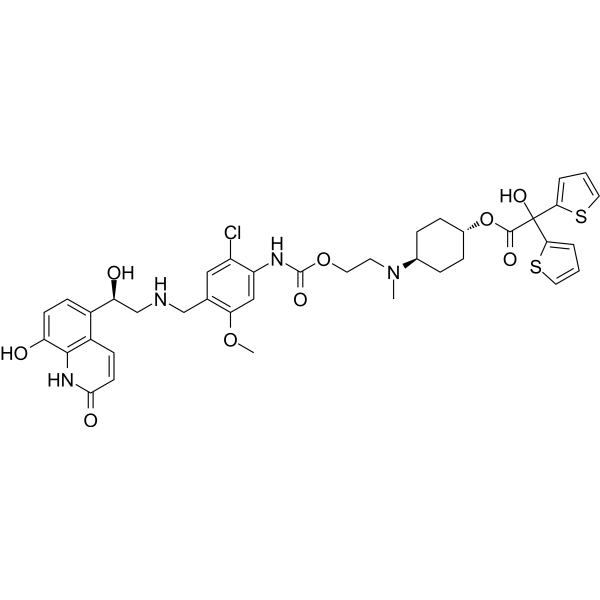 0 ImagesCat. No.: HY-148527CAS No.: 1347232-69-2Synonyms: AZD8999
LAS190792 is a bifunctional muscarinic acetylcholine receptor (mAChR) antagonist and β2-adrenergic receptor agonist. LAS190792 has a pIC50 of 8.8 against human M3 muscarinic receptor and a pIC50 of 9.1 against human β2-adrenergic receptor. LAS190792 exhibits vasodilatory and anti-inflammatory activities, and induces sustained bronchodilation in dogs. LAS190792 inhibits the release of IL-8, MMP9, IL-1β and GM-CSF from lipopolysaccharide-stimulated neutrophils. LAS190792 can be used in research related to respiratory system diseases.
-
Trifloroside
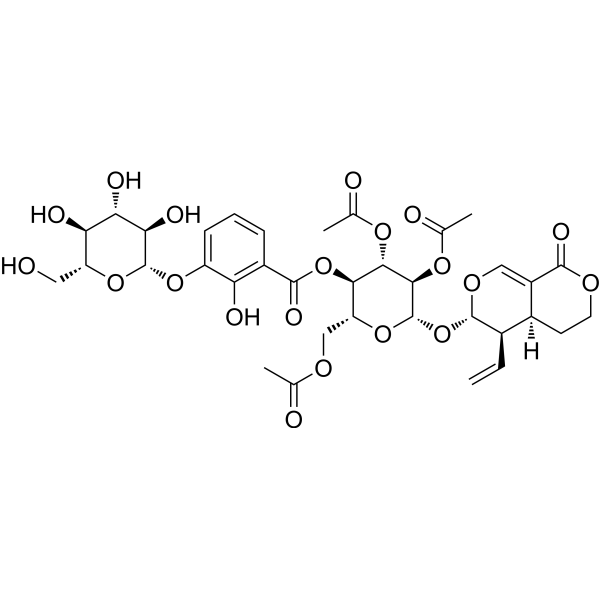 0 ImagesCat. No.: HY-N8837CAS No.: 53823-10-2
Trifloroside is a secoiridoid glycoside with antioxidant effects. Trifloroside induces osteogenic effects through osteoblast differentiation, adhesion, migration, and mineral apposition. Trifloroside has the potential for osteoblast-mediated bone diseases research.
-
β-Neo-Endorphin acetate
 0 ImagesCat. No.: HY-P3513ACAS No.: 78658-39-6
-
Propoxur (Standard)
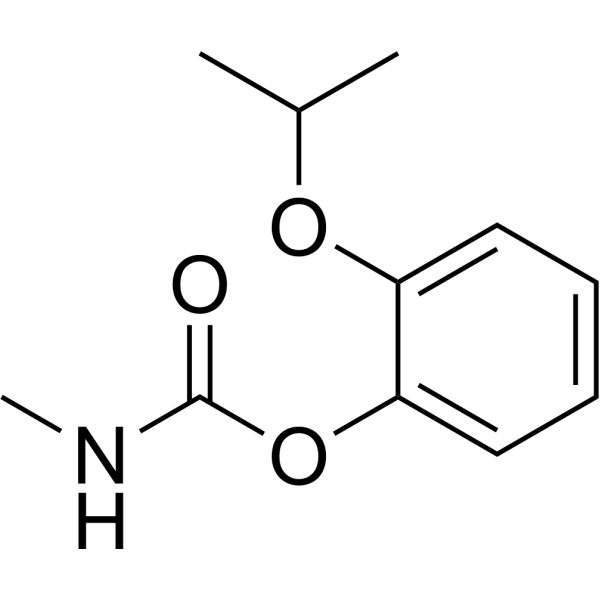 0 Images
Propoxue (Standard) is the analytical standard of Propoxue (HY-B0916). This product is intended for research and analytical applications. Propoxur is a reversible, competitive, orally active AChE inhibitor that can cross the blood-brain barrier. Propoxur inhibits AChE activity to induce neurotoxicity, while promoting MMP-2 expression and enhancing tumor cell migration and invasion by inducing intracellular ROS generation and activating the ERK/Nrf2 signaling pathway. On the one hand, Propoxur inhibits AChE, leading to acetylcholine accumulation and causing neurological dysfunction; on the other hand, it promotes Nrf2 nuclear translocation through ROS-dependent ERK1/2 phosphorylation, and upregulates MMP-2 and other invasion-related proteins. Propoxur is also a carbamate insecticide used to combat turf, forestry, and household pests.
-
VEGFR2 AUTOTAC-1
 0 ImagesCat. No.: HY-187534
VEGFR2 AUTOTAC-1 is a VEGFR2 AUTOTAC degrader. VEGFR2 AUTOTAC-1 recruits p62, activates the autophagy-lysosome pathway through the p62-LC3 axis cascade, forms a ternary complex with VEGFR2 and p62, and drives UPS-independent post-translational degradation of VEGFR2. VEGFR2 AUTOTAC-1 induces G1 phase arrest and endogenous apoptosis in cells via the mitochondrial and caspase apoptotic pathways, thereby inhibiting cancer cell proliferation, migration and malignant phenotypes; meanwhile, it inhibits endothelial cell tube formation, migration and endothelial-mesenchymal transition by regulating E-cadherin and MMP2. VEGFR2 AUTOTAC-1 is applicable to research related to triple-negative breast cancer.(Pink: VEGFR2 target protein ligand (HY-187558); Blue: p62 ligand (HY-W014292); Black: Linker)
-
Propoxur-d7
 0 ImagesCat. No.: HY-W750153CAS No.: 2140327-65-5
Propoxur-d7 is the deuterium labeled Propoxur. Propoxur is a reversible, competitive, orally active AChE inhibitor that can cross the blood-brain barrier. Propoxur inhibits AChE activity to induce neurotoxicity, while promoting MMP-2 expression and enhancing tumor cell migration and invasion by inducing intracellular ROS generation and activating the ERK/Nrf2 signaling pathway. On the one hand, Propoxur inhibits AChE, leading to acetylcholine accumulation and causing neurological dysfunction; on the other hand, it promotes Nrf2 nuclear translocation through ROS-dependent ERK1/2 phosphorylation, and upregulates MMP-2 and other invasion-related proteins. Propoxur is also a carbamate insecticide used to combat turf, forestry, and household pests.
-
AG73
 0 ImagesCat. No.: HY-P11777CAS No.: 170655-66-0
AG73 is a polypeptide. AG73 is derived from the G domain of the Laminin α1 chain. AG73 binds heparin, Syndecan-1 and Syndecan-4. AG73 promotes the adhesion of various cells, induces the differentiation of salivary gland acinar cells, stimulates neurite outgrowth, secretion of matrix metalloproteinases and angiogenesis. AG73 retains its angiogenic activity when conjugated to chitosan membranes. AG73 can be used in the research of melanoma and ischemic injury.
-
Sorafenib tosylate (Standard)
 0 ImagesSynonyms: Bay 43-9006 tosylate (Standard)
Sorafenib (tosylate) (Standard) (Bay 43-9006 (tosylate) (Standard)) is the analytical standard of Sorafenib (tosylate) (HY-10201A). This product is intended for research and analytical applications. Sorafenib (Bay 43-9006) tosylate is a potent oral active multikinase inhibitor. Sorafenib blocks autophosphorylation and activity of receptor tyrosine kinases (VEGFR-2, VEGFR-3) and RAF family kinases, thereby suppressing the RAF/MEK/ERK and PI3K/Akt pathways, inhibiting STAT3 phosphorylation, and selectively inhibiting the MAPK pathway in cancer cells. Sorafenib tosylate induces cell cycle arrest, autophagy, apoptosis, and PARP cleavage, reduces Bcl-2, Bcl-XL, cyclin D1 levels, and activates Bak and Bax. Sorafenib tosylate inhibits tumor growth and metastasis in mouse and rat models. Sorafenib tosylate can be used for cancer research, such as colon, breast, non-small-cell lung cancer (NSCLC), ovarian, pancreatic, melanoma, colorectal and hepatocellular carcinoma.
-
Bimatoprost (Standard)
 0 ImagesSynonyms: AGN 192024 (Standard)
Bimatoprost (Standard) is the analytical standard of Bimatoprost. This product is intended for research and analytical applications. Bimatoprost is a prostaglandin analog that reduces intraocular pressure by regulating scleral and trabecular outflow. Bimatoprost is used in the study of open-angle glaucoma, ocular hypertension, and other forms of glaucoma. Topical application of bimatoprost induces fat atrophy and causes a deepening of the eyelid sulcus[4].
-
MK-1903 (Standard)
 0 Images
MK-1903 (Standard) is the analytical standard of MK-1903 (HY-107581). This product is intended for research and analytical applications. MK-1903 is an orally active full agonist of GPR109a/HCAR2, with an EC50 of 12.9 nM. MK-1903 activates antilipolytic and vasodilatory pathways, reduces plasma free fatty acid levels, and induces skin flushing. MK-1903 stimulates the expression of HCAR2 protein and regulates the inflammatory response of microglia. MK-1903 prevents the enhanced firing activity of spinal nociceptive neurons. MK-1903 triggers the release of MMP-9 and the formation of NET. MK-1903 can be used in the research of dyslipidemia and neuroinflammation-based central nervous system diseases.
- 1
- 2



