



Fluorescent Dye
Fluorescence is a phenomenon of photoluminescence in luminescence. When an atom is irradiated by light, some electrons around the nucleus jump from their original orbitals to higher energy orbitals under the influence of light energy, i.e., from the ground state to the first or second excited single-line state, etc. Due to the instability of the first or second excited singlet state, the electron returns from the excited singlet state to the ground state accompanied by released energy, resulting in fluorescence.
Fluorescent dyes can be covalently bound or physically adsorbed in the structure of the substance. The fluorescence properties allow for the characterization, localization and quantitative analysis of the labeled object. Fluorescent dyes have shown great potential for the detection of proteins, nucleic acids, cells, and immunoassays, attributed to the advantages in non-radioactive contamination, simple experimental operation and easy observation.
Fluorescent dyes have penetrated many fields such as pharmacology, physiology, environmental science, and information science, as well as functional studies of proteins and drug screening.
All Product Categories
-
Fluorescent Dye Related Products (4851)
Related Products (4851)

-
Antibodies (4)
-
DiOC16(3)
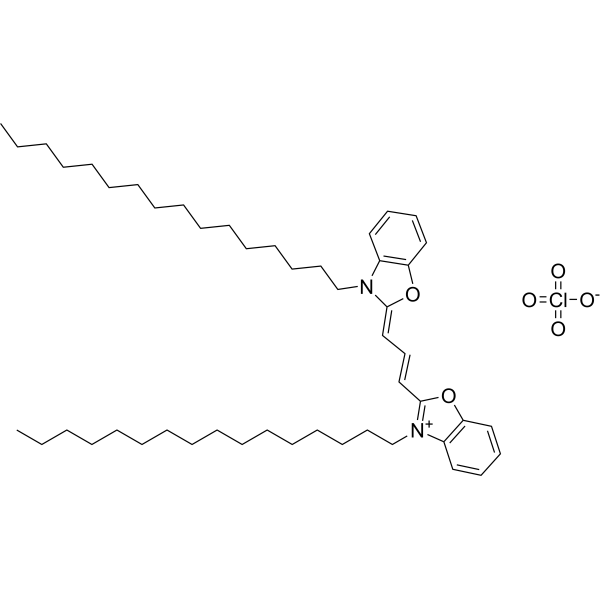 0 ImagesCat. No.: HY-D1741CAS No.: 161433-32-5Synonyms: 3,3'-DihexadecyloxacarbocyanineDiOC16(3) (3,3'-Dihexadecyloxacarbocyanine) is a lipophilic carbocyanine dye used primarily for optical recordings of membrane voltage and studies of membrane fluidity.
-
Cy3 labled Trecovirsen sodium
 0 ImagesCat. No.: HY-149906HCy3 labled Trecovirsen sodium is a Cy3 labled Trecovirsen sodium.
-
CS-1-174
 0 ImagesCat. No.: HY-186233CS-1-174 is a biotin-modified probe derived from KCC-07 (HY-131031), with specific binding activity to enrich MBD2. CS-1-174 captures MBD2 in cell lysates via pull-down by binding streptavidin magnetic beads through its terminal biotin tag. CS-1-174 serves as a functional tool probe in the development of TRACER technology, and is used to verify the target binding ability of MBD2 in tumor cells.
-
Galanthus Nivalis Lectin
 0 ImagesCat. No.: HY-NP067Synonyms: GNLGalanthus Nivalis Lectin (GNL) is a plant lectin that can be used as a probe to specifically bind biomolecules (such as polysaccharides, peptides, etc.).Galanthus Nivalis Lectin (GNL) is a biological material or organic compound that can be used in life science research.
-
Br-5MP-Fluorescein
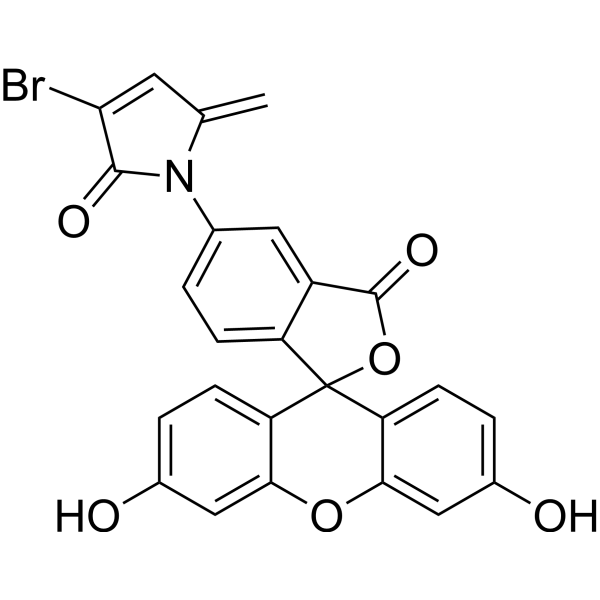 0 ImagesCat. No.: HY-D1405CAS No.: 2468100-39-0Br-5MP-Fluorescein is a dye reagent for labeling of peptides and proteins.
-
Janelia Fluor® 585, SE
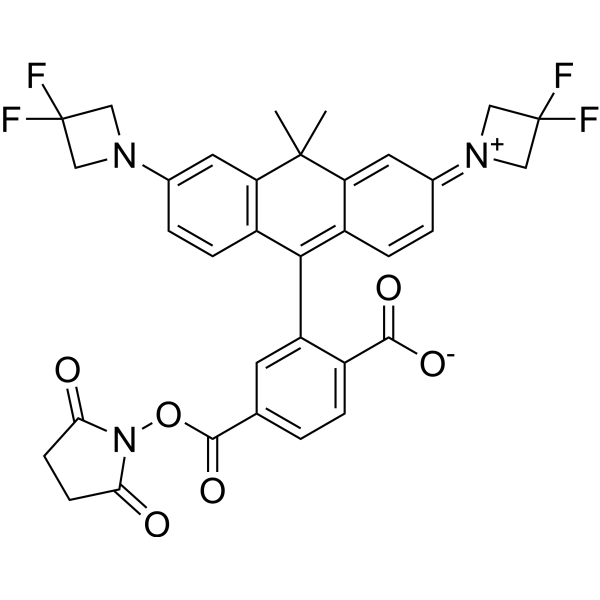 0 ImagesSynonyms: JF585, SE; JF585, NHSJanelia Fluor 585, SE (JF585, SE) is an orange fluorescent dye containing an NHS ester that can be conjugated with primary amine groups. Janelia Fluor 585, SE can be used immediately for structured illumination (SIM) and stimulated emission depletion (STED) imaging and could be converted to photoactivatable derivative for single-molecule localization microscopy (SMLM) experiments. Janelia Fluor fluorescent dyes can be chemically conjugated to the specific HaloTag substrate (a chloroalkane ligand) to form a fluorescent ligand, rather than binding directly to the HaloTag protein itself. Janelia Fluor products are licensed under U.S. Pat. Nos. 9,933,417, 10,018,624 and 10,161,932 and other patents from Howard Hughes Medical Institute (Ex/Em = 585/609 nm).
-
FAM labled Belcesiran sodium
 0 ImagesCat. No.: HY-177619CFAM labled Belcesiran sodiumis a FAM labled Belcesiran sodium.
-
Sulfo-Cy3(Me)COOH potassium
 0 ImagesCat. No.: HY-D1365BCAS No.: 3091879-86-3Sulfo-Cyanine 3 free acid potassium is a sulfo-Cyanine3 derivative. Cyanine3 is an orange-fluorescent label dye for protein and nucleic acid (Ex=554 nm, Em=568 nm).

-
PTZ-LD
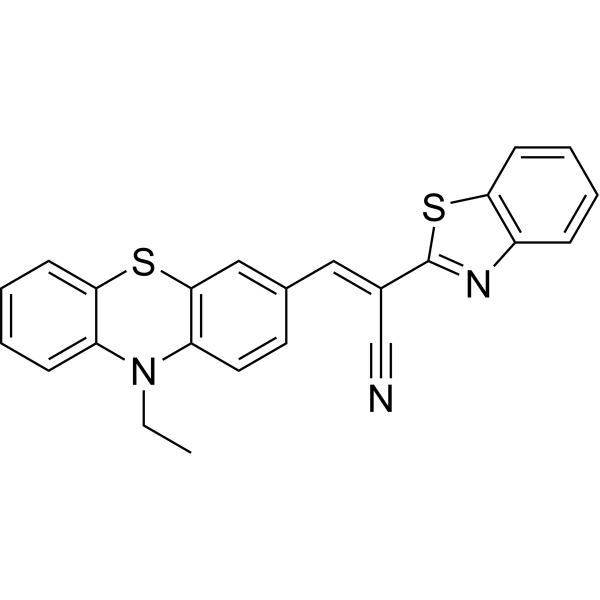 0 ImagesCat. No.: HY-149596CAS No.: 2231747-49-0PTZ-LD is a phenothiazine (HY-Y0055)-based fluorescent probe for lipid droplets (LDs) detection. PTZ-LD is apparently emissive in LDs with high specificity. (Ex/Em=488/570-620 nm). PTZ-LD can be used for diabetic cataract (DC) research.
-
L-Biotin-NH-5MP
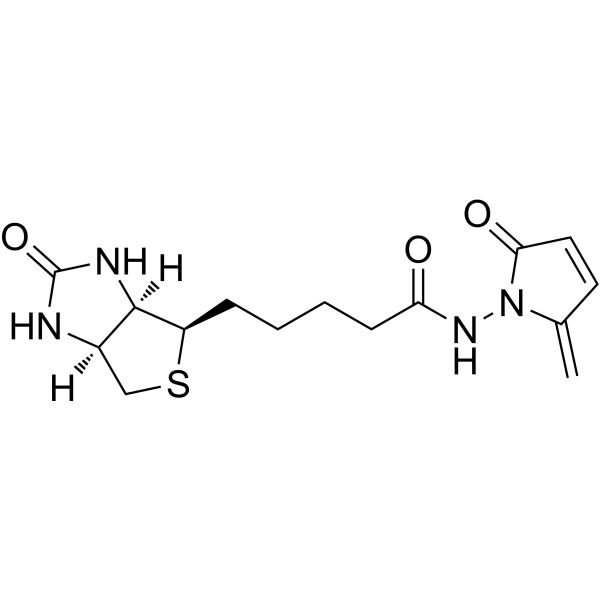 0 ImagesCat. No.: HY-D1403CAS No.: 2100288-18-2L-Biotin-NH-5MP is a biotin-conjugated 5-Methylene pyrrolone (5MP). 5-Methylene pyrrolones (5MPs) are thiol-specific, reversible bioconjugation reagents for cysteine-specific protein modification, that are commonly used for protein bioconjugation.
-
Sulfo-Cy3-Methyltetrazine
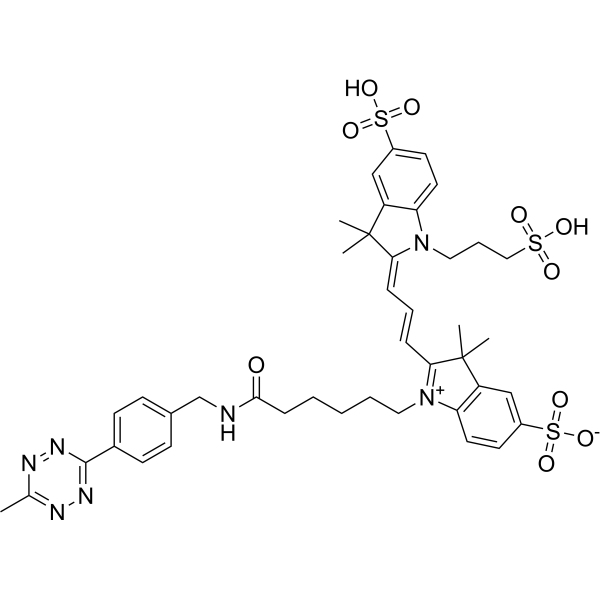 0 ImagesCat. No.: HY-151713CAS No.: 1801924-47-9Sulfo-Cy3-Methyltetrazine (figure 7 compound 5) is a click chemistry reagent containing methyltetrazine and a water-soluble dye. Sulfo-Cy3-Methyltetrazine shows good stability at physiological pH. Sulfo-Cy3-Methyltetrazine can be coupled to trans-cyclooctene and is also highly reactive towards cyclooctene.
-
Wheat germ agglutinin-AF350
 0 ImagesCat. No.: HY-NP163Synonyms: WGA-AF350Wheat germ agglutinin-AF350 (WGA-AF350) is a plant lectin that contains the fluorescent dye AF350, which can be used to identify carbohydrate chains. Wheat germ agglutinin-AF350 can be used to assess abnormal glycosylation levels in the body. The specific glycosylation detection sites of Wheat germ agglutinin is bis-GlcNAc, SA.

-
FAM labled Aprinocarsen sodium
 0 ImagesCat. No.: HY-148413BFAM labled Aprinocarsen sodiumis a FAM labled Aprinocarsen sodium.


-
4-(Phenylazo)diphenylamine
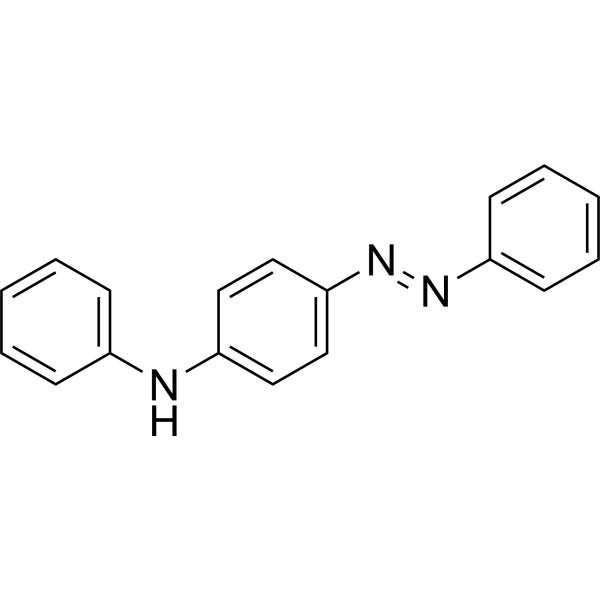 0 ImagesCat. No.: HY-W142631CAS No.: 101-75-74-(Phenylazo)diphenylamine is an excellent colorimetric indicator for the accurate determination of the concentration for a variety of strong bases, Lewis acids, and hydride reducing agents.
-
5(6)-Rhodamine 6G maleimide
 0 ImagesCat. No.: HY-D30565(6)-Rhodamine 6G maleimide is a maleimide-based fluorescent reagent based on Rhodamine 6G (HY-D0309). Maleimide can be labeled by forming a stable thioester structure through an affinity addition reaction with a thiol group (-SH) (Ex/Em = 526/547 nm).




