



iGluR
Ionotropic glutamate receptors
iGluR (ionotropic glutamate receptor) is a ligand-gated ion channel that is activated by the neurotransmitter glutamate. iGluR are integral membrane proteins compose of four large subunits that form a central ion channel pore. Sequence similarity among all known glutamate receptor subunits, including the AMPA, kainate, NMDA, and δ receptors.
AMPA receptors are the main charge carriers during basal transmission, permitting influx of sodium ions to depolarise the postsynaptic membrane. NMDA receptors are blocked by magnesium ions and therefore only permit ion flux following prior depolarisation. This enables them to act as coincidence detectors for synaptic plasticity. Calcium influx through NMDA receptors leads to persistent modifications in the strength of synaptic transmission.
iGluR Isoform Specific Products
All Product Categories
-
iGluR Inhibitors
(130)
View all products
-
iGluR Agonists
(131)
View all products
-
iGluR Antagonists
(347)
View all products
-
iGluR Activators
(35)
View all products
-
iGluR Modulators
(93)
View all products
-
iGluR MDM2 Inhibitor
(1)
View all products
-
iGluR Controls
(5)
View all products
-
iGluR Ligands
(3)
View all products
-
iGluR Related Products (828)
Related Products (828)

-
Antibodies (11)
-
iGluR Isoform Comparison
-
Cyclothiazide (Standard)
 0 ImagesCat. No.: HY-101165RCAS No.: 2259-96-3Cyclothiazide (Standard) is the analytical standard of Cyclothiazide. This product is intended for research and analytical applications. Cyclothiazide is a positive allosteric modulator of ionotropic AMPA-type glutamate receptors. Cyclothiazide inhibits GABAA receptors. Cyclothiazide is frequently used to produce a fast inhibition of AMPA receptor desensitization and a much slower potentiation of the AMPA current. Cyclothiazide can potentiate responses to kainate in hippocampal neurons. Cyclothiazide has effects on glutamatergic neurotransmission. Cyclothiazide also induces epileptiform EEG activity accompanying behavioral seizures.
-
S 18986 (Standard)
 0 ImagesCat. No.: HY-10936RCAS No.: 175340-20-2S 18986 (Standard) is the analytical standard of S 18986 (HY-10936). This product is intended for research and analytical applications. S 18986 is a selective, orally active, brain penetrant positive allosteric modulator of AMPA-type receptors. S 18986 shows cognitive enhancing properties in rodents. S 18986 activates the release of noradrenaline and acetylcholine in rat hippocampus and enhances rat memory in object-recognition tests.
-
L-Aspartic aicd sodium (Standard)
 0 ImagesCat. No.: HY-N0666CRCAS No.: 3792-50-5Synonyms: Sodium L-aspartate (Standard)L-Aspartic aicd sodium (Standard) (Sodium L-aspartate (Standard)) is the analytical standard of L-Aspartic aicd sodium (HY-N0666C). This product is intended for research and analytical applications. L-Aspartic acid sodium (Sodium L-aspartate) is a NMDA receptor agonist and acidic amino acid. L-Aspartic acid sodium has no independent analgesic activity. L-Aspartic acid sodium can antagonize the analgesic effects of D-Aspartic acid and Morphine. L-Aspartic acid sodium regulates polymorph transformation, crystal growth/aggregation and nucleation processes of calcium carbonate, and can serve as a biomineralization template. L-Aspartic acid sodium promotes burst firing of central neurons. L-Aspartic acid sodium can be used in studies related to cerebral ischemia and epilepsy.
-
IEM-1460 (Standard)
 0 ImagesCat. No.: HY-103230RCAS No.: 121034-89-7
-
LY3130481 (Standard)
 0 ImagesCat. No.: HY-108707RCAS No.: 1610802-47-5LY3130481 (Standard) is the analytical standard of LY3130481 (HY-108707). This product is intended for research and analytical applications. LY3130481 is an orally available AMPA receptor antagonist, selectively inhibiting the IC50 value of AMPA/TARP γ-8 at 65 nM. LY3130481 has anticonvulsant, antiepileptic, and pain-relieving effects.
-
CX614 (Standard)
 0 ImagesCat. No.: HY-110175RCAS No.: 191744-13-5CX614 (Standard) is the analytical standard of CX614 (HY-110175). This product is intended for research and analytical applications. CX614 is a positive variant modulator of AMPA receptors that enhances excitatory postsynaptic potentials (amplitude and duration) by blocKing and slowing the inactivation of responses to glutamate and automatically evokes excitatory postsynaptic currents in neuronal cultures. CX614 can be used in the study of psychiatric disorders such as depression.
-
Delucemine hydrochloride
 0 ImagesCat. No.: HY-106397ACAS No.: 186495-99-8Synonyms: NPS-1506 hydrochlorideDelucemine hydrochloride is a selective serotonin reuptake inhibitor (SSRI) and NMDAR antagonist. Delucemine hydrochloride can be used as an antidepressant.
-
Epiallopregnanolone-d5
 0 ImagesCat. No.: HY-124463S1Synonyms: 5α,3β-THDOC-d5Epiallopregnanolone-d5 (5α,3β-THDOC-d5) is deuterium labeled Epiallopregnanolone. Epiallopregnanolone (5α,3β-THDOC), a 3β-hydroxy neurosteroid, an antagonist at GABAA receptors and a NMDA receptor enhancer.
-
Radiprodil (Standard)
 0 ImagesSynonyms: RGH-896 (Standard)Radiprodil (Standard) is the analytical standard of Radiprodil. This product is intended for research and analytical applications. Radiprodil (RGH-896) is an orally active and selective NMDA NR2B antagonist. A potential therapeutic agent in treatment of neuropathic pain and possibly other chronic pain conditions.
-
1-BCP (Standard)
 0 ImagesCat. No.: HY-101363RCAS No.: 34023-62-6Synonyms: Piperonylic acid piperidide (Standard)1-BCP (Standard) is the analytical standard of 1-BCP. This product is intended for research and analytical applications. 1-BCP (Piperonylic acid piperidide) is a centrally active agent that modulates AMPA receptor gated currents. 1-BCP is a memory-enhancing agent.
-
Otaplimastat (Standard)
 0 ImagesCat. No.: HY-109097RCAS No.: 1176758-04-5Synonyms: SP-8203 (Standard)Otaplimastat (Standard) is the analytical standard of Otaplimastat (HY-109097). This product is intended for research and analytical applications. Otaplimastat (SP-8203), a matrix metalloproteinase (MMP) inhibitor, blocks N-methyl-D-aspartate (NMDA) receptor-mediated excitotoxicity in a competitive manner. Otaplimastat also exhibits anti-oxidant activity. Otaplimastat can be used for the research of brain ischemic injury.
-
Topiramate-13C
 0 ImagesCat. No.: HY-B0122S1Synonyms: McN 4853-13C; RWJ 17021-13CTopiramate-13C (McN 4853-13C) is 13C labeled Topiramate. Topiramate (McN 4853) is a broad-spectrum antiepileptic agent. Topiramate is a GluR5 receptor antagonist. Topiramate produces its antiepileptic effects through enhancement of GABAergic activity, inhibition of kainate/AMPA receptors, inhibition of voltage-sensitive sodium and calcium channels, increases in potassium conductance, and inhibition of carbonic anhydrase.
-
Farampator (Standard)
 0 ImagesCat. No.: HY-10937RCAS No.: 211735-76-1Synonyms: CX-691 (Standard); Org24448 (Standard)Farampator (Standard) is the analytical standard of Farampator (HY-10937). This product is intended for research and analytical applications. Farampator (CX-691;Org24448) is an AMPA receptor positive modulator.
-
NBQX (Standard)
 0 ImagesSynonyms: FG9202 (Standard)NBQX (Standard) is the analytical standard of NBQX. This product is intended for research and analytical applications. NBQX (FG9202) is a highly selective and competitive AMPA receptor antagonist. NBQX has neuroprotective and anticonvulsant activity.
-
CNQX (Standard)
 0 ImagesSynonyms: FG9065 (Standard)CNQX (Standard) is the analytical standard of CNQX. This product is intended for research and analytical applications. CNQX (FG9065) is a potent and competitive AMPA/kainate receptor antagonist with IC50s of 0.3 μM and 1.5 μM, respectively. CNQX is a competitive non-NMDA receptor antagonist. CNQX blocks the expression of fear-potentiated startle in rats.
-
Oleoyl-D-lysine
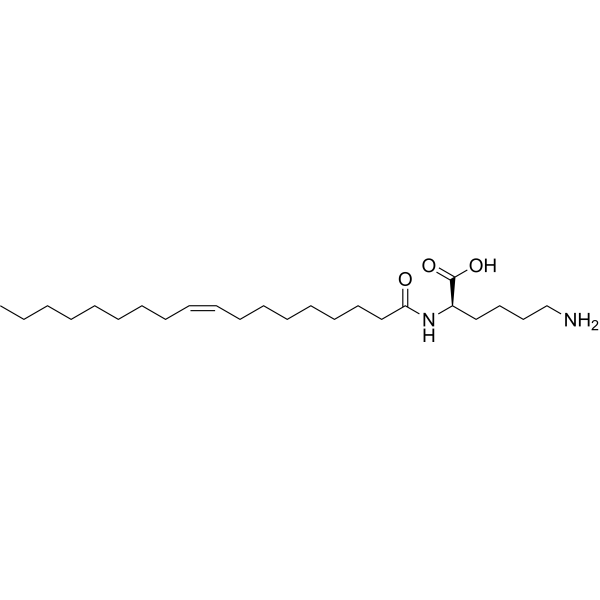 0 ImagesCat. No.: HY-148708CAS No.: 2240164-55-8Oleoyl-D-lysine is a selective Glycine Transporter-2 (GlyT2) inhibitor based on lipid. Oleoyl-D-lysine reverses neuropathic pain in mice,shows antidrowsiness effect on chronic neuropathic pain. Oleoyl-D-lysine is safe and effective without respiratory depression.
-
Org-26576 (Standard)
 0 ImagesCat. No.: HY-101216RCAS No.: 100044-96-0Org-26576 (Standard) is the analytical standard of Org-26576 (HY-101216). This product is intended for research and analytical applications. Org-26576 is a AMPA receptor positive allosteric modulator.
-
Rislenemdaz (Standard)
 0 ImagesCat. No.: HY-106441ARCAS No.: 808732-98-1Synonyms: MK-0657 (Standard); CERC-301 (Standard)Rislenemdaz (Standard) is the analytical standard of Rislenemdaz (HY-106441A). This product is intended for research and analytical applications. Rislenemdaz (CERC-301) is an orally bioavailable and selective N-methyl-D-aspartate (NMDA) receptor subunit 2B (GluN2B) antagonist with Ki and IC 50 of 8.1 nM and 3.6 nM, respectively.

-
PF-04701475
 0 ImagesCat. No.: HY-120811CAS No.: 1488407-52-8PF-04701475 is a potent AMPA receptor potentiator with an EC50 of 123 nM. PF-04701475 can be used for the study of neurological disorders.




