



SMARCA4
SMARCA4 (also known as BRG1) encodes the ATPase catalytic subunit of the SWI/SNF chromatin-remodeling complex and uses ATP hydrolysis to alter nucleosome positioning, thereby regulating chromatin accessibility and transcriptional programs[1][2]. Mechanistically, SMARCA4 functions as a core epigenetic regulator that coordinates gene expression, DNA damage-associated chromatin responses, and cell-state transitions through ATP-dependent chromatin remodeling[1][3]. As one of two mutually exclusive SWI/SNF ATPase subunits, SMARCA4 is functionally distinct from SMARCA2 (BRM), with each complex containing either BRG1 or BRM as its catalytic engine rather than both simultaneously[4][5]. This isoform distinction is biologically important because SMARCA4 deficiency can increase cellular dependence on SMARCA2-containing SWI/SNF complexes in specific tumor contexts[4][6]. In disease settings, recurrent SMARCA4 inactivation has been identified across multiple malignancies and is strongly associated with chromatin dysregulation, including small cell carcinoma of the ovary, hypercalcemic type (SCCOHT), where loss of SMARCA4 protein is a defining molecular feature[4][6][7]. Experimental studies further demonstrate that restoration of either SMARCA4 or SMARCA2 suppresses growth of SMARCA4-deficient SCCOHT cell lines, supporting a tumor-suppressive role for SWI/SNF ATPase activity in this model[4]. For experimental applications, the SMARCA4 bromodomain recognizes acetylated histone H3K14 and has therefore emerged as a potential target for developing bromodomain-directed chemical probes and inhibitors that interrogate chromatin-remodeling mechanisms in cancer and epigenetic research[3].
References:
- [1]. Enríquez P, et al. Binding specificity and function of the SWI/SNF subunit SMARCA4 bromodomain interaction with acetylated histone H3K14. J Biol Chem. 2021 Oct;297(4):101145. [Content Brief]
- [2]. Karnezis AN, et al. Dual loss of the SWI/SNF complex ATPases SMARCA4/BRG1 and SMARCA2/BRM is highly sensitive and specific for small cell carcinoma of the ovary, hypercalcaemic type. J Pathol. 2016 Feb;238(3):389-400. [Content Brief]
- [3]. Medina PP, et al. Transcriptional targets of the chromatin-remodelling factor SMARCA4/BRG1 in lung cancer cells. Hum Mol Genet. 2005;14(7):973-982.
- [4]. Enríquez P, et al. Binding specificity and function of the SWI/SNF subunit SMARCA4 bromodomain interaction with acetylated histone H3K14. J Biol Chem. 2021;297(4):101145.
- [5]. Abedini A, et al. SWI/SNF chromatin remodeling subunit Smarca4/BRG1 is essential for female fertility. Biol Reprod. 2023;108(2):279-291.
- [6]. Navickas SM, et al. The role of chromatin remodeler SMARCA4/BRG1 in brain cancers: a potential therapeutic target. Oncogene. 2023;42:2363-2373.
- [7]. Mardinian K, et al. SMARCA4: Implications of an Altered Chromatin-Remodeling Gene for Cancer Development and Therapy. Mol Cancer Ther. 2021;20(12):2341-2351.
-
SMARCA4 Related Products (51)
Related Products (51)

-
AU-15330
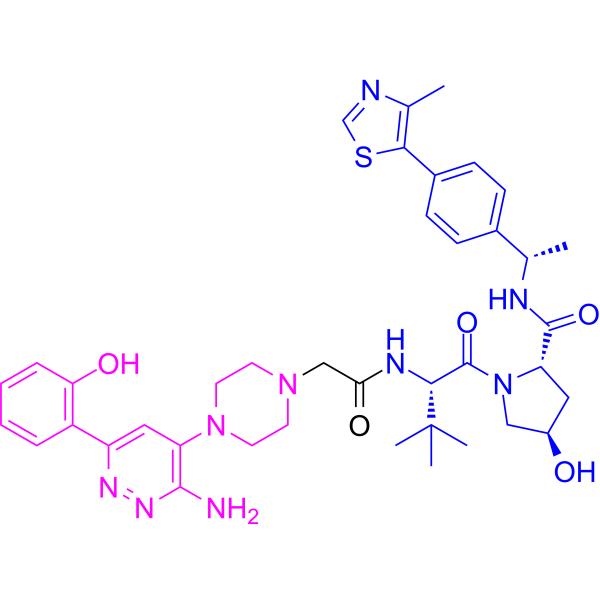 0 ImagesAU-15330 is a proteolysis-targeting chimera (PROTAC) degrader of the SWI/SNF ATPase subunits, SMARCA2 and SMARCA4. AU-15330 induces potent inhibition of tumour growth in xenograft models of prostate cancer and synergizes with the AR antagonist enzalutamide. AU-15330 induces disease remission in castration-resistant prostate cancer (CRPC) models without toxicity.
-
AU-24118
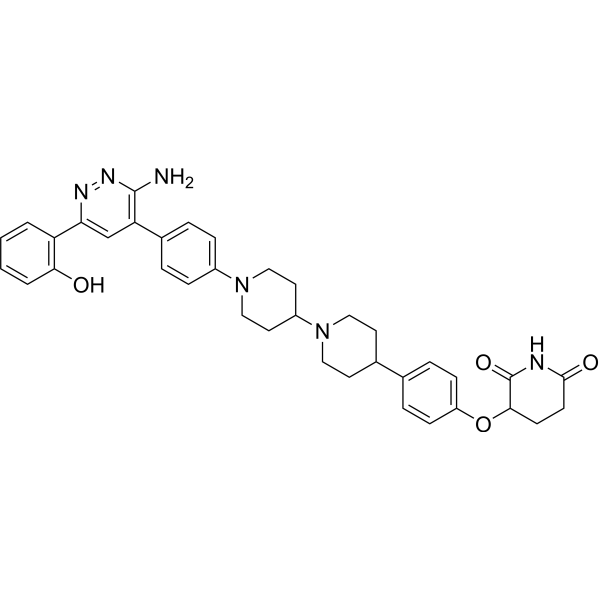 0 ImagesAU-24118 is an orally active PROTAC degrader that recruits cereblon to target the degradation of SMARCA2, SMARCA4 and PBRM1. AU-24118 impairs the chromatin accessibility of oncogenic transcription factors, inhibits colony formation, dislodges chromatin-bound transcription factors, attenuates downstream signal transduction, induces apoptosis, and exerts antiproliferative and cytotoxic effects. AU-24118 can be used in research related to castration-resistant prostate cancer, colorectal cancer, small cell lung cancer and multiple myeloma (including the t (4;14) subtype).
-
PRT3789
 0 ImagesCat. No.: HY-159607CAS No.: 2755761-78-3PRT3789 is a selective SMARCA2 PROTAC degrader (DC50 in HeLa cell: 0.72 nM for SMARCA2, 14 nM for SMARCA4). PRT3789 forms a stable ternary complex with Von Hippel-Lindau (VHL) E3 ligase, induces polyubiquitination at SMARCA2-specific lysine residues, and drives proteasome-dependent SMARCA2 degradation. PRT3789 disrupts SWI/SNF chromatin remodeling complex integrity, induces dissociation of specific subunits, suppresses oncogenic gene expression, reduces chromatin accessibility, and upregulates antigen processing/presentation-related gene expression. PRT3789 induces synthetic lethality, inhibits proliferation and colony formation, and drives tumor growth inhibition and regression in SMARCA4-deficient contexts. PRT3789 can be used for the research of SMARCA4-mutated solid tumors, non-small cell lung cancer, endometrial cancer, colorectal cancer, bladder cancer, esophageal cancer, ovarian cancer, and gastric cancer.
-
G-6599
 0 ImagesG-6599 is a covalent molecular glue degrader targeting SMARCA2/SMARCA4, with DC50 values of 0.017 nM and 0.057 nM against SMARCA2 and SMARCA4 in SW1573 cells, respectively. G-6599 exhibits proteome selectivity for SMARCA2, SMARCA4, and PBRM1. G-6599 induces the assembly of the SMARCA2-FBXO22 ternary complex, enabling ubiquitination and proteasomal degradation of both proteins via the ubiquitin-proteasome pathway without the need for biotransformation. G-6599 shows antiproliferative effects in relevant cancer cell models. G-6599 can be used for research on androgen-dependent prostate cancer and SMARCA4-mutant non-small cell lung cancer.

-
A947
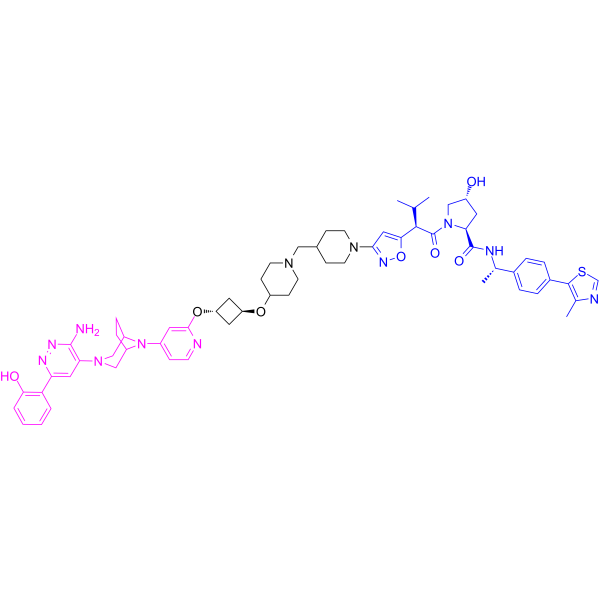 0 ImagesCat. No.: HY-148381CAS No.: 2378056-80-3A947 is a VHL-based SMARCA2 PROTAC degrader with a DC50 of 39 pM and a Kd of 93 nM for human SMARCA2. A947 recruits SMARCA2 to the VHL E3 ubiquitin ligase for ubiquitination modification, mediates its degradation via the proteasome, and exerts selective degradation effects on SMARCA4 and PBRM1. A947 induces G1 cell cycle arrest, inhibits transcription, and exerts growth inhibitory effects in SMARCA4G12C-mutant cancer cells. A947 acts synergistically with MCL1 inhibitors to induce apoptosis in SMARCA4G12C-mutant cancer cells. A947 can be used in studies related to SMARCA4G12C-mutant non-small cell lung cancer and non-small cell lung cancer.
-
YD54
 0 ImagesYD54 is an orally active and selective SMARCA2 PROTAC degrader. YD54 induces SMARCA4 degradation but with low potency and selectivity. YD54 selectively inhibits the growth of various cancer cells and suppresses tumor growth in mouse xenograft models. YD54 can be used for the research of SMARCA4-mutant lung cancer.
-
PROTAC SMARCA2/4 degrader-38
 0 ImagesPROTAC SMARCA2/4 degrader-38 is a SMARCA2/4 degrader (SMARCA2: DC50 = 3.0 nM; SMARCA4: 4.0 nM). PROTAC SMARCA2/4 degrader-38 binds to SMARCA2 and SMARCA4 bromodomains to induce degradation via the ubiquitin-proteasome system. PROTAC SMARCA2/4 degrader-38 induces G0/G1 phase cell cycle arrest and cell apoptosis in hematological cancer cells, blocks oncogenic activity of MYC and other disease-related genes in acute myeloid leukemia cells and inhibits proliferation of hematological cancer cell lines. PROTAC SMARCA2/4 degrader-38 can be used for the research of acute myeloid leukemia, diffuse large B-cell lymphoma, breast cancer, ovarian cancer, colorectal cancer, liver cancer, lung cancer.
-
FHD-909
 0 ImagesCat. No.: HY-185075CAS No.: 3008577-34-9Synonyms: LY4050784FHD-909 (LY4050784) is an orally active and selective SMARCA2 (BRM) ATPase inhibitor. FHD-909 potently inhibits purified BRM ATPase with an IC50 of 0.0025 μM and exhibits 35.69-fold selectivity for BRM over purified SMARCA4 (BRG1) ATPase. FHD-909 induces synthetic lethality, suppresses cell proliferation, modulates target gene expression, and achieves remarkable tumor growth inhibition and regression in SMARCA4-mutant cancer cells and xenograft models. FHD-909 can be used for the research of SMARCA4/BRG1-mutant cancers, advanced solid tumors, and BAF complex-related disorders.
-
PXR Ligand 2
 0 ImagesCat. No.: HY-169280CAS No.: 3059971-00-2


-
PROTAC SMARCA2/4 degrader-36
 0 ImagesCat. No.: HY-170347CAS No.: 3033588-00-7PROTAC SMARCA2/4 degrader-36 is a bifunctional PROTAC degrader that degrades SMARCA2 and SMARCA4. PROTAC SMARCA2/4 degrader-36 hijacks the ubiquitin-proteasome system to mediate the degradation of SMARCA2/4 by binding to the VHL E3 ubiquitin ligase. PROTAC SMARCA2/4 degrader-36 downregulates SMARCA2/4 in tumor tissues in mouse xenograft models. PROTAC SMARCA2/4 degrader-36 can be used in studies related to non-small cell lung cancer.
-
PROTAC SMARCA2/4 degrader-25
 0 ImagesCat. No.: HY-162813PROTAC SMARCA2/4 degrader-25 is a selective SMARCA2/SMARCA4 PROTAC degrader with selective anti-tumor activity. PROTAC SMARCA2/4 degrader-25 is activated by endogenous GSH, forms a ternary complex with SMARCA2 or SMARCA4 and VHL E3 ubiquitin ligase, and mediates degradation via the proteasome pathway. PROTAC SMARCA2/4 degrader-25 induces DNA damage and apoptosis, and inhibits cancer cell proliferation. PROTAC SMARCA2/4 degrader-25 is applicable to lung cancer-related research.
-
PROTAC SMARCA2/4 degrader-39
 0 ImagesCat. No.: HY-178225CAS No.: 3099581-74-2



