



YD54

Based on 1 Customer Validation
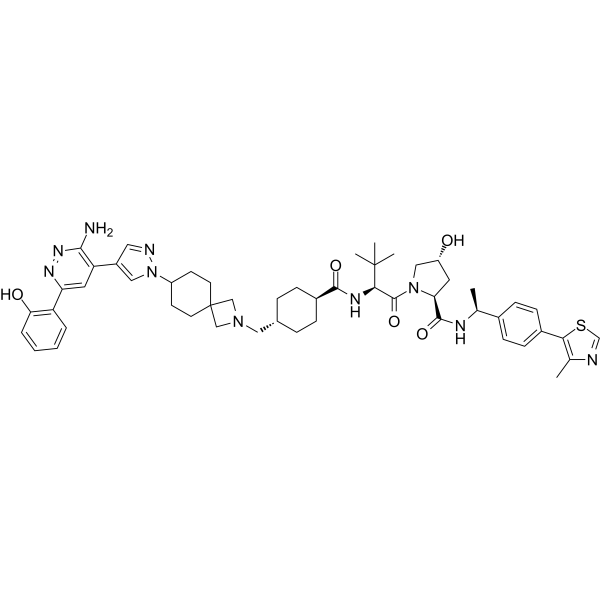
YD54 is an orally active and selective SMARCA2 PROTAC degrader. YD54 induces SMARCA4 degradation but with low potency and selectivity. YD54 selectively inhibits the growth of various cancer cells and suppresses tumor growth in mouse xenograft models. YD54 can be used for the research of SMARCA4-mutant lung cancer.
(Pink: SMARCA2 ligand (HY-44012B); Blue: Cereblon ligand (HY-168222); Black: linker (HY-168223)).
For research use only. We do not sell to patients.
- Purity : 98.74%
- CAS No.: 2951015-30-6
- Formula: C40H42FN9O6
- Molecular Weight:763.82
-
Storage:Powder -20°C, 3 years , 4°C, 2 years ; In solvent -80°C, 6 months , -20°C, 1 month


To place orders, for customer services and technical support, please contact: MedChemExpress USA
Tel: 609-228-6898 E-mail: [email protected] [email protected]


-
 Biological Activity
-
Chemical Information
-
Solvent & Solubility
- Protocols
- Purity & Documentation
- References
-
 Help & FAQs





Biological Activity
Description
IC50 & Target
|
SMARCA2 |
SMARCA4 |
In Vitro
YD54 (0.001-10 μM; 24-48 h) potently degrades SMARCA2 (DC50: 8.1-16 nM) and SMARCA4 (DC50: 19-149 nM) in H1792 SMARCA4WT human lung cancer cells, with nearly complete degradation of both proteins[1].
YD54 (0.001-10 μM; 48 h) potently degrades SMARCA2 in multiple SMARCA4-mutant lung cancer cells, with a DC50 ranging from 1.0 to 10.3 nM and a maximum degradation rate of >98%[1].
YD54 (0.001-10 μM; 9-14 days) selectively inhibits clonogenic growth of SMARCA4-mutant human lung cancer cells (mean IC50 = 11 nM), with a potency 827-fold higher than that in SMARCA4-WT cells (mean IC50 = 9.1 μM)[1].
YD54 (20 nM; 24 h) selectively degrades SMARCA2 in H1792 SMARCA4WT human lung cancer cells, with minimal effects on SMARCA4 or other proteins[1].
YD54 (0.0313-5 μM; 8 days) acts synergistically with Sotorasib (HY-114277) to inhibit the colony formation of human lung cancer cell line H2030 harboring co-mutations of SMARCA4 and KRASG12C[1].
YD54 (10 μM; 60 min) exhibits moderate metabolic clearance in human (T1/2 = 34.876 min) and mouse (T1/2 = 45.949 min) liver microsomes, with N-dealkylation serving as the major metabolic pathway in mouse microsomes[1].
MedChemExpress (MCE) has not independently confirmed the accuracy of these methods. They are for reference only.
-
Cell Line:H1792 SMARCA4-WT human lung cancer cells
-
Concentration:0, 0.001, 0.01, 0.1, 1and 10 μM
-
Incubation Time:24 h; 48 h
-
Result:Degraded SMARCA2 with a DC50 of 8.1 nM and a Dmax of 98.9% at 24 h, and a DC50 of 16 nM and a Dmax of 99.2% at 48 h.
Degraded SMARCA4 with a DC50 of 19 nM and a Dmax of 98% at 24 h, and a DC50 of 149 nM and a Dmax of 99.3% at 48 h.
-
Cell Line:SMARCA4 mutant human lung cancer cell lines (H322, HCC515, H2030, H2126)
-
Concentration:0, 0.001, 0.01, 0.1, 1and 10 μM
-
Incubation Time:48 h
-
Result:Degraded SMARCA2 in H322 cells with a DC50 of 1.2 nM and a Dmax of 99.3%.
Degraded SMARCA2 in HCC515 cells with a DC50 of 1 nM and a Dmax of 98.9%.
Degraded SMARCA2 in H2030 cells with a DC50 of 10.3 nM and a Dmax of 98.6%.
Degraded SMARCA2 in H2126 cells with a DC50 of 1.6 nM and a Dmax of 98.9%.
-
Cell Line:SMARCA4 mutant (H1568, H1693) and SMARCA4-WT (HCC44, H2122) human lung cancer cell lines
-
Concentration:0, 0.001, 0.01, 0.1, 1and 10 μM
-
Incubation Time:9-14 days
-
Result:Caused dose-dependent inhibition of clonogenic growth in SMARCA4 mutant cells, with an average IC50 of 11 nM.
Exerted minimal impact on SMARCA4-WT cell growth, with an average IC50 of 9.1 μM, resulting in an 827-fold selectivity for SMARCA4 mutant cells over WT cells.
-
Cell Line:H2030 SMARCA4 and KRAS G12C comutant human lung cancer cells
-
Concentration:0.0313, 0.313, 0.625, 1.25, 2.5 and 5 μM
-
Incubation Time:8 days
-
Result:Induced robust synergistic growth inhibition in combination with Sotorasib, with a Bliss synergy score of 43.5.
Parmacokinetics
In Vivo
YD54 (5 mg/kg; p.o.; once daily; for 19 consecutive days) achieves a 48.8% tumor growth inhibition rate and a 96% SMARCA2 degradation rate in the HCC515 SMARCA4G12C-mutant non-small cell lung cancer xenograft model, accompanied by moderate body weight loss[1].
YD54 (5 mg/kg; p.o.; once daily; for 17 consecutive days) achieves a 93.4% tumor growth inhibition rate and a 40% SMARCA2 degradation rate in the H2030 SMARCA4G12C-mutant non-small cell lung cancer xenograft model, accompanied by moderate body weight loss[1].
MedChemExpress (MCE) has not independently confirmed the accuracy of these methods. They are for reference only.
-
Animal Model:Nude female mice at 6-8 weeks of age were subcutaneously injected in the flanks with H2023 cells (10 × 106 cells/mouse) that had been trypsinized and resuspended in 1× PBS, mixed with a 1:1 mix of Matrigel in a final volume of 200 μL. Mice were randomized to control and treatment groups once the average tumor volume of H2023 xenograft reached < 200 mm3.[1]
-
Dosage:5 mg/kg
-
Administration:p.o.; daily; 19 days
-
Result:Achieved a tumor growth inhibition (TGI) of 62.5% compared to vehicle control.
Reduced SMARCA2 protein levels in tumors by 76% relative to vehicle-treated tumors.
Caused minimal body weight reduction (<10% compared to controls), indicating good tolerability.
-
Animal Model:Nude female mice at 6-8 weeks of age were subcutaneously injected in the flanks with HCC515 cells (5 × 10⁶ cells/mouse) that had been trypsinized and resuspended in 1× PBS, mixed with a 1:1 mix of Matrigel in a final volume of 200 μL. Mice were randomized to control and treatment groups once the average tumor volume of HCC515 xenograft reached < 200 mm3.[1]
-
Dosage:5 mg/kg
-
Administration:p.o.; daily; 19 days
-
Result:Achieved a tumor growth inhibition (TGI) of 48.8% compared to vehicle control.
Reduced SMARCA2 protein levels in tumors by 96% relative to vehicle-treated tumors.
Caused moderate body weight reduction (<20% compared to controls), with no other signs of toxicity.
-
Animal Model:Nude female mice at 6-8 weeks of age were subcutaneously injected in the flanks with H2030 cells (10 × 106 cells/mouse) that had been trypsinized and resuspended in 1× PBS, mixed with a 1:1 mix of Matrigel in a final volume of 200 μL. Mice were randomized to control and treatment groups once the average tumor volume of H2023 xenograft reached < 200 mm3.[1]
-
Dosage:5 mg/kg
-
Administration:p.o.; daily; 17 days
-
Result:Achieved a tumor growth inhibition (TGI) of 93.4% compared to vehicle control.
Reduced SMARCA2 protein levels in tumors by 40% relative to vehicle-treated tumors.
Caused moderate body weight reduction (<20% compared to controls), with no other signs of toxicity.


Chemical Information
-
CAS No. 2951015-30-6
-
Appearance Solid
-
Molecular Weight 763.82
-
Formula C40H42FN9O6
-
Color Off-white to light yellow
-
SMILES
O=C(N(C1CCC(NC1=O)=O)C2=O)C3=C2C=CC=C3OCCN4CCN(C5=C(F)C=C(CN6CCN(C7=C(N)N=NC(C8=C(O)C=CC=C8)=C7)CC6)C=C5)CC4
-
Shipping
Room temperature in continental US; may vary elsewhere.
-
Storage
Powder -20°C 3 years 4°C 2 years In solvent -80°C 6 months -20°C 1 month


Solvent & Solubility
In Vitro:
DMSO : 200 mg/mL (261.84 mM; Need ultrasonic; Hygroscopic DMSO has a significant impact on the solubility of product, please use newly opened DMSO)
Please refer to the solubility information to select the appropriate solvent. Once prepared, please aliquot and store the solution to prevent product inactivation from repeated freeze-thaw cycles.
Storage method and period of stock solution: -80°C, 6 months; -20°C, 1 month. When stored at -80°C, please use it within 6 months. When stored at -20°C, please use it within 1 month.
Please refer to the solubility information to select the appropriate solvent. Once prepared, please aliquot and store the solution to prevent product inactivation from repeated freeze-thaw cycles.
Storage method and period of stock solution: -80°C, 6 months; -20°C, 1 month. When stored at -80°C, please use it within 6 months. When stored at -20°C, please use it within 1 month.
Concentration (start) × Volume (start) = Concentration (final) × Volume (final)
In Vivo:
Select the appropriate dissolution method based on your experimental animal and administration route.
- For the following dissolution methods, please ensure to first prepare a clear stock solution using an In Vitro approach and then sequentially add co-solvents:
- To ensure reliable experimental results, the clarified stock solution can be appropriately stored based on storage conditions. As for the working solution for In Vivo experiments, it is recommended to prepare freshly and use it on the same day.
- The percentages shown for the solvents indicate their volumetric ratio in the final prepared solution. If precipitation or phase separation occurs during preparation, heat and/or sonication can be used to aid dissolution.
Add each solvent one by one: 10% DMSO 40% PEG300 5% Tween-80 45% Saline
Solubility: ≥ 5 mg/mL (6.55 mM); Clear solution
This protocol yields a clear solution of ≥ 5 mg/mL (saturation unknown).
Taking 1 mL working solution as an example, add 100 μL DMSO stock solution (50.0 mg/mL) to 400 μL PEG300, and mix evenly; then add 50 μL Tween-80 and mix evenly; then add 450 μL Saline to adjust the volume to 1 mL.
Preparation of Saline: Dissolve 0.9 g sodium chloride in ddH₂O and dilute to 100 mL to obtain a clear Saline solution.
In Vivo Dissolution Calculator
Please enter the basic information of animal experiments:
-
-
-
-
Recommended: Prepare an additional quantity of animals to account for potential losses during experiments.
Please enter your animal formula composition:
-
%DMSO +
Recommended: Keep the proportion of DMSO in working solution below 2% if your animal is weak.
-
%+
-
+%Tween-80 + +
-
%Saline +
The co-solvents required include: DMSO, . All of co-solvents are available by MedChemExpress (MCE). , Tween 80. All of co-solvents are available by MedChemExpress (MCE).
Working solution concentration: 0.22 mg/mL
Method for preparing stock solution: mg drug dissolved in μL DMSO. Stock solution concentration: mg/mL.
1. Take μL DMSO stock solution;
2. Add μL .
μL , mix evenly;
3. Then add μL Tween 80, mix evenly;
4. Then add μL
Please ensure that the stock solution in the first step is dissolved to a clear state, and add co-solvents in sequence. You can use ultrasonic heating (ultrasonic cleaner, recommended frequency 20-40 kHz), vortexing, etc. to assist dissolution.


Purity & Documentation
-
Data Sheet (280 KB)
-
SDS (254 KB)
- English - EN (254 KB)
- Français - FR (254 KB)
- Deutsch - DE (254 KB)
- Norwegian - NO (254 KB)
- Español - ES (254 KB)
- Swedish - SV (254 KB)
- Italian - IT (254 KB)
- Korean - KR (254 KB)
- Portuguese - PT (254 KB)
-
Handling Instructions (2659 KB)
References
[1]. Kotagiri S, et al. Discovery of Novel, Potent, and Orally Bioavailable SMARCA2 Proteolysis-Targeting Chimeras with Synergistic Antitumor Activity in Combination with Kirsten Rat Sarcoma Viral Oncogene Homologue G12C Inhibitors. Journal of medicinal chemistry. 2025 May 08;68(9):9202-9219. [Content Brief]


Complete Stock Solution Preparation Table
Please refer to the solubility information to select the appropriate solvent. Once prepared, please aliquot and store the solution to prevent product inactivation from repeated freeze-thaw cycles.
Storage method and period of stock solution: -80°C, 6 months; -20°C, 1 month. When stored at -80°C, please use it within 6 months. When stored at -20°C, please use it within 1 month.
| Optional Solvent | Concentration Solvent Mass | 1 mg | 5 mg | 10 mg | 25 mg |
|---|---|---|---|---|---|
| DMSO | 1 mM | 1.3092 mL | 6.5460 mL | 13.0921 mL | 32.7302 mL |
| 5 mM | 0.2618 mL | 1.3092 mL | 2.6184 mL | 6.5460 mL | |
| 10 mM | 0.1309 mL | 0.6546 mL | 1.3092 mL | 3.2730 mL | |
| 15 mM | 0.0873 mL | 0.4364 mL | 0.8728 mL | 2.1820 mL | |
| 20 mM | 0.0655 mL | 0.3273 mL | 0.6546 mL | 1.6365 mL | |
| 25 mM | 0.0524 mL | 0.2618 mL | 0.5237 mL | 1.3092 mL | |
| 30 mM | 0.0436 mL | 0.2182 mL | 0.4364 mL | 1.0910 mL | |
| 40 mM | 0.0327 mL | 0.1637 mL | 0.3273 mL | 0.8183 mL | |
| 50 mM | 0.0262 mL | 0.1309 mL | 0.2618 mL | 0.6546 mL | |
| 60 mM | 0.0218 mL | 0.1091 mL | 0.2182 mL | 0.5455 mL | |
| 80 mM | 0.0164 mL | 0.0818 mL | 0.1637 mL | 0.4091 mL | |
| 100 mM | 0.0131 mL | 0.0655 mL | 0.1309 mL | 0.3273 mL |


YD54 Related Classifications
HY-168221 Related Classifications
 Powered by Bioz