



Levoketoconazole
Based on 1 publication(s) in Google Scholar
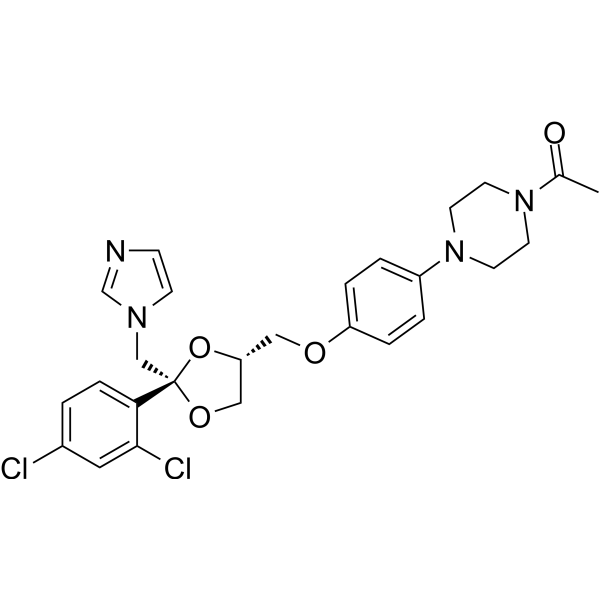
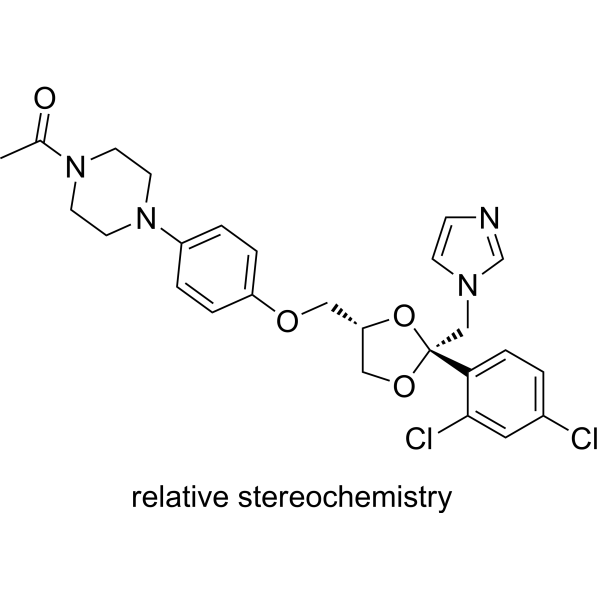
Levoketoconazole ((-)-Ketoconazole) is the 2S,4R enantiomer derived from racemic Ketoconazole (HY-B0105). Levoketoconazole is a potent and orally active cortisol synthesis inhibitor. Levoketoconazole inhibits key steps in cortisol and testosterone synthesis by inhibiting CYP11B1, CYP11A1, and CYP17A1. Levoketoconazole can be used for research on endogenous Cushing’s syndrome.
For research use only. We do not sell to patients.
- Purity : 99.82%
- CAS No.: 142128-57-2
- Formula: C26H28Cl2N4O4
- Molecular Weight:531.43
-
Storage:Powder -20°C, 3 years , 4°C, 2 years ; In solvent -80°C, 2 years , -20°C, 1 year

To place orders, for customer services and technical support, please contact: MedChemExpress USA
Tel: 609-228-6898 E-mail: [email protected] [email protected]


-
 Biological Activity
-
Chemical Information
-
Solvent & Solubility
- Purity & Documentation
- References
-
 Help & FAQs


Publications Citing Use of MedChemExpress (MCE) Levoketoconazole
More

Biological Activity
Description
IC50 & Target
[2]|
CYP11B1 |
CYP11A1 |
CYP17A1 |
In Vitro
Levoketoconazole (0.05-5 µM, 24-72 h) potently suppresses cortisol production in HAC15 cells with an IC50 of 0.300 µM (72 h)[3].
Levoketoconazole (0.1-10 µM, 1-7 days) inhibits cell number (7 days IC50 = 1.05 µM) in a time- and dose-dependent manner, and also significantly inhibits ACTH secretion in corticotroph pituitary murine AtT20 cells after 3 days of treatment[3].
Levoketoconazole (5 µM, 7 days) significantly inhibits cell number after 7 days in primary human corticotroph pituitary adenoma cultures[3].
MedChemExpress (MCE) has not independently confirmed the accuracy of these methods. They are for reference only.
-
Cell Line:murine AtT20 cells
-
Concentration:0.1-10 µM
-
Incubation Time:1, 3, 7 days
-
Result:Inhibited murine AtT20 cell number in a time- and dose-dependent manner.
Inhibited murine AtT20 cell number with an IC50 of 1.05 µM after 7 days treatment.
In Vivo
MedChemExpress (MCE) has not independently confirmed the accuracy of these methods. They are for reference only.
Clinical Trial
| NCT Number | Sponsor | Condition | Start Date |
Phase

|
|---|---|---|---|---|
| NCT01329991 | Plexxikon| | 2011-05 | PHASE1 |


Chemical Information
-
CAS No. 142128-57-2
-
Appearance Solid
-
Molecular Weight 531.43
-
Formula C26H28Cl2N4O4
-
Color White to off-white
-
SMILES
CC(N1CCN(C2=CC=C(OC[C@H]3O[C@](CN4C=CN=C4)(C5=CC=C(Cl)C=C5Cl)OC3)C=C2)CC1)=O
-
Synonyms
(-)-Ketoconazole; (-)-Ketoconazol; (-)-R 41400
-
Shipping
Room temperature in continental US; may vary elsewhere.
-
Storage
Powder -20°C 3 years 4°C 2 years In solvent -80°C 2 years -20°C 1 year


Publications (1)
-
Journal Impact Factor
-
Most Recent
-
Clin Exp Pharmacol Physiol
Indole-3-Propionic Acid Improves Vascular Function in High-Fat Diet-Induced Obese Mice via eNOS. [Abstract]2025 Nov;52(11):e70081. PMID: 41057979


Solvent & Solubility
In Vitro:
DMSO : 33.33 mg/mL (62.72 mM; Need ultrasonic; Hygroscopic DMSO has a significant impact on the solubility of product, please use newly opened DMSO)
Please refer to the solubility information to select the appropriate solvent. Once prepared, please aliquot and store the solution to prevent product inactivation from repeated freeze-thaw cycles.
Storage method and period of stock solution: -80°C, 2 years; -20°C, 1 year. When stored at -80°C, please use it within 2 years. When stored at -20°C, please use it within 1 year.
Please refer to the solubility information to select the appropriate solvent. Once prepared, please aliquot and store the solution to prevent product inactivation from repeated freeze-thaw cycles.
Storage method and period of stock solution: -80°C, 2 years; -20°C, 1 year. When stored at -80°C, please use it within 2 years. When stored at -20°C, please use it within 1 year.
Concentration (start) × Volume (start) = Concentration (final) × Volume (final)
In Vivo:
Select the appropriate dissolution method based on your experimental animal and administration route.
- For the following dissolution methods, please ensure to first prepare a clear stock solution using an In Vitro approach and then sequentially add co-solvents:
- To ensure reliable experimental results, the clarified stock solution can be appropriately stored based on storage conditions. As for the working solution for In Vivo experiments, it is recommended to prepare freshly and use it on the same day.
- The percentages shown for the solvents indicate their volumetric ratio in the final prepared solution. If precipitation or phase separation occurs during preparation, heat and/or sonication can be used to aid dissolution.
Add each solvent one by one: 10% DMSO 40% PEG300 5% Tween-80 45% Saline
Solubility: ≥ 2.5 mg/mL (4.70 mM); Clear solution
This protocol yields a clear solution of ≥ 2.5 mg/mL (saturation unknown).
Taking 1 mL working solution as an example, add 100 μL DMSO stock solution (25.0 mg/mL) to 400 μL PEG300, and mix evenly; then add 50 μL Tween-80 and mix evenly; then add 450 μL Saline to adjust the volume to 1 mL.
Preparation of Saline: Dissolve 0.9 g sodium chloride in ddH₂O and dilute to 100 mL to obtain a clear Saline solution.
Add each solvent one by one: 10% DMSO 90% (20% SBE-β-CD in Saline)
Solubility: ≥ 2.5 mg/mL (4.70 mM); Clear solution
This protocol yields a clear solution of ≥ 2.5 mg/mL (saturation unknown).
Taking 1 mL working solution as an example, add 100 μL DMSO stock solution (25.0 mg/mL) to 900 μL 20% SBE-β-CD in Saline, and mix evenly.
Preparation of 20% SBE-β-CD in Saline (4°C, storage for one week): 2 g SBE-β-CD powder is dissolved in 10 mL Saline, completely dissolve until clear.
In Vivo Dissolution Calculator
Please enter the basic information of animal experiments:
-
-
-
-
Recommended: Prepare an additional quantity of animals to account for potential losses during experiments.
Please enter your animal formula composition:
-
%DMSO +
Recommended: Keep the proportion of DMSO in working solution below 2% if your animal is weak.
-
%+
-
+%Tween-80 + +
-
%Saline +
The co-solvents required include: DMSO, . All of co-solvents are available by MedChemExpress (MCE). , Tween 80. All of co-solvents are available by MedChemExpress (MCE).
Working solution concentration: 0.22 mg/mL
Method for preparing stock solution: mg drug dissolved in μL DMSO. Stock solution concentration: mg/mL.
1. Take μL DMSO stock solution;
2. Add μL .
μL , mix evenly;
3. Then add μL Tween 80, mix evenly;
4. Then add μL
Please ensure that the stock solution in the first step is dissolved to a clear state, and add co-solvents in sequence. You can use ultrasonic heating (ultrasonic cleaner, recommended frequency 20-40 kHz), vortexing, etc. to assist dissolution.


Purity & Documentation
-
Data Sheet (276 KB)
-
SDS (254 KB)
- English - EN (254 KB)
- Français - FR (254 KB)
- Deutsch - DE (254 KB)
- Norwegian - NO (254 KB)
- Español - ES (254 KB)
- Swedish - SV (254 KB)
- Italian - IT (254 KB)
- Korean - KR (254 KB)
- Portuguese - PT (254 KB)
-
Handling Instructions (2659 KB)
References
[1]. Pivonello R, et al. Levoketoconazole in the treatment of patients with endogenous Cushing's syndrome: a double-blind, placebo-controlled, randomized withdrawal study (LOGICS). Pituitary. 2022 Dec;25(6):911-926. [Content Brief]
[2]. McCartney NK, et al. Levoketoconazole. Hosp Pharm. 2022 Oct;57(5):605-614. [Content Brief]
[3]. Creemers SG, et al. Levoketoconazole, the 2S,4R Enantiomer of Ketoconazole, a New Steroidogenesis Inhibitor for Cushing's Syndrome Treatment. J Clin Endocrinol Metab. 2021 Mar 25;106(4):e1618-e1630. [Content Brief]


Complete Stock Solution Preparation Table
Please refer to the solubility information to select the appropriate solvent. Once prepared, please aliquot and store the solution to prevent product inactivation from repeated freeze-thaw cycles.
Storage method and period of stock solution: -80°C, 2 years; -20°C, 1 year. When stored at -80°C, please use it within 2 years. When stored at -20°C, please use it within 1 year.
| Optional Solvent | Concentration Solvent Mass | 1 mg | 5 mg | 10 mg | 25 mg |
|---|---|---|---|---|---|
| DMSO | 1 mM | 1.8817 mL | 9.4086 mL | 18.8172 mL | 47.0429 mL |
| 5 mM | 0.3763 mL | 1.8817 mL | 3.7634 mL | 9.4086 mL | |
| 10 mM | 0.1882 mL | 0.9409 mL | 1.8817 mL | 4.7043 mL | |
| 15 mM | 0.1254 mL | 0.6272 mL | 1.2545 mL | 3.1362 mL | |
| 20 mM | 0.0941 mL | 0.4704 mL | 0.9409 mL | 2.3521 mL | |
| 25 mM | 0.0753 mL | 0.3763 mL | 0.7527 mL | 1.8817 mL | |
| 30 mM | 0.0627 mL | 0.3136 mL | 0.6272 mL | 1.5681 mL | |
| 40 mM | 0.0470 mL | 0.2352 mL | 0.4704 mL | 1.1761 mL | |
| 50 mM | 0.0376 mL | 0.1882 mL | 0.3763 mL | 0.9409 mL | |
| 60 mM | 0.0314 mL | 0.1568 mL | 0.3136 mL | 0.7840 mL |


Levoketoconazole Related Classifications
HY-B0105B Related Classifications
 Powered by Bioz