



Phospho-BTK(Y223) Antibody (YA221)
(Synonyms: BTK(Y223); BTK (phospho Y223); p-BTK (phospho Y223); Agammaglobulinaemia tyrosine kinase; AGMX 1; AGMX1; AT; ATK; B cell progenitor kinase; B-cell progenitor kinase; BPK; Bruton agammaglobulinemia tyrosine kinase; Bruton tyrosine kinase; Bruton’s Tyrosine Kinase; Btk; BTK_HUMAN; IMD 1; IMD1; MGC126261; MGC126262; OTTHUMP00000063593; PSCTK 1; PSCTK1; Tyrosine protein kinase BTK; Tyrosine-protein kinase BTK; XLA.)Based on 1 Customer Validation
Phospho-BTK(Y223) Antibody (YA221) is a Rabbit-derived and non-conjugated IgG monoclonal antibody, targeting to Phospho-BTK(Y223).
-
Host:
Rabbit
-
Isotype:
IgG
-
Application:
WB, IP
-
Reactivity :
Human
-
Formulation:
Supplied in 50mM Tris-Glycine(pH 7.4), 0.15M NaCl, 40%Glycerol, 0.01% sodium azide and 0.05% BSA.
-
Conjugation:
Non-conjugated


To place orders, for customer services and technical support, please contact: MedChemExpress USA
Tel: 609-228-6898 E-mail: [email protected] [email protected]





Applications
| Application |
WB

WB: Western Blot
|
IP
IP: Immunoprecipitation
|
|---|---|---|
| Dilution Ratio | 1:500-1:1000 | 1:20 |


Product Details
Phospho-BTK(Y223) Antibody (YA221) is a Rabbit-derived and non-conjugated IgG monoclonal antibody, targeting to Phospho-BTK(Y223).
-
Host Rabbit

-
Clonality Recombinant,Monoclonal

-
Species ReactivityHuman
-
Observed Molecular WeightObserved band size: 76 kDa
Note: Due to possible protein modifications or aggregation, the molecular weight should be confirmed by actual measurement, and the predicted value is for reference only.

-
Calculated Molecular Weight Predicted band size: 76 kDa

Synthetic phosphopeptide corresponding to residues surrounding Tyr223 of Human BTK.The exact sequence is proprietary to MCE.
Endogenous
Protein A affinity purified.
Non-conjugated
Phosphorylated
IgG


Product Properties
-
Appearance
Solution
-
Formulation
Supplied in 50mM Tris-Glycine(pH 7.4), 0.15M NaCl, 40%Glycerol, 0.01% sodium azide and 0.05% BSA.
-
Concentration
Batch-dependent, Please check the COA for the concentration of each lot. Check Lot Concentration
-
Storage & Stability
Stored at -20°C for 1 year. Avoid repeated freeze / thaw cycles.
-
Shipping
Shipping with blue ice.


Verification Images
-
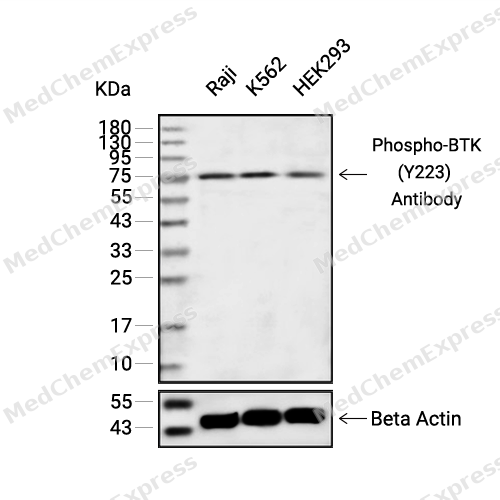 Western blot analysis of extracts from Raji(lane 2(20ug) , K562(lane 3(20ug) and HEK293(lane 4(20ug) using Phospho-BTK Antibody (HY-P80454) Rabbit mAb. Proteins were transferred to a PVDF membrane and blocked with 5% non-fat milk in TBST for 2 hour at room temperature. The primary antibody (1/1000) and Loading control antibody (Beta Actin, HY-P80438, 1/10000) was used in 5% non-fat milk in TBST at 4°C overnight. Goat Anti-Mouse/Rabbit IgG-HRP Secondary Antibody (1/10000) was used for 1 hour at room temperature.


Background
-
Function
Bruton tyrosine kinase (Btk) is a member of the Tec family kinases with a well-characterized role in B-cell antigen receptor (BCR) -signaling and B-cell activation. Btk plays a crucial role in B cell development and activation through the BCR signaling pathway and represents a new target for diseases characterized by inappropriate B cell activity. Btk is a kinase expressed exclusively in B cells and myeloid cells and has a well characterized, vital role in B cells highlighted by the human primary immune deficiency disease, X-linked agammaglobulinemia (XLA), which results from mutation in the Btk gene. Btk plays an essential role in the BCR signaling pathway. Antigen binding to the BCR results in B cell receptor oligomerization, Syk and Lyn kinase activation, followed by Btk kinase activation. Once activated, Btk forms a signaling complex with proteins such as BLNK, Lyn, and Syk and phosphorylates phospholipase C (PLC) γ2. This leads to downstream release of intracellular Ca2+ stores and propagation of the BCR signaling pathway through extracellular signal-regulated kinase and NF-κB signaling, ultimately resulting in transcriptional changes to foster B cell survival, proliferation, and/or differentiation.
-
Subcellular Localization
Cytoplasm; Cell membrane; Peripheral membrane protein; Nucleus; Membrane raft
-
Expression
Tissue_specificity:It is mainly expressed in B lymphocytes -
Isoforms & Post-Translational Modification
Q06187 has 2 isomers: Q06187-1: 76281 Da (predicted); Q06187-2: 79937 Da (predicted).
Following B-cell receptor (BCR) engagement, translocates to the plasma membrane where it gets phosphorylated at Tyr-551 by LYN and SYK. Phosphorylation at Tyr-551 is followed by autophosphorylation of Tyr-223 which may create a docking site for a SH2 containing protein. Phosphorylation at Ser-180 by PRKCB, leads in translocation of BTK back to the cytoplasmic fraction. Phosphorylation at Ser-21 and Ser-115 creates a binding site for PIN1 at these Ser-Pro motifs, and promotes it's recruitment -
Subunit
Part of a complex composed of EEIG1, TNFRSF11A/RANK, PLCG2, GAB2, TEC and BTK; complex formation increases in the presence of TNFSF11/RANKL (By similarity). Binds GTF2I through the PH domain. Interacts with SH3BP5 via the SH3 domain. Interacts with IBTK via its PH domain. Interacts with ARID3A, CAV1, FASLG, PIN1, TLR8 and TLR9. Interacts with MPL/TPOR (PubMed:24607955)
-
SwissProt ID
-
Synonyms
BTK(Y223); BTK (phospho Y223); p-BTK (phospho Y223); Agammaglobulinaemia tyrosine kinase; AGMX 1; AGMX1; AT; ATK; B cell progenitor kinase; B-cell progenitor kinase; BPK; Bruton agammaglobulinemia tyrosine kinase; Bruton tyrosine kinase; Bruton’s Tyrosine Kinase; Btk; BTK_HUMAN; IMD 1; IMD1; MGC126261; MGC126262; OTTHUMP00000063593; PSCTK 1; PSCTK1; Tyrosine protein kinase BTK; Tyrosine-protein kinase BTK; XLA.
-
Research Field
Signal Transduction


Documentation
-
Data Sheet (232 KB)
-
SDS (254 KB)
- English - EN (254 KB)
- Français - FR (254 KB)
- Deutsch - DE (254 KB)
- Norwegian - NO (254 KB)
- Español - ES (254 KB)
- Swedish - SV (254 KB)
- Italian - IT (254 KB)
- Korean - KR (254 KB)
- Portuguese - PT (254 KB)
-
User Guide for Antibodies (1077 KB)

 Powered by Bioz
