



Caspase-6 p18 Antibody (YA555)

Based on 1 Customer Validation
Caspase-6 p18 Antibody (YA555) is a Rabbit-derived and non-conjugated IgG monoclonal antibody, targeting to Caspase-6 p18.
-
Host:
Rabbit
-
Isotype:
IgG
-
Application:
WB
-
Reactivity :
Human
-
Formulation:
Supplied in 1*TBS (pH7.4), 0.05% BSA and 40% Glycerol. Preservative: 0.05% Sodium Azide.
-
Conjugation:
Non-conjugated


To place orders, for customer services and technical support, please contact: MedChemExpress USA
Tel: 609-228-6898 E-mail: [email protected] [email protected]





Applications
| Application |
WB

WB: Western Blot
|
|---|---|
| Dilution Ratio | 1:1000-1:5000 |


Product Details
Caspase-6 p18 Antibody (YA555) is a Rabbit-derived and non-conjugated IgG monoclonal antibody, targeting to Caspase-6 p18.
-
Host Rabbit

-
Clonality Recombinant, Monoclonal

-
Species ReactivityHuman
-
Observed Molecular WeightObserved band size: 34 kDa
Note: Due to possible protein modifications or aggregation, the molecular weight should be confirmed by actual measurement, and the predicted value is for reference only.

-
Calculated Molecular Weight Predicted band size: 33 kDa

Synthetic peptide corresponding to Human Caspase-6 p18.AA range:25-182.
Endogenous
Protein A affinity purified.
Non-conjugated
Unmodified
IgG


Product Properties
-
Appearance
Liquid
-
Formulation
Supplied in 1*TBS (pH7.4), 0.05% BSA and 40% Glycerol. Preservative: 0.05% Sodium Azide.
-
Concentration
Batch-dependent, Please check the COA for the concentration of each lot. Check Lot Concentration
-
Storage & Stability
Stored at -20°C for 1 year. Avoid repeated freeze / thaw cycles.
-
Shipping
Shipping with blue ice.


Verification Images
-
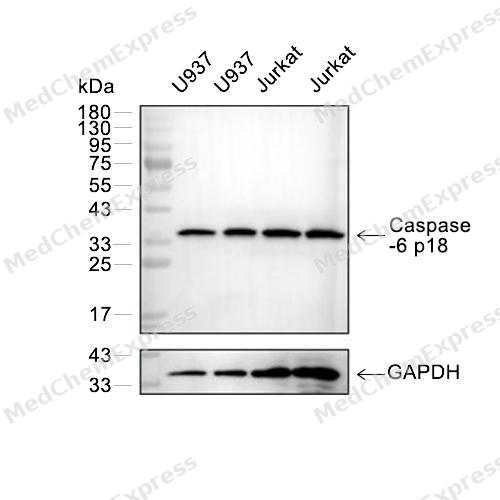 Western blot analysis of extracts from U937(lane 2(20μg) and U937(lane 3(40μg), Jurkat(lane 4(20μg) ) and Jurkat(lane 5(40μg) ) using Caspase-6 p18 (HY-P80048) Rabbit mAb. Proteins were transferred to a PVDF membrane and blocked with 5% BSA in TBST for 2 hour at room temperature. The primary antibody (HY-P80048, 1/1000) and Loading control antibody (GAPDH, HY-P80954, 1/3000) was used in 5% BSA in TBST at 4°C overnight. Goat Anti-Mouse/Rabbit IgG-HRP Secondary Antibody (HY-P8004/HY-P8001, 1/10,000) was used for 1 hour at room temperature.
 -
 Western blot analysis was performed on protein extracts (25 μg) from HCT 116 (lane 2), HT-1080 (lane 3), THP-1 (lane 4), and Raji (lane 5) using Caspase-6 p18 antibody. Proteins were transferred onto a 0.45 μm PVDF membrane using the Trans-Blot® Turbo™ system for 13 min. The membrane was then blocked with 5% nonfat milk in TBST (HY-K1025) for 1 h at room temperature. The primary antibody (1:1000) and loading control antibody GAPDH Antibody (HRP) (HY-P80954A) (1:5000) were diluted in 5% nonfat milk in TBST and incubated with the membrane overnight at 4°C. After washing, the membrane of primary antibody was incubated with HRP-conjugated goat anti-rabbit/mouse IgG secondary antibody (HY-P8001/HY-P8004) (1:5000) diluted in 5% nonfat milk in TBST for 1 h at room temperature. Protein bands were visualized using an Ultra High Sensitivity ECL detection kit (HY-K1005).


Background
-
Function
Caspase-6 p18 is a Cysteine protease that plays essential roles in programmed cell death, axonal degeneration, development and innate immunity. Acts as a non-canonical executioner caspase during apoptosis: localizes in the nucleus and cleaves the nuclear structural protein NUMA1 and lamin A/LMNA thereby inducing nuclear shrinkage and fragmentation. Lamin-A/LMNA cleavage is required for chromatin condensation and nuclear disassembly during apoptotic execution. Acts as a regulator of liver damage by promoting hepatocyte apoptosis: in absence of phosphorylation by AMP-activated protein kinase (AMPK), catalyzes cleavage of BID, leading to cytochrome c release, thereby participating in nonalcoholic steatohepatitis. Cleaves PARK7/DJ-1 in cells undergoing apoptosis. Involved in intrinsic apoptosis by mediating cleavage of RIPK1. Furthermore, cleaves many transcription factors such as NF-kappa-B and cAMP response element-binding protein/CREBBP. Cleaves phospholipid scramblase proteins XKR4 and XKR9. In addition to apoptosis, involved in different forms of programmed cell death. Plays an essential role in defense against viruses by acting as a central mediator of the ZBP1-mediated pyroptosis, apoptosis, and necroptosis (PANoptosis), independently of its cysteine protease activity. PANoptosis is a unique inflammatory programmed cell death, which provides a molecular scaffold that allows the interactions and activation of machinery required for inflammasome/pyroptosis, apoptosis and necroptosis. Mechanistically, interacts with RIPK3 and enhances the interaction between RIPK3 and ZBP1, leading to ZBP1-mediated inflammasome activation and cell death. Plays an essential role in axon degeneration during axon pruning which is the remodeling of axons during neurogenesis but not apoptosis. Regulates B-cell programs both during early development and after antigen stimulation; (Microbial infection) Proteolytically cleaves the N protein of coronaviruses such as MERS-CoV and SARS-CoV. The cleavage of MERS-CoV N-protein leads to two fragments and modulates coronavirus replication by regulating IFN signaling. The two fragments produced by the cleavage interact with IRF3 inhibiting its nuclear translocation after activation and reduce the expression of IFNB and IFN-stimulated genes. The same mechanism seems to be used by other coronaviruses such as SARS-CoV and SARS-CoV-2 to enhance their replication[1][2][3][4][5][6][7][8][9][10][11][12][13][14][15].
-
Subcellular Localization
Cytoplasm; Nucleus
-
Isoforms & Post-Translational Modification
P55212 has 2 isomers: P55212-1: 33310 Da (predicted); P55212-2: 22574 Da (predicted).
Phosphorylated by NUAK1; phosphorylation inhibits self-activation (PubMed:15273717, PubMed:22483120). Phosphorylation at Ser-257 by AMP-activated protein kinase (PRKAA1 or PRKAA2) inhibits autocleavage, preventing caspase activation, thereby preventing hepatocyte apoptosis (PubMed:32029622);Palmitoylation by ZDHHC17 blocks dimerization and subsequent activation, leading to inhibit the cysteine protease activity;Can be cleaved and activated by different caspases, depending on the context (PubMed:19133298, PubMed:28864531). Cleaved and activated by caspase-8 (CASP8) and subsequently by caspase-3 (CASP3) (PubMed:9463409). Can also undergo autoactivation by mediating autocleavage at Asp-179 and Asp-193, while it is not able to cleave its N-terminal disordered prodomain (PubMed:19133298, PubMed:28864531). Cleaved and activated by CASP1, possibly in the context of inflammation (PubMed:16123779) -
Subunit
Heterotetramer that consists of two anti-parallel arranged heterodimers, each one formed by a 18 kDa (p18) and a 11 kDa (p11) subunits (PubMed:19133298, PubMed:19694615, PubMed:20890311). Interacts with BIRC6/bruce (PubMed:15200957). Interacts with RIPK3 (PubMed:32298652)
-
SwissProt ID
-
Research Field
Cell Biology


Documentation
-
Data Sheet (235 KB)
-
SDS (251 KB)
- English - EN (251 KB)
- Français - FR (251 KB)
- Deutsch - DE (251 KB)
- Norwegian - NO (251 KB)
- Español - ES (251 KB)
- Swedish - SV (251 KB)
- Italian - IT (251 KB)
- Korean - KR (251 KB)
- Portuguese - PT (251 KB)
-
User Guide for Antibodies (1077 KB)

 Powered by Bioz
