



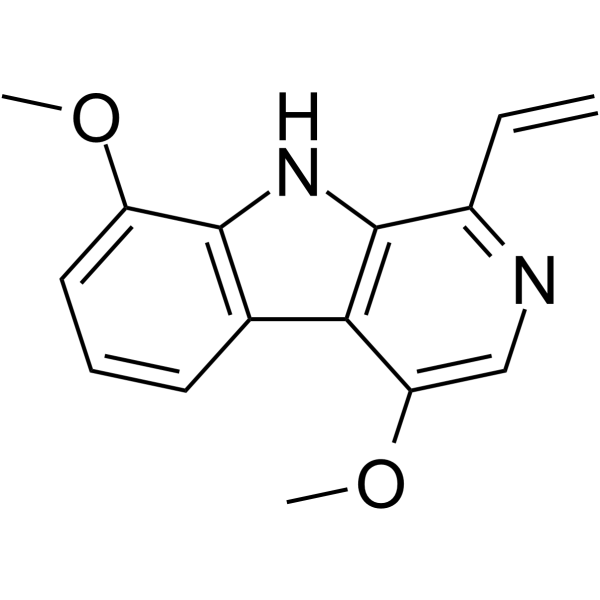
Dehydrocrenatidine

Based on 1 Customer Validation
Dehydrocrenatidine, a natural alkaloid, is a specific JAK inhibitor. Dehydrocrenatidine inhibits voltage-gated sodium channels and ameliorates mechanic allodia in a rat model of neuropathic pain.
For research use only. We do not sell to patients.
- Purity : 98.0%
- CAS No.: 65236-62-6
- Formula: C15H14N2O2
- Molecular Weight:254.28
-
Storage:
4°C, protect from light
* In solvent : -80°C, 6 months; -20°C, 1 month (protect from light)

To place orders, for customer services and technical support, please contact: MedChemExpress USA
Tel: 609-228-6898 E-mail: [email protected] [email protected]


-
 Biological Activity
-
Chemical Information
- Protocols
- Purity & Documentation
- References
-
 Help & FAQs




Biological Activity
Description
Cellular Effect
|
Cell Line

|
Type | Value | Description | References |
|---|---|---|---|---|
| A2780 | IC50 |
2.02 μg/mL
Compound: 51; 53
|
Antiproliferative activity against human A2780 cells
Antiproliferative activity against human A2780 cells
|
[PMID: 34332400] |
| SK-OV-3 | IC50 |
11.89 μg/mL
Compound: 51; 53
|
Antiproliferative activity against human SK-OV-3 cells
Antiproliferative activity against human SK-OV-3 cells
|
[PMID: 34332400] |
In Vitro
Dehydrocrenatidine inhibits JAK-STAT3 dependent DU145 and MDA-MB-468 cell survival and induces cell apoptosis. Dehydrocrenatidine inhibits JAKs-JH1 domain over-expression induced STAT3 and STAT1 phosphorylations[1].
Dehydrocrenatidine diminishes IL-6, IFNα and IFNγ stimulated STAT3 phosphorylation as well as constitutive STAT3 phosphorylation[1].
DHCT suppresses both tetrodotoxin-resistant (TTX-R) and sensitive (TTX-S) voltage-gated sodium channel (VGSC) currents with IC50 values of 12.36 µM and 4.87 µM, respectively[2].
MedChemExpress (MCE) has not independently confirmed the accuracy of these methods. They are for reference only. Further protocols information, click here.
In Vivo
Dehydrocrenatidine diminishes IL-6, IFNα and IFNγ stimulated STAT3 phosphorylation as well as constitutive STAT3 phosphorylation[1].
DHCT suppresses both tetrodotoxin-resistant (TTX-R) and sensitive (TTX-S) voltage-gated sodium channel (VGSC) currents with IC50 values of 12.36 µM and 4.87 µM, respectively[2].
MedChemExpress (MCE) has not independently confirmed the accuracy of these methods. They are for reference only.


Chemical Information
-
CAS No. 65236-62-6
-
Appearance Solid
-
Molecular Weight 254.28
-
Formula C15H14N2O2
-
Color Off-white to light yellow
-
SMILES
COC1=CC=CC2=C1NC3=C2C(OC)=CN=C3C=C
-
Synonyms
Kumujian G; O-Methylpicrasidine I
-
Structure Classification
-
Initial Source
-
Shipping
Room temperature in continental US; may vary elsewhere.
-
Storage
4°C, protect from light
* In solvent : -80°C, 6 months; -20°C, 1 month (protect from light)

Protocols
-
How to Select a Suitable Non-Mouse Animal Model
Selecting a suitable non-mouse animal model is a structured decision based on the research question, required anatomy or physiology, disease mechanism, endpoint feasibility, translational relevance, and ethical justification. Non-mouse models are preferred when mice cannot reproduce key human-relevant features, such as organ size, surgical anatomy, cardiovascular physiology, neuroanatomy, immune features, pharmacology, toxicology, or long-term clinical procedures. Candidate species may include rats, rabbits, guinea pigs, ferrets, zebrafish, pigs, sheep, goats, dogs, cats, horses, and non-human primates, but each species must be justified by its specific scientific advantage rather than convenience or tradition. Unresolved questions include how to quantify translational superiority across species, how to balance increased biological relevance against higher ethical burden, and when human-derived systems or new approach methodologies should replace animal use.
-
How to Choose the Right Model Animal
Choosing the right model animal is a validity-driven decision in which the species, strain, sex, age, genetic background, disease-induction method, outcome measures, and welfare burden must match the scientific question rather than laboratory tradition or convenience. A model should be selected by judging face validity, construct validity, and predictive validity: whether it resembles the human phenotype, whether it reproduces relevant mechanisms, and whether results are likely to predict human biology or treatment response. Animal studies often fail to translate because of species differences, weak disease resemblance, poor experimental design, inadequate reporting, publication bias, and underuse of randomization, blinding, and sample-size justification. Unresolved questions include how to rank competing models objectively, how much human-disease complexity must be reproduced for a given objective, and when non-animal systems such as organoids, ex vivo tissue, or computational models


Purity & Documentation
-
Data Sheet (277 KB)
-
SDS (252 KB)
- English - EN (252 KB)
- Français - FR (252 KB)
- Deutsch - DE (252 KB)
- Norwegian - NO (252 KB)
- Español - ES (252 KB)
- Swedish - SV (252 KB)
- Italian - IT (252 KB)
- Korean - KR (252 KB)
- Portuguese - PT (252 KB)
-
Handling Instructions (2659 KB)
References
[1]. Jing Zhang, et al. Dehydrocrenatidine is a novel janus kinase inhibitor. Mol Pharmacol. 2015 Apr;87(4):572-81. [Content Brief]
[2]. Fang Zhao, et al. Dehydrocrenatidine Inhibits Voltage-Gated Sodium Channels and Ameliorates Mechanic Allodia in a Rat Model of Neuropathic Pain. Toxins (Basel). 2019 Apr 18;11(4):229. [Content Brief]

Calculators
Concentration (start) × Volume (start) = Concentration (final) × Volume (final)


Dehydrocrenatidine Related Classifications
HY-N3710 Related Classifications
 Powered by Bioz