



DHICA

Based on 1 Customer Validation
DHICA (5,6-Dihydroxyindole-2-carboxylic acid) is an eumelanin building block, GPR35 agonist and melanin synthesis intermediate. DHICA activates GPR35, triggering dynamic mass redistribution and β-arrestin translocation. DHICA interacts with DNA and interferes with Fpg activity. DHICA promotes the generation of single-strand breaks in plasmid DNA. DHICA increases the activity and expression levels of SOD and Catalase. DHICA is applicable to research related to skin cancer and colon cancer.
Nur für Forschungszwecke. Wir verkaufen nicht an Patienten.
- Reinheit : 96.26%
- CAS. Nr.: 4790-08-3
- Formel: C9H7NO4
- Molecular Weight:193.16
-
Speicherung:Powder -20°C, 3 years , 4°C, 2 years ; In solvent -80°C, 6 months , -20°C, 1 month


To place orders, for customer services and technical support, please contact: MedChemExpress USA
Tel: 609-228-6898 E-mail: [email protected] [email protected]


-
 Biologische Aktivität
-
Chemical Information
-
Lösungsmittel & Löslichkeit
- Protokoll
- Reinheit & Dokumentation
- Verweise
-
 Help & FAQs


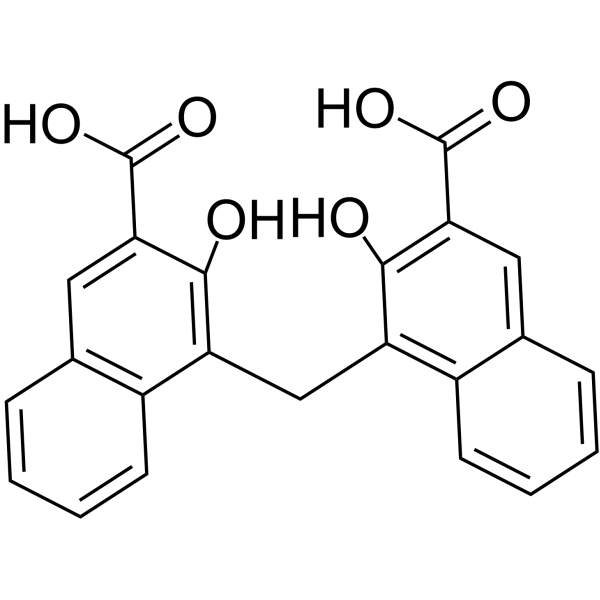
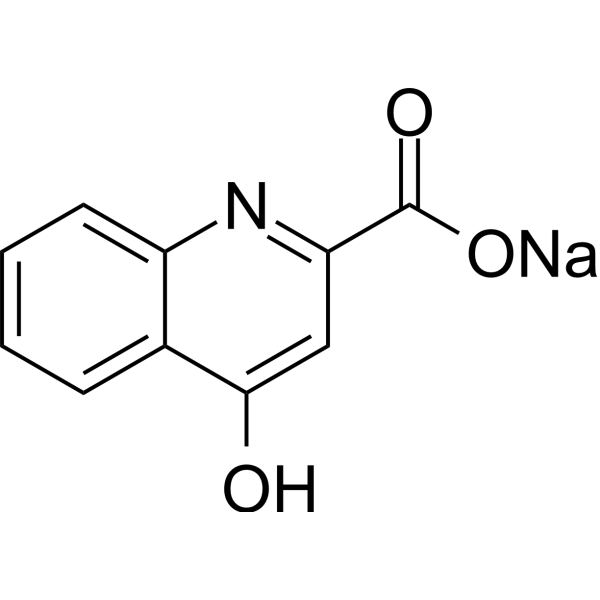

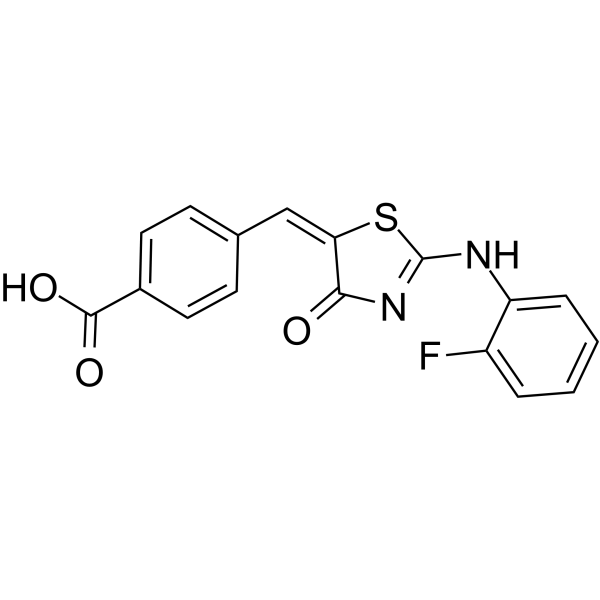


Alle Endogenous Metabolite Isoform-spezifische Produkte anzeigen
MoreAlle Arrestin Isoform-spezifische Produkte anzeigen
MoreAlle DNA/RNA Synthesis Isoform-spezifische Produkte anzeigen
More

Biologische Aktivität
Beschreibung
IC50 & Target
[1]|
Human Endogenous Metabolite |
Cellular Effect
|
Cell Line

|
Type | Value | Description | References |
|---|---|---|---|---|
| HT-29 | EC50 |
23.6 μM
Compound: 3, DHICA
|
Agonist activity at GPR35 in human HT-29 cells measured after 10 mins by dynamic mass redistribution assay
Agonist activity at GPR35 in human HT-29 cells measured after 10 mins by dynamic mass redistribution assay
|
[PMID: 24900508] |
| U2OS | EC50 |
23.2 μM
Compound: 3, DHICA
|
Agonist activity at human GPR35 expressed in U2OS cells coexpressing Gal4-VP16/beta-arrestin fusion protein after 5 hrs by tango beta-arrestin translocation reporter gene assay
Agonist activity at human GPR35 expressed in U2OS cells coexpressing Gal4-VP16/beta-arrestin fusion protein after 5 hrs by tango beta-arrestin translocation reporter gene assay
|
[PMID: 24900508] |
In Vitro
DHICA acts as a GPR35 agonist in native HT-29 colon cancer cells, triggering a DMR response with an EC50 of 23.6 ± 2.5 μM[1].
DHICA (5-50 μM; 24-72 h) inhibits the proliferation of primary normal human keratinocytes in a dose- and time-dependent manner[3].
DHICA (25-50 μM; 24-48 h) dose-dependently promotes the differentiation of primary normal human keratinocytes by upregulating the mRNA and protein expression of early and late differentiation markers[3].
DHICA (5-50 μM; 24-48 h) increases the activity and protein expression levels of the antioxidant enzymes SOD and catalase in primary normal human keratinocytes in a dose- and time-dependent manner[3].
DHICA (5-50 μM) protects primary normal human keratinocytes against UVA-induced cell damage, lipid peroxidation, and apoptosis[3].
MedChemExpress (MCE) has not independently confirmed the accuracy of these methods. They are for reference only.


Chemical Information
-
CAS. Nr. 4790-08-3
-
Appearance Solid
-
Molecular Weight 193.16
-
Formel C9H7NO4
-
Color Gray to brown
-
SMILES
OC(C1=CC2=C(C=C(C(O)=C2)O)N1)=O
-
Synonyms
5,6-Dihydroxyindole-2-carboxylic acid
-
Versand
Room temperature in continental US; may vary elsewhere.
-
Speicherung
Powder -20°C 3 years 4°C 2 years In solvent -80°C 6 months -20°C 1 month


Lösungsmittel & Löslichkeit
In Vitro:
DMSO : 50 mg/mL (258.85 mM; Need ultrasonic; Hygroscopic DMSO has a significant impact on the solubility of product, please use newly opened DMSO)
Please refer to the solubility information to select the appropriate solvent. Once prepared, please aliquot and store the solution to prevent product inactivation from repeated freeze-thaw cycles.
Storage method and period of stock solution: -80°C, 6 months; -20°C, 1 month. When stored at -80°C, please use it within 6 months. When stored at -20°C, please use it within 1 month.
Please refer to the solubility information to select the appropriate solvent. Once prepared, please aliquot and store the solution to prevent product inactivation from repeated freeze-thaw cycles.
Storage method and period of stock solution: -80°C, 6 months; -20°C, 1 month. When stored at -80°C, please use it within 6 months. When stored at -20°C, please use it within 1 month.
Konzentration (Stammlösung) × Volumen (Stammlösung) = Konzentration (Ziellösung) × Volumen (Ziellösung)
In Vivo:
Select the appropriate dissolution method based on your experimental animal and administration route.
- For the following dissolution methods, please ensure to first prepare a clear stock solution using an In Vitro approach and then sequentially add co-solvents:
- To ensure reliable experimental results, the clarified stock solution can be appropriately stored based on storage conditions. As for the working solution for In Vivo experiments, it is recommended to prepare freshly and use it on the same day.
- The percentages shown for the solvents indicate their volumetric ratio in the final prepared solution. If precipitation or phase separation occurs during preparation, heat and/or sonication can be used to aid dissolution.
Add each solvent one by one: 10% DMSO 40% PEG300 5% Tween-80 45% Saline
Solubility: ≥ 2.5 mg/mL (12.94 mM); Clear solution
This protocol yields a clear solution of ≥ 2.5 mg/mL (saturation unknown).
Taking 1 mL working solution as an example, add 100 μL DMSO stock solution (25.0 mg/mL) to 400 μL PEG300, and mix evenly; then add 50 μL Tween-80 and mix evenly; then add 450 μL Saline to adjust the volume to 1 mL.
Preparation of Saline: Dissolve 0.9 g sodium chloride in ddH₂O and dilute to 100 mL to obtain a clear Saline solution.
In Vivo Dissolution Calculator
Please enter the basic information of animal experiments:
-
-
-
-
Recommended: Prepare an additional quantity of animals to account for potential losses during experiments.
Please enter your animal formula composition:
-
%DMSO +
Recommended: Keep the proportion of DMSO in working solution below 2% if your animal is weak.
-
%+
-
+%Tween-80 + +
-
%Saline +
The co-solvents required include: DMSO, . All of co-solvents are available by MedChemExpress (MCE). , Tween 80. All of co-solvents are available by MedChemExpress (MCE).
Working solution concentration: 0.22 mg/mL
Method for preparing stock solution: mg drug dissolved in μL DMSO. Stock solution concentration: mg/mL.
1. Take μL DMSO stock solution;
2. Add μL .
μL , mix evenly;
3. Then add μL Tween 80, mix evenly;
4. Then add μL
Please ensure that the stock solution in the first step is dissolved to a clear state, and add co-solvents in sequence. You can use ultrasonic heating (ultrasonic cleaner, recommended frequency 20-40 kHz), vortexing, etc. to assist dissolution.


Reinheit & Dokumentation
-
Data Sheet (275 KB)
-
SDS (396 KB)
- English - EN (396 KB)
- Français - FR (396 KB)
- Deutsch - DE (396 KB)
- Norwegian - NO (396 KB)
- Español - ES (396 KB)
- Swedish - SV (396 KB)
- Italian - IT (396 KB)
- Korean - KR (396 KB)
- Portuguese - PT (396 KB)
-
Handling Instructions (2659 KB)
Verweise
[1]. Deng H, et al. Synthesis and Agonistic Activity at the GPR35 of 5,6-Dihydroxyindole-2-carboxylic Acid Analogues. ACS Med Chem Lett. 2012;3(7):550-554. Published 2012 Jun 6. [Content Brief]
[2]. Pellosi MC, et al. Effects of the melanin precursor 5,6-dihydroxy-indole-2-carboxylic acid (DHICA) on DNA damage and repair in the presence of reactive oxygen species. Arch Biochem Biophys. 2014 Sep 1;557:55-64. [Content Brief]
[3]. Kovacs D, et al. The eumelanin intermediate 5,6-dihydroxyindole-2-carboxylic acid is a messenger in the cross-talk among epidermal cells. J Invest Dermatol. 2012;132(4):1196-1205. [Content Brief]


Complete Stock Solution Preparation Table
Please refer to the solubility information to select the appropriate solvent. Once prepared, please aliquot and store the solution to prevent product inactivation from repeated freeze-thaw cycles.
Storage method and period of stock solution: -80°C, 6 months; -20°C, 1 month. When stored at -80°C, please use it within 6 months. When stored at -20°C, please use it within 1 month.
| Optional Solvent | Concentration Solvent Mass | 1 mg | 5 mg | 10 mg | 25 mg |
|---|---|---|---|---|---|
| DMSO | 1 mM | 5.1771 mL | 25.8853 mL | 51.7706 mL | 129.4264 mL |
| 5 mM | 1.0354 mL | 5.1771 mL | 10.3541 mL | 25.8853 mL | |
| 10 mM | 0.5177 mL | 2.5885 mL | 5.1771 mL | 12.9426 mL | |
| 15 mM | 0.3451 mL | 1.7257 mL | 3.4514 mL | 8.6284 mL | |
| 20 mM | 0.2589 mL | 1.2943 mL | 2.5885 mL | 6.4713 mL | |
| 25 mM | 0.2071 mL | 1.0354 mL | 2.0708 mL | 5.1771 mL | |
| 30 mM | 0.1726 mL | 0.8628 mL | 1.7257 mL | 4.3142 mL | |
| 40 mM | 0.1294 mL | 0.6471 mL | 1.2943 mL | 3.2357 mL | |
| 50 mM | 0.1035 mL | 0.5177 mL | 1.0354 mL | 2.5885 mL | |
| 60 mM | 0.0863 mL | 0.4314 mL | 0.8628 mL | 2.1571 mL | |
| 80 mM | 0.0647 mL | 0.3236 mL | 0.6471 mL | 1.6178 mL | |
| 100 mM | 0.0518 mL | 0.2589 mL | 0.5177 mL | 1.2943 mL |


DHICA Related Classifications
HY-W018158 Related Classifications
 Powered by Bioz