



Arrestin-3/β-Arrestin 2
Arrestin-3/β-arrestin 2 is a ubiquitously expressed cytosolic adaptor protein that regulates GPCR signaling by limiting heterotrimeric G protein activity, promoting receptor endocytosis, and supporting kinase activation pathways[1]. Mechanistically, β-arrestins act as endocytic adaptors and signaling scaffolds for seven-transmembrane receptors, linking receptor trafficking with alternate downstream signaling pathways[2]. In lysophosphatidic acid receptor models, β-arrestin 2 expression attenuated EGFR transactivation-dependent signaling and promoted a distinct subset of ERK1/2-mediated transcriptional responses[3]. In PAR-2 signaling, β-arrestin 2 mediated delayed receptor internalization and membrane-associated ERK1/2 activation, whereas β-arrestin 1 mediated early internalization and lysosomal receptor degradation[4]. In inflammatory disease models, β-arrestin 2 overexpression decreased TNFα and IL-6 production in fibroblast-like synoviocytes, and β-arrestin 2 knockout mice developed more severe collagen antibody-induced arthritis[5]. Compared with β-arrestin 1, β-arrestin 2 showed opposite regulation of IGF-1R by promoting unstimulated receptor degradation while protecting against agonist-induced degradation[6]. For experimental applications, biased ligands that block G protein activation while promoting β-arrestin binding enable pathway-selective analysis of GPCR signaling[1][7].
References:
- [1]. Jean-Charles PY, et al. G Protein-Coupled Receptor Signaling Through β-Arrestin-Dependent Mechanisms. J Cardiovasc Pharmacol. 2017 Sep;70(3):142-158. [Content Brief]
- [2]. Shenoy SK, et al. β-Arrestin-mediated receptor trafficking and signal transduction. Trends Pharmacol Sci. 2011 Sep;32(9):521-33. [Content Brief]
- [3]. Gesty-Palmer D, et al. beta-Arrestin 2 expression determines the transcriptional response to lysophosphatidic acid stimulation in murine embryo fibroblasts. J Biol Chem. 2005 Sep 16;280(37):32157-67. [Content Brief]
- [4]. Kumar P, et al. Differential effects of β-arrestins on the internalization, desensitization and ERK1/2 activation downstream of protease activated receptor-2[J]. American Journal of Physiology-Cell Physiology, 2007, 293(1): C346-C357.
- [5]. Li P, et al. Increased expression of beta-arrestin 1 and 2 in murine models of rheumatoid arthritis: isoform specific regulation of inflammation. Mol Immunol. 2011 Oct;49(1-2):64-74. [Content Brief]
- [6]. Suleymanova N, et al. Functional antagonism of β-arrestin isoforms balance IGF-1R expression and signalling with distinct cancer-related biological outcomes. Oncogene. 2017 Oct 12;36(41):5734-5744. [Content Brief]
- [7]. Whalen EJ, et al. Therapeutic potential of β-arrestin- and G protein-biased agonists. Trends Mol Med. 2011 Mar;17(3):126-39. [Content Brief]
All Product Categories
-
Arrestin-3/β-Arrestin 2 Related Products (15)
Related Products (15)

- 1
-
Barbadin
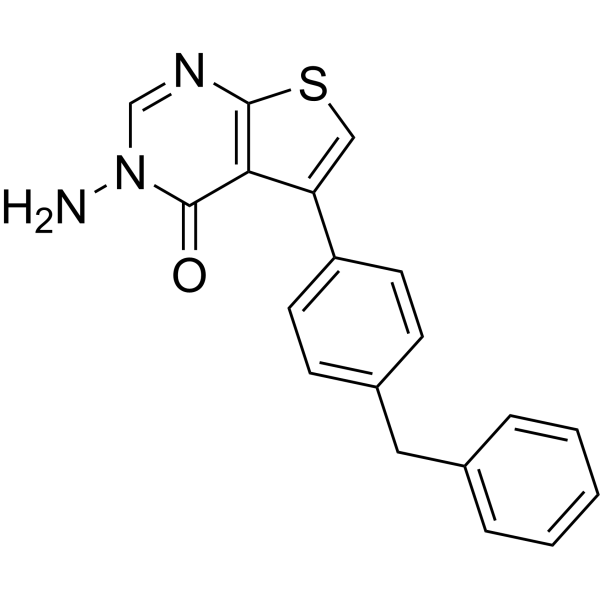 0 ImagesBarbadin is a novel and selective β-arrestin/β2-adaptin interaction inhibitor, has IC50 values of 19.1 μM for β-arrestin1 and 15.6 μM for β-arrestin2. Barbadin blocks agonist-promoted endocytosis of the prototypical β2-adrenergic, V2-vasopressin and angiotensin-II type-1 receptors. Barbadin can induce apoptosis.
-
IHCH-7086
 0 ImagesIHCH-7086 is a blood-brain barrier-permeable, partial β-arrestin-biased agonist of 5-HT2AR with a Ki of 12.59 nM. IHCH-7086 blocks D-lysergic acid diethylamide-induced head-twitch response in mice and alleviates depression-like behaviors in mice subjected to acute restraint stress or injected with Corticosterone (HY-B1618). IHCH-7086 is applicable to research related to depression.
-
IHCH-7113
 0 ImagesIHCH-7113 is a 5-HT2AR agonist with EC50 values of 58.9 nM (Gq bioluminescence resonance energy transfer assay) and 44.7 nM (β-arrestin 2 bioluminescence resonance energy transfer assay). IHCH-7113 activates both Gαq-mediated signaling pathways and β-arrestin 2 recruitment pathways. IHCH-7113 is applicable for research related to depression.
-
Ro 106-9920
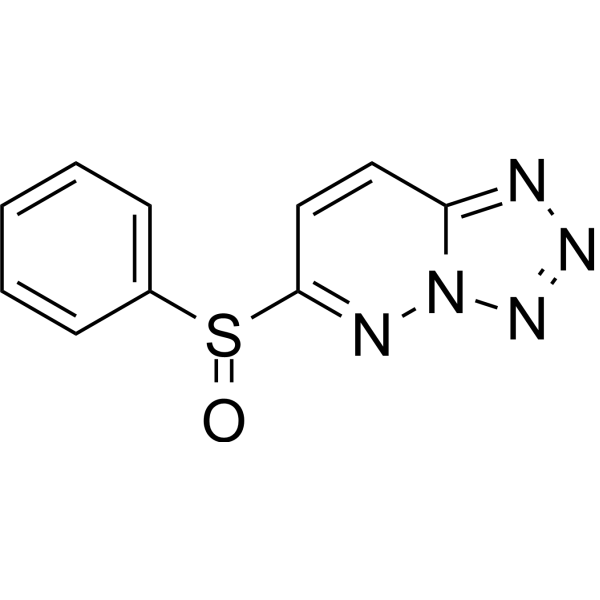 0 ImagesCat. No.: HY-107665CAS No.: 62645-28-7Ro 106-9920 is an orally active NF-κB inhibitor. Ro 106-9920 prevents ubiquitination of IκBα, blocks nuclear translocation of NF-κB, and inhibits NF-κB activation. Ro 106-9920 suppresses TNF-α-induced tissue factor expression and procoagulant activity, enhances TNF-α-mediated cytotoxicity against cancer cells, and eliminates the formation of neutrophil extracellular traps. Ro 106-9920 inhibits NLRP3 inflammasome activation, reduces inflammatory cytokine secretion, decreases myeloperoxidase activity, attenuates renal cell apoptosis, and improves renal function. Ro 106-9920 blocks ANG II (Angiotensin II human) (HY-13948)-induced nuclear localization of p65, internalization of AT1A receptor, colocalization of β-arrestin-2, and expression of COX-2, and alters the formation of β-arrestin endosomes. Ro 106-9920 can be used in research related to non-small cell lung cancer, acute kidney injury, diabetes mellitus, and osteoporosis.
-
RWT9996
 0 ImagesCat. No.: HY-179606CAS No.: 2877694-62-5RWT9996 is a GPR17 antagonist. RWT9996 inhibits GPR17-mediated signal transduction processes, including G protein activation and β-arrestin-2 recruitment. RWT9996 inhibits MDL-29951 (HY-16312)-mediated phosphorylation of ERK1/2, phosphorylation of CREB, and accumulation of inositol phosphate (IP1) in oligodendrocyte precursor cells in vitro. RWT9996 can be used in studies related to demyelinating diseases.
-
Tyr-c[D-Lys-p-F-Phe-Phe-Asp]-D-Pro-NH2
![Tyr-c[D-Lys-p-F-Phe-Phe-Asp]-D-Pro-NH2](https://file.medchemexpress.com/product_pic/hy-p11895.gif "Click to View Tyr-c[D-Lys-p-F-Phe-Phe-Asp]-D-Pro-NH2 Product Detail") 0 ImagesCat. No.: HY-P11895CAS No.: 3081054-21-6Tyr-c [D-Lys-p-F-Phe-Phe-Asp]-D-Pro-NH2 is a multi-opioid receptor (Opioid Receptor) modulator, acting as a MOR/KOR agonist and a DOR antagonist. Tyr-c [D-Lys-p-F-Phe-Phe-Asp]-D-Pro-NH2 activates the G protein-mediated cAMP inhibitory pathway and β-arrestin2 recruitment pathway downstream of MOR, with an EC50 of 159 nM for β-arrestin2 recruitment, an EC50 of 1.1 nM for MOR-mediated calcium mobilization, and an EC50 of 397 nM for KOR. Tyr-c [D-Lys-p-F-Phe-Phe-Asp]-D-Pro-NH2 exhibits potent analgesic activity in vivo. It can be used in studies related to opioid receptor function and analgesia.
0 ImagesCat. No.: HY-P11895CAS No.: 3081054-21-6Tyr-c [D-Lys-p-F-Phe-Phe-Asp]-D-Pro-NH2 is a multi-opioid receptor (Opioid Receptor) modulator, acting as a MOR/KOR agonist and a DOR antagonist. Tyr-c [D-Lys-p-F-Phe-Phe-Asp]-D-Pro-NH2 activates the G protein-mediated cAMP inhibitory pathway and β-arrestin2 recruitment pathway downstream of MOR, with an EC50 of 159 nM for β-arrestin2 recruitment, an EC50 of 1.1 nM for MOR-mediated calcium mobilization, and an EC50 of 397 nM for KOR. Tyr-c [D-Lys-p-F-Phe-Phe-Asp]-D-Pro-NH2 exhibits potent analgesic activity in vivo. It can be used in studies related to opioid receptor function and analgesia.
-
B-007
 0 ImagesCat. No.: HY-183777B-007 is an AplnR agonist with G protein-biased signaling (EC50 = 11.6 nM). B-007 activates the G protein pathway while abolishing β-arrestin1 and β-arrestin2 signaling. B-007 serves as a scaffold for development of G protein-biased apelin receptor agonists. B-007 can be used for the research of heart failure.
-
DOR agonist 3
 0 ImagesCat. No.: HY-175366CAS No.: 939956-07-7DOR agonist 3 (Compound 10) is a δ-opioid receptor (DOR)-selective positive allosteric modulator. DOR agonist 3 enhances G protein signaling while reducing β-arrestin2 recruitment. DOR agonist 3 is promising for research of chronic pain and depression.

-
GEP44
 0 ImagesCat. No.: HY-P11043GEP44 is a peptide biased triple agonist targeting Glucagon-like peptide 1 receptor (GLP-1R), neuropeptide Y1 Receptor (Y1-R), and neuropeptide Y2 Receptor (Y2-R). GEP44 induces Y1-R antagonist-controlled, GLP-1R-dependent stimulation of insulin secretion in both rat and human pancreatic islets by counteracting effects of Y1-R and GLP-1R agonism. GEP44 promotes insulin-independent Y1-R-mediated glucose uptake in muscle tissue and significantly reduces food intake and body weight in diet-induced obese rat models. GEP44 can be used for obesity and type 2 diabetes mellitus research.
-
ID110460002
 0 ImagesCat. No.: HY-W414109CAS No.: 1172882-21-1ID110460002 possesses both full agonist activity at the μ-opioid receptor (OPRM) and agonist activity at the δ-opioid receptor (OPRD). ID110460002 acts as a potent agonist for the G protein pathways of both receptors, but exhibits only very weak partial agonist activity towards the β-arrestin-2 pathway. The agonistic potency of ID110460002 at OPRM has extremely high intrinsic activity and is unaffected by reduced receptor expression levels, while its potency at OPRD depends on receptor expression levels. ID110460002 displays tissue- or organ-dependent properties, and serves as a critical compound for investigating pain mechanisms and analgesia.
-
GPR183 inverse agonist-1
 0 ImagesCat. No.: HY-175306CAS No.: 2380033-51-0GPR183 inverse agonist-1 (Compound 78) is a GPR183 inverse agonist. GPR183 inverse agonist-1 inhibits the GPR183-mediated Gi activation and β-arrestin2 recruitment, and blocks PBMC migration. GPR183 inverse agonist-1 can be used for inflammatory, autoimmune and neoplastic disorders research.
-
Arrestin-3 modulator-1
 0 ImagesCat. No.: HY-175178CAS No.: 1214645-87-0Arrestin-3 modulator-1 (Compound LSH-3) is an arrestin-3 modulator. Arrestin-3 modulator-1 binds arrestin-3 at the interdomain interface. Arrestin-3 modulator-1 enhances recruitment of arrestin-3 to phosphorylation-deficient β2AR in cells with increase of FRET levels. Arrestin-3 modulator-1 can be used for congenital disorders like retinal degeneration, hyperthyroidism and obesity research.
-
SLW131
 0 ImagesSLW131 is a CCR7 antagonist with a Ki value of 9.85 nM. SLW131 inhibits CCL19-induced Go protein activation with an IC50 of 29.4 μM, and suppresses β-arrestin2 recruitment with an IC50 of 6.0 μM. SLW131 serves as a probe for investigating the biological functions of CCR7 in cells. SLW131 is applicable to research related to rheumatoid arthritis.
-
BMS-986331
 0 ImagesBMS-986331 is an orally active selective N-Formyl Peptide Receptor 2 (FPR2) agonist with an EC50 of 0.5 nM in humans and 1 nM in rats. BMS-986331 activates Gαi2, GαoA, Gα12, Gα13 signaling pathways, recruits β-arrestin1 and β-arrestin2, and inhibits downstream cAMP. BMS-986331 induces the expression and release of the pro-resolution cytokine IL-10. BMS-986331 improves cardiac structure and function in a rat model of heart failure induced by permanent coronary artery occlusion. BMS-986331 can be used for the research of heart failure.
- 1



