



Melimine
Melimine is an antimicrobial peptide with broad-spectrum antimicrobial activity against Gram-negative/Gram-positive bacteria, fungi and protozoa. Melimine neutralizes endotoxin activity by interacting with the phosphate groups of lipid A, depolarizes and permeabilizes the cytoplasmic membrane of *Pseudomonas aeruginosa*, and induces bacterial lysis. Melimine exerts additive antiviral effects against H1N1 and MHV-1 when used in combination with RK610. Melimine retains its antimicrobial activity when conjugated to polymer and titanium surfaces. Melimine can be used in infection-related research.
For research use only. We do not sell to patients.
- CAS No.: 709611-59-6
- Formula: C158H290N74O35
- Molecular Weight:3786.47
-
Storage:
Please store the product under the recommended conditions in the Certificate of Analysis.

To place orders, for customer services and technical support, please contact: MedChemExpress USA
Tel: 609-228-6898 E-mail: [email protected] [email protected]


-
 Biological Activity
-
Chemical Information
- Protocols
- Purity & Documentation
- References
-
 Help & FAQs




Biological Activity
Description
In Vitro
Melimine inhibits and kills the growth of Pseudomonas aeruginosa strains 6206, 6294, Paer1 and ATCC 19660, with MIC values ranging from 66 to 132 nM and MBC values ranging from 132 to 528 nM[3].
Melimine dose-dependently neutralizes LPS of Pseudomonas aeruginosa, with a neutralization rate of 71% at 1×100 MIC and 82% at 2×100 MIC[3].
Melimine (66-132 nM) rapidly depolarizes the cytoplasmic membrane of Pseudomonas aeruginosa 6294 within 30 seconds; it permeabilizes the cytoplasmic membrane of Pseudomonas aeruginosa 6294, allowing Sytox Green to start entering the cells at 5 minutes; it induces concentration-dependent release of DNA/RNA from Pseudomonas aeruginosa 6294; and it lyses Pseudomonas aeruginosa 6294 in a concentration-dependent manner[3].
Melimine (66 nM; 30-150 min) permeabilizes the cell membrane of Pseudomonas aeruginosa strain 6294 in 74.8% of cells within 30 minutes[3].
Melimine (66-132 nM; 2-10 min) releases 75% of total cellular ATP at 66 nM and 92% of total cellular ATP at 132 nM from Pseudomonas aeruginosa 6294 within 2 minutes, while the viable cell count decreases by >3.0 log10[3].
MedChemExpress (MCE) has not independently confirmed the accuracy of these methods. They are for reference only.
-
Cell Line:A9 cells, MDCK cells
-
Concentration:62.5 μM (A9 cells alone)
62.5 μM + 1.09 μM RK610 (A9 cells combined)
31.25 μM (MDCK cells alone)
31.25 μM + 1 μM RK610 (MDCK cells combined) -
Incubation Time:24 h
-
Result:Resulted in 6.4% cell viability in A9 cells when used alone at 62.5 μM, indicating strong cytotoxicity.
Resulted in 5.9% cell viability in A9 cells when combined with 1.09 μM RK610, indicating retained strong cytotoxicity.
Resulted in 96.9% cell viability in MDCK cells when used alone at 31.25 μM, indicating no cytotoxicity.
Resulted in 100% cell viability in MDCK cells when combined with 1 μM RK610, indicating no cytotoxicity.
In Vivo
MedChemExpress (MCE) has not independently confirmed the accuracy of these methods. They are for reference only.


Chemical Information
-
CAS No. 709611-59-6
-
Molecular Weight 3786.47
-
Formula C158H290N74O35
-
Sequence
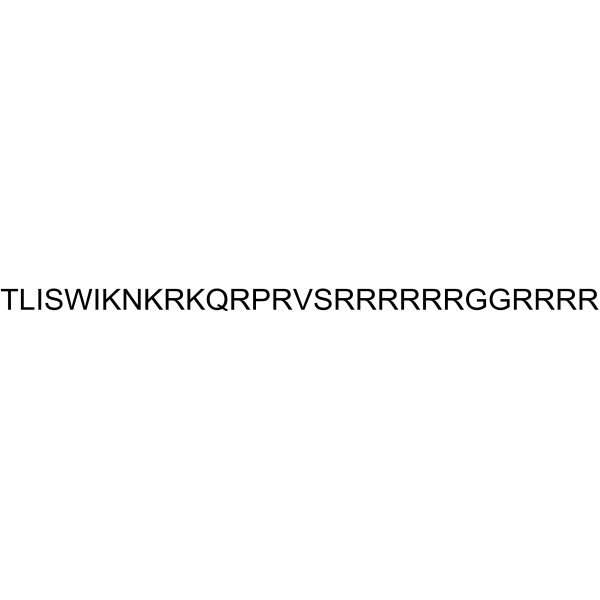
Thr-Leu-Ile-Ser-Trp-Ile-Lys-Asn-Lys-Arg-Lys-Gln-Arg-Pro-Arg-Val-Ser-Arg-Arg-Arg-Arg-Arg-Arg-Gly-Gly-Arg-Arg-Arg-Arg
-
Sequence Shortening
TLISWIKNKRKQRPRVSRRRRRRGGRRRR
-
Shipping
Room temperature in continental US; may vary elsewhere.
-
Storage
Please store the product under the recommended conditions in the Certificate of Analysis.


Purity & Documentation
References

Calculators
Concentration (start) × Volume (start) = Concentration (final) × Volume (final)


Melimine Related Classifications
HY-P5552 Related Classifications
 Powered by Bioz