



NCS-382
Based on 1 publication(s) in Google Scholar
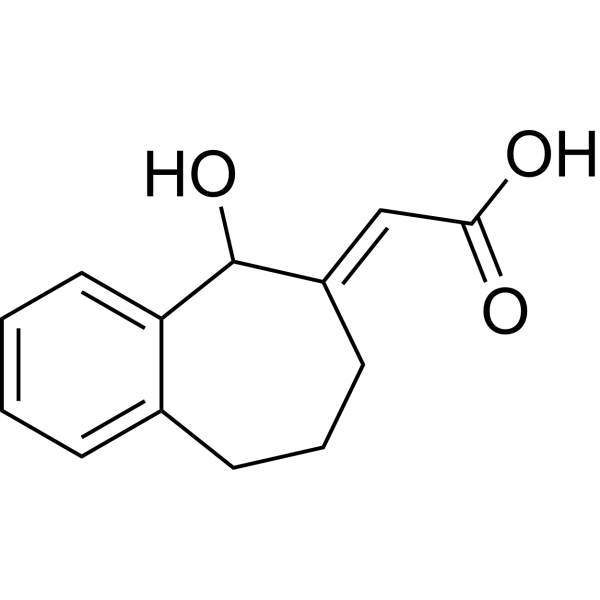
NCS-382 is a potent GABA receptor antagonist and also a GHBR receptor antagonist. NCS-382 has anticonvulsant and antisedative activity. NCS-382 is used in the related research of hereditary nervous system diseases.
For research use only. We do not sell to patients.
- CAS No.: 520505-01-5
- Formula: C13H14O3
- Molecular Weight:218.25
-
Storage:
Please store the product under the recommended conditions in the Certificate of Analysis.

To place orders, for customer services and technical support, please contact: MedChemExpress USA
Tel: 609-228-6898 E-mail: [email protected] [email protected]


-
 Biological Activity
-
Chemical Information
-
Solvent & Solubility
- Purity & Documentation
- References
-
 Help & FAQs


Publications Citing Use of MedChemExpress (MCE) NCS-382
More

Biological Activity
Description
In Vitro
NCS-382 (0.5 nM, 24 h) shows no capacity for inhibition of microsomal CYPs (CYP1A2, 2B6, 2C8, 2C9, 2C19, 2D6 and 3A4) and minimal potential for activation of xenobiotic nuclear receptors in HepG2 cells[2]. NCS-382 (0.01-1000 μM, 24 h) shows low probability of cellular toxicity in HepG2 cells[2]. NCS-382 is a GHBR antagonist with IC50s of 134.1 nM and 201.3 nM in isolated rat striatum and hippocampus membranes, respectively[4].
MedChemExpress (MCE) has not independently confirmed the accuracy of these methods. They are for reference only.
-
Cell Line:HepG2 cells
-
Concentration:0.01-1000 μM
-
Incubation Time:24 h
-
Result:Reduced HepG2 cell viability at a concentration of 1 mM, and this same concentration did not induce apoptosis or cytotoxicity in HepG2 cells.
In Vivo
At a dose of 500 mg/kg, it may preferentially reside in the liver after intraperitoneal administration in mouse model[1].
At a dose of 500 mg/kg, brain permeability improves, as evidenced by an increase in brain serum ratio in mouse model[1].
NCS-382 (0.83-2.08 mmol/kg; i.p.) reduces GHB-induced increases in the time mice spent immobile in the forced swim test, indicating anti-sedative activity, when administered at doses of 1.66 and 2.08 mmol/kg in mice model[3].
NCS-382 (2.3 mmol/kg; i.p.) decreases spike and wave discharges in audiogenic seizure-susceptible Swiss Rb mice, as well as a rat model of petit mal epilepsy [4].
Pharmacokinetic analysis of mouse serum and tissue at a dose of 100 mg/kg [1]
| Tissue | Dose (mg/kg) | AUC (μg h/L) | Cmax (μmol/L) | T1/2 (h) |
| Serum | 100 | 119 | 241 | 0.243 |
| Brain | 100 | 139 | 60 | 0.967 |
| Liver | 100 | 1150 | 1695 | / |
| Kidney | 100 | 24.5 | 23.6 | 0.308 |
Pharmacokinetic Analysis[1]
| Tissue | Dose (mg/kg) | AUC (μg h/L) | Cmax (μmol/L) | T1/2 (h) |
| Serum | 300 | 436 | 374 | 0.468 |
| Brain | 300 | 313 | 141 | 0.883 |
| Liver | 300 | / | / | / |
| Kidney | 300 | / | / | / |
Pharmacokinetic Analysis[1]
| Tissue | Dose (mg/kg) | AUC (μg h/L) | Cmax (μmol/L) | T1/2 (h) |
| Serum | 500 | 717 | 451 | 0.683 |
| Brain | 500 | 1280 | 530 | 0.761 |
| Liver | 500 | / | / | / |
| Kidney | 500 | / | / | / |
MedChemExpress (MCE) has not independently confirmed the accuracy of these methods. They are for reference only.
-
Animal Model:GBL induced mouse model[1]
-
Dosage:300 mg/kg(Combined with diclofenac (25 mg/kg))
-
Administration:Intraperitoneal injection (i.p.), Thirty minutes later, mice were given an i.p. injection of GBL (100 mg/kg diluted in PBS)
-
Result:In the presence of diclofenac, it was highly protective against GBL mediated responses.
-
Animal Model:GBL induced mouse model[3]
-
Dosage:0.83, 1.25, 1.66, 2.08mmol/kg
-
Administration:Intraperitoneal injection (i.p.), 30 min before the test
-
Result:At a dosage of 2.08 mmol/kg, completely blocked the effect of GHB when administered at 3.18 mmol/kg


Chemical Information
-
CAS No. 520505-01-5
-
Molecular Weight 218.25
-
Formula C13H14O3
-
SMILES
O=C(O)/C=C1CCCC2=CC=CC=C2C\1O
-
Shipping
Room temperature in continental US; may vary elsewhere.
-
Storage
Please store the product under the recommended conditions in the Certificate of Analysis.


Publications (1)
-
Journal Impact Factor
-
Most Recent
-
J Neuroinflammation
Sleep deprivation induces anxiety-like behaviors through IL-6 driven astrocyte-GABAergic neuron crosstalk in the PAG-ACC circuit. [Abstract]2026 May 22. PMID: 42174628


Solvent & Solubility
In Vivo:
The following protocol is derived from the literature and is for reference only. It is recommended to first try a small sample.
In Vivo Dissolution Calculator
Please enter the basic information of animal experiments:
-
-
-
-
Recommended: Prepare an additional quantity of animals to account for potential losses during experiments.
Working solution concentration: 0.22 mg/mL


Purity & Documentation
References
[1]. Ainslie GR, et al. A pharmacokinetic evaluation and metabolite identification of the GHB receptor antagonist NCS-382 in mouse informs novel therapeutic strategies for the treatment of GHB intoxication. Pharmacol Res Perspect. 2016 Oct 18;4(6):e00265. [Content Brief]
[2]. Vogel KR, et al. In vitro toxicological evaluation of NCS-382, a high-affinity antagonist of γ-hydroxybutyrate (GHB) binding. Toxicol In Vitro. 2017 Apr;40:196-202 [Content Brief]
[3]. Schmidt C, et al. Anti-sedative and anti-cataleptic properties of NCS-382, a gamma-hydroxybutyrate receptor antagonist. Eur J Pharmacol. 1991 Oct 22;203(3):393-7. [Content Brief]
[4]. Maitre M, Hechler V, Vayer P, Gobaille S, Cash CD, Schmitt M, Bourguignon JJ. A specific gamma-hydroxybutyrate receptor ligand possesses both antagonistic and anticonvulsant properties. J Pharmacol Exp Ther. 1990 Nov;255(2):657-63. [Content Brief]

Calculators
Concentration (start) × Volume (start) = Concentration (final) × Volume (final)


NCS-382 Related Classifications
HY-101207 Related Classifications
 Powered by Bioz