



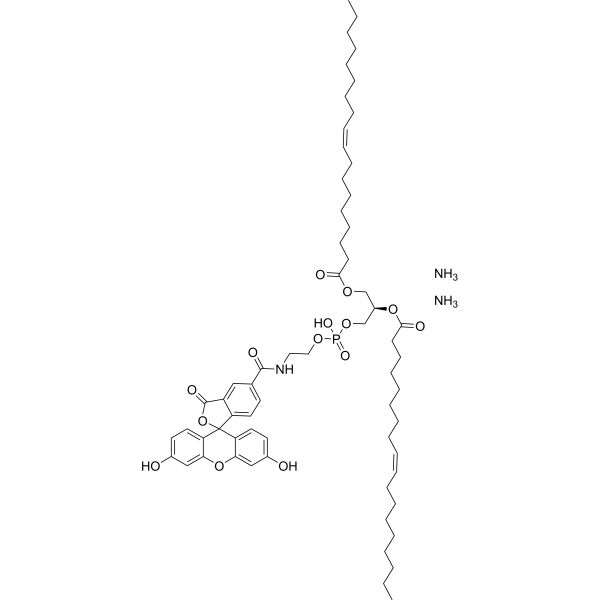
18:1 PE CF
Based on 1 publication(s) in Google Scholar
18:1 PE CF (1,2-dioleoyl-sn-glycero-3-phosphoethanolamine-N-(carboxyfluorescein) (ammonium)) is a pH-sensitive fluorescent indicator. 18:1 PE CF exhibits changes in fluorescence intensity in response to pH variations and reflects the electrostatic states of cationic liposomes and lipoplexes. 18:1 PE CF supports real-time visualization of pH distribution and membrane deformation in giant unilamellar vesicles and is suitable for steady-state fluorescence testing in large unilamellar vesicle membranes. 18:1 PE CF is capable of monitoring the surface electrical potential of cationic liposomes and lipoplexes and can effectively label lipid bilayers and nanomicelles. 18:1 PE CF can be used for the research of the investigation of lung cancer (Ex = 495 nm; Em = 520 nm).
For research use only. We do not sell to patients.
- CAS No.: 384832-91-1
- Formula: C62H94N3O14P
- Molecular Weight:1136.40
-
Storage:
Please store the product under the recommended conditions in the Certificate of Analysis.

To place orders, for customer services and technical support, please contact: MedChemExpress USA
Tel: 609-228-6898 E-mail: [email protected] [email protected]


-
 Biological Activity
-
Chemical Information
- Purity & Documentation
- References
-
 Help & FAQs


Publications Citing Use of MedChemExpress (MCE) 18:1 PE CF
More

Biological Activity
Description
In Vitro
18:1 PE CF (1% (mol)) acts as a pH-sensitive fluorescent marker for EYPC-PS (90:10 mol/mol) LUVs, with a steep fluorescence increase around pH 7.5, enabling visualization of membrane pH changes starting from neutral conditions[1].
18:1 PE CF (1% (mol); 4 s) enables direct visualization of spatiotemporal membrane pH profiles on EYPC-PS (90:10 mol/mol) GUVs during and after local NaOH microinjection, correlating pH changes with reversible membrane deformation toward the injection site over a 4 s injection period[1].
18:1 PE CF (Total lipid-to-fluorophore mole ratio of 400; 0.04 mM; ~5 s) labels cationic LUV (DOTAP, DMRIE, DOSPA with/without cholesterol or DOPE helper lipids) and neutral DOPE/DOPC LUV to measure electrical surface potential and surface pH[2].
18:1 PE CF (0.04 mM; DNA-/L+ mole ratios of 0-2.0; 5 min) monitors DNA-induced electrostatic changes in cationic LUV lipoplexes, showing a DNA-/L+ ratio-dependent reduction in fluorescence intensity that plateaus above a ratio of 1.0[2].
18:1 PE CF (1% molar ratio; 1-24 h) enables sensitive detection of time-dependent liposome binding to primary human aortic smooth muscle cells[3].
18:1 PE CF enables fluorescence visualization of spherical silica colloidal particles functionalized with surface-bound DNA linkers[4].
Free 18:1 PE CF (0.5 μg/mL; 4 h) shows significantly lower cellular uptake in CD133+ and CD133− A549 and A431 human lung cancer cells compared to 18:1 PE CF-labeled targeted and non-targeted gefitinib nanomicelles, while uptake of 18:1 PE CF via targeted nanomicelles is significantly higher than via non-targeted nanomicelles in CD133+ cell populations, and not significantly different in CD133− cell populations[5].
MedChemExpress (MCE) has not independently confirmed the accuracy of these methods. They are for reference only.


Chemical Information
-
CAS No. 384832-91-1
-
Molecular Weight 1136.40
-
Formula C62H94N3O14P
-
SMILES
O=C1OC2(C3=CC=C(O)C=C3OC4=CC(O)=CC=C42)C5=CC=C(C(NCCOP(OC[C@H](OC(CCCCCCC/C=C\CCCCCCCC)=O)COC(CCCCCCC/C=C\CCCCCCCC)=O)(O)=O)=O)C=C51.N.N
-
Synonyms
1,2-dioleoyl-sn-glycero-3-phosphoethanolamine-N-(carboxyfluorescein) ammonium
-
Shipping
Room temperature in continental US; may vary elsewhere.
-
Storage
Please store the product under the recommended conditions in the Certificate of Analysis.


Publications (1)
-
Journal Impact Factor
-
Most Recent


Purity & Documentation
References
[2]. Hirsch-Lerner D, et al. Effect of "helper lipid" on lipoplex electrostatics. Biochim Biophys Acta. 2005;1714(2):71-84. [Content Brief]
[3]. Wu Y, et al. The promoted delivery of RRM2 siRNA to vascular smooth muscle cells through liposome-polycation-DNA complex conjugated with cell penetrating peptides. Biomed Pharmacother. 2018;103:982-988. [Content Brief]
[4]. Chakraborty I, et al. Colloidal joints with designed motion range and tunable joint flexibility. Nanoscale. 2017;9(23):7814-7821. [Content Brief]
[5]. Huang X, et al. Gefitinib-loaded DSPE-PEG2000 nanomicelles with CD133 aptamers target lung cancer stem cells. World J Surg Oncol. 2017;15(1):167. Published 2017 Aug 30. [Content Brief]

Calculators
Concentration (start) × Volume (start) = Concentration (final) × Volume (final)


18:1 PE CF Related Classifications
HY-D1556 Related Classifications
 Powered by Bioz
Keywords
- 18:1 PE CF
- 384832-91-1
- 1,2-dioleoyl-sn-glycero-3-phosphoethanolamine-N-(carboxyfluorescein)
- Fluorescent Dye
- giant unilamellar vesicle membranes
- large unilamellar vesicle membranes
- pH-sensitive fluorescent indicator
- lung cancer
- phosphatidylethanolamine lipid analog
- cationic liposomes
- lipid bilayers
- nanomicelles
- intimal hyperplasia
- lipoplexes
- Inhibitor
- inhibitor
- inhibit