



Xenin

Based on 1 Customer Validation
Xenin is a 25-amino acid peptide initially isolated from human gastric mucosa. Xenin is a gut hormone that can reduce food intake.
Para uso exclusivo en investigación. No vendemos a pacientes.
- Pureza: 99.98%
- No. CAS: 144092-28-4
- Fòrmula: C139H224N38O32S
- Peso molecular:2971.57
-
Almacenamiento:
Sealed storage, away from moisture and light, under nitrogen.
Powder -80°C, 2 years , -20°C, 1 year* In solvent : -80°C, 6 months; -20°C, 1 month (sealed storage, away from moisture and light, under nitrogen)

To place orders, for customer services and technical support, please contact: MedChemExpress USA
Tel: 609-228-6898 E-mail: [email protected] [email protected]


-
 Actividad biológica
-
Chemical Information
-
Solvente y solubilidad
- Protocolo
- Pureza y Documentación
- Referencias
-
 Help & FAQs


Ver todos los productos específicos de isoformas Endogenous Metabolite
More

Actividad biológica
Descripciòn
In Vitro
Xenin is abundantly expressed in gastric, duodenal, and jejunal mucosa, and is found at lower levels in the pancreas. Xenin is released into the circulation postprandially and has been reported to stimulatepancreatic endocrine and exocrine secretion, inhibit gastrin secretion, and influence gastrointestinal motility. Xenin is highly homologous to neurotensin. Xenin and neurotensin are reported to have similar biological effects[1].
MedChemExpress (MCE) has not independently confirmed the accuracy of these methods. They are for reference only.
In Vivo
MedChemExpress (MCE) has not independently confirmed the accuracy of these methods. They are for reference only.


Chemical Information
-
No. CAS 144092-28-4
-
Appearance Solid
-
Peso molecular 2971.57
-
Fòrmula C139H224N38O32S
-
Color White to off-white
-
Sequence
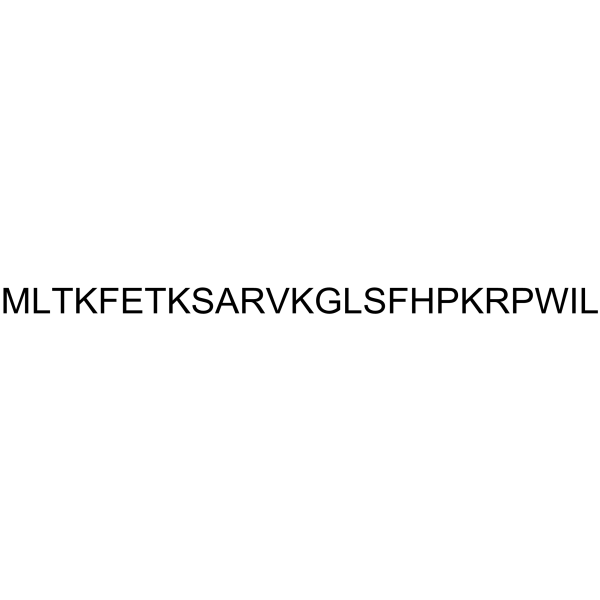
Met-Leu-Thr-Lys-Phe-Glu-Thr-Lys-Ser-Ala-Arg-Val-Lys-Gly-Leu-Ser-Phe-His-Pro-Lys-Arg-Pro-Trp-Ile-Leu
-
Sequence Shortening
MLTKFETKSARVKGLSFHPKRPWIL
-
Structure Classification
-
Initial Source
-
Envío
Room temperature in continental US; may vary elsewhere.
-
Almacenamiento
Sealed storage, away from moisture and light, under nitrogen
Powder -80°C 2 years -20°C 1 year * In solvent : -80°C, 6 months; -20°C, 1 month (sealed storage, away from moisture and light, under nitrogen)


Solvente y solubilidad
In Vitro
H2O
Peptide Solubility and Storage Guidelines:
1. Calculate the length of the peptide.
2. Calculate the overall charge of the entire peptide according to the following table:
| Contents | Assign value | |
|---|---|---|
| Acidic amino acid | Asp (D), Glu (E), and the C-terminal -COOH. | -1 |
| Basic amino acid | Arg (R), Lys (K), His (H), and the N-terminal -NH2 | +1 |
| Neutral amino acid | Gly (G), Ala (A), Leu (L), Ile (I), Val (V), Cys (C), Met (M), Thr (T), Ser (S), Phe (F), Tyr (Y), Trp (W), Pro (P), Asn (N), Gln (Q) | 0 |
3. Recommended solution:
| Overall charge of peptide | Details |
|---|---|
| Negative (<0) |
1. Try to dissolve the peptide in water first. 2. If water fails, add NH4OH (<50 μL). 3. If the peptide still does not dissolve, add DMSO (50-100 μL) to solubilize the peptide. |
| Positive (>0) |
1. Try to dissolve the peptide in water first. 2. If water fails, try dissolving the peptide in a 10%-30% acetic acid solution. 3. If the peptide still does not dissolve, try dissolving the peptide in a small amount of DMSO. |
| Zero (=0) |
1. Try to dissolve the peptide in organic solvent (acetonitrile, methanol, etc.) first. 2. For very hydrophobic peptides, try dissolving the peptide in a small amount of DMSO, and then dilute the solution with water to the desired concentration. |

Protocolo
Animal Administration[2]
Mice: Mice (wild-type and ob/ob mice) are fasted overnight (1800–1000 h) and injected with xenin intracerebroventricularly (0.1, 1, or 5 μg) or intraperitoneally (0.5, 5, 15, or 50 μg/g body wt) at 1000 h. To compare the feeding-suppressing effect between xenin and neurotensin, equimolar amounts (16.5 nmol) of xenin (50 μg/g body wt) or neurotensin (28 μg/g body) are injected intraperitoneally after an overnight fast. Control mice receive either intracerebroventricular injection of aCSF or intraperitoneal injection of saline. Preweighed food is provided to mice immediately after the injection. Cumulative food intake is measured at time points indicated in each figure up to 24 h after injection[2].
MedChemExpress (MCE) has not independently confirmed the accuracy of these methods. They are for reference only.


Pureza y Documentación
-
Ficha de datos (263 KB)
-
SDS (252 KB)
- English - EN (252 KB)
- Français - FR (252 KB)
- Deutsch - DE (252 KB)
- Norwegian - NO (252 KB)
- Español - ES (252 KB)
- Swedish - SV (252 KB)
- Italian - IT (252 KB)
- Korean - KR (252 KB)
- Portuguese - PT (252 KB)
-
Instrucciones de manejo (2659 KB)
Referencias
[1]. Cooke JH, et al. Peripheral and central administration of xenin and neurotensin suppress food intake in rodents. Obesity (Silver Spring). 2009 Jun;17(6):1135-43. [Content Brief]
[2]. Leckstrom A, et al. Xenin, a gastrointestinal peptide, regulates feeding independent of the melanocortinsignaling pathway. Diabetes. 2009 Jan;58(1):87-94. [Content Brief]
[3]. Kim ER, et al. Xenin delays gastric emptying rate and activates the brainstem in mice. Neurosci Lett. 2010 Aug 30;481(1):59-63. [Content Brief]

Calculators
Concentration (start) × Volume (start) = Concentration (final) × Volume (final)


Xenin Related Classifications
HY-P0259 Related Classifications
 Powered by Bioz