



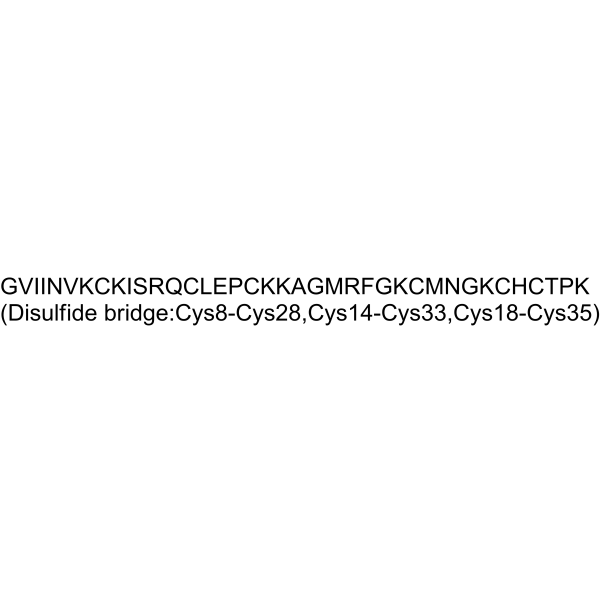
OSK-1
OSK-1 is a potent Kv channel blocker with IC50s of of 0.6 nM, 5.4 nM, 0.014 nM for Kv1.1, Kv1.2 and Kv1.3, respectively. OSK1 is a moderate blocker of Ca2+-activated KCa3.1 channel with an IC50 of 225 nM. OSK-1 belongs to α-KTx3 toxins and is used as a immunosuppressive agent.
Para uso exclusivo en investigación. No vendemos a pacientes.
- No. CAS: 183815-75-0
- Fòrmula: C177H300N56O46S8
- Peso molecular:4205.17
-
Almacenamiento:
Please store the product under the recommended conditions in the Certificate of Analysis.

To place orders, for customer services and technical support, please contact: MedChemExpress USA
Tel: 609-228-6898 E-mail: [email protected] [email protected]


-
 Actividad biológica
-
Chemical Information
-
Solvente y solubilidad
- Pureza y Documentación
- Referencias
-
 Help & FAQs




Actividad biológica
Descripciòn
IC50 & Target
IC50: 0.6 nM (Kv1.1), 5.4 nM (Kv1.2), 0.014 nM (Kv1.3) and 225 nM (KCa3.1)[1]
In Vitro
OSK1 has no effect on KCa2.1, KCa2.2, KCa2.3 and KCa1.1 channels when in the micromolar concentration range, whereas it shows a moderate activity on KCa3.1 channel (also referred to as IK1 or SK4) with an IC50 value of 225 nM[1].
MedChemExpress (MCE) has not independently confirmed the accuracy of these methods. They are for reference only.
In Vivo
MedChemExpress (MCE) has not independently confirmed the accuracy of these methods. They are for reference only.


Chemical Information
-
No. CAS 183815-75-0
-
Peso molecular 4205.17
-
Fòrmula C177H300N56O46S8
-
Envío
Room temperature in continental US; may vary elsewhere.
-
Almacenamiento
Please store the product under the recommended conditions in the Certificate of Analysis.


Solvente y solubilidad
In Vitro
H2O
Peptide Solubility and Storage Guidelines:
1. Calculate the length of the peptide.
2. Calculate the overall charge of the entire peptide according to the following table:
| Contents | Assign value | |
|---|---|---|
| Acidic amino acid | Asp (D), Glu (E), and the C-terminal -COOH. | -1 |
| Basic amino acid | Arg (R), Lys (K), His (H), and the N-terminal -NH2 | +1 |
| Neutral amino acid | Gly (G), Ala (A), Leu (L), Ile (I), Val (V), Cys (C), Met (M), Thr (T), Ser (S), Phe (F), Tyr (Y), Trp (W), Pro (P), Asn (N), Gln (Q) | 0 |
3. Recommended solution:
| Overall charge of peptide | Details |
|---|---|
| Negative (<0) |
1. Try to dissolve the peptide in water first. 2. If water fails, add NH4OH (<50 μL). 3. If the peptide still does not dissolve, add DMSO (50-100 μL) to solubilize the peptide. |
| Positive (>0) |
1. Try to dissolve the peptide in water first. 2. If water fails, try dissolving the peptide in a 10%-30% acetic acid solution. 3. If the peptide still does not dissolve, try dissolving the peptide in a small amount of DMSO. |
| Zero (=0) |
1. Try to dissolve the peptide in organic solvent (acetonitrile, methanol, etc.) first. 2. For very hydrophobic peptides, try dissolving the peptide in a small amount of DMSO, and then dilute the solution with water to the desired concentration. |


Pureza y Documentación
Referencias

Calculators
Concentration (start) × Volume (start) = Concentration (final) × Volume (final)


OSK-1 Related Classifications
HY-P3316 Related Classifications
 Powered by Bioz