



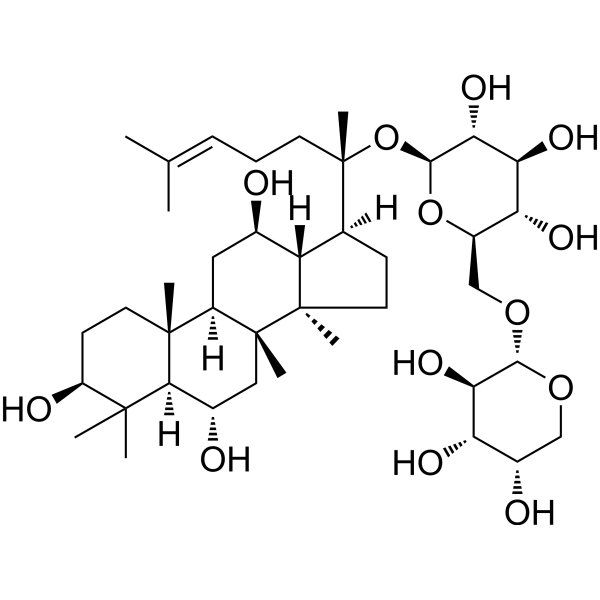
Ginsenoside F3

Based on 1 Customer Validation
Ginsenoside F3 is a saponin extracted from the leaves of Panax ginseng with immunoenhancing and antitumor immunostimulatory activities. Ginsenoside F3 upregulates RIPOR2 with a Kd value of 3.77 μM. Ginsenoside F3 enhances NF‑κB activation, upregulates T‑bet and downregulates GATA‑3, increases the production of IL‑2 and IFN‑γ, decreases the production of IL‑4 and IL‑10, reverses CD8⁺ T‑cell exhaustion, restores cytokine secretion, and enhances antitumor immunity in a mouse non‑small cell lung cancer model. Ginsenoside F3 can be used for the research of non-small cell lung cancer.
For research use only. We do not sell to patients.
- Purity : 99.84%
- CAS No.: 62025-50-7
- Formula: C41H70O13
- Molecular Weight:770.99
-
Storage:Powder -20°C, 3 years , 4°C, 2 years ; In solvent -80°C, 6 months , -20°C, 1 month

To place orders, for customer services and technical support, please contact: MedChemExpress USA
Tel: 609-228-6898 E-mail: [email protected] [email protected]


-
 Biological Activity
-
Chemical Information
-
Solvent & Solubility
- Protocols
- Purity & Documentation
- References
-
 Help & FAQs





Biological Activity
Description
IC50 & Target
[2]|
IL-2 |
IL-4 |
IL-10 |
NF-κB |
In Vitro
Ginsenoside F3 (0.1-100 μmol/L; 72 h) significantly enhances Concanavalin A (HY-P2149)-induced murine spleen cell proliferation, with the maximal 87.2% increase occurring at 10 μmol/L[1].
Ginsenoside F3 (0.1-100 μmol/L; 48 or 72 h) increases Concanavalin A-induced IL-2 and IFN-γ production and decreases ConA-induced IL-4 and IL-10 production in murine spleen cells, with maximal effects at 10 μmol/L[1].
Ginsenoside F3 (0.1-100 μmol/L; 10 h) upregulates Concanavalin A-induced IFN-γ and T-bet mRNA expression and downregulates ConA-induced IL-4 and GATA-3 mRNA expression in murine spleen cells[1].
Ginsenoside F3 (10 μmol/L; 1 h) enhances Concanavalin A-induced NF-κB DNA binding activity in murine spleen cells[1].
Ginsenoside F3 directly binds to RIPOR2 with a binding affinity of 3.77 μM[2].
Ginsenoside F3 (0.1-10 μM; day 4 and day 6 of chronic stimulation) dose-dependently reduces the frequency of PD-1+ TIM-3+ exhausted primary mouse CD8+ T cells under chronic anti-CD3 stimulation, and restores RIPOR2 expression in these cells[2].
Ginsenoside F3 (0.1-10 μM; 6 days) dose-dependently restores TNF-α and IFN-γ cytokine production in exhausted primary mouse CD8+ T cells cultured under chronic anti-CD3 stimulation for 6 days[2].
Ginsenoside F3 (1-10 μM; 48 h) significantly promotes the proliferation of Jurkat T cells[2].
MedChemExpress (MCE) has not independently confirmed the accuracy of these methods. They are for reference only.
-
Cell Line:Jurkat T cells
-
Concentration:0.1, 1, 10, 100 μM
-
Incubation Time:48 h
-
Result:Significantly increased Jurkat T cell proliferation at 1 and 10 μM, with the 10 μM dose yielding the largest increase (~20% higher absorbance than untreated controls).
Showed a trend toward increased proliferation at 0.1 μM.
Showed reduced proliferation relative to the 10 μM dose but remained above control levels at 100 μM.
-
Cell Line:H1299, A549, and Lewis lung carcinoma (LLC) cells
-
Concentration:0.1, 1, 10, 100 μM
-
Incubation Time:24, 48, or 72 h
-
Result:Showed no significant cytotoxic effect on H1299, A549, or LLC cells at concentrations ≤ 10 μM at any incubation time.
Showed a modest inhibitory effect on A549 and H1299 cells (≤ 20% reduction in viability) after 72 h at 100 μM.
Showed no significant effect on LLC cells at any dose or time point.
In Vivo
MedChemExpress (MCE) has not independently confirmed the accuracy of these methods. They are for reference only.
-
Animal Model:C57BL/6 J mice (male, 6-8 weeks old, 20-30 g, intravenous tail vein injection of 4 × 10⁶ LLC cells)[2]
-
Dosage:5 mg/kg
-
Administration:i.p.; daily; 28 days
-
Result:Reduced mean lung tumor weight to 0.457 g, compared to 0.907 g in the model group.
Increased the proportion of CD4+ T cells among tumor-infiltrating CD3+ lymphocytes to 28.1%, compared to 19.5% in the model group.


Chemical Information
-
CAS No. 62025-50-7
-
Appearance Solid
-
Molecular Weight 770.99
-
Formula C41H70O13
-
Color White to off-white
-
SMILES
C[C@]([C@@](C[C@H]1O)([H])[C@]2(CC[C@@H]3O)C)(C[C@H](O)[C@@]2([H])C3(C)C)[C@]4([C@@]1([H])[C@]([C@@](CC/C=C(C)/C)(C)O[C@@H]([C@@H]([C@@H](O)[C@@H]5O)O)O[C@@H]5CO[C@H](OC[C@H](O)[C@@H]6O)[C@@H]6O)([H])CC4)C
-
Structure Classification
-
Initial Source
-
Shipping
Room temperature in continental US; may vary elsewhere.
-
Storage
Powder -20°C 3 years 4°C 2 years In solvent -80°C 6 months -20°C 1 month


Solvent & Solubility
In Vitro:
DMSO : 100 mg/mL (129.70 mM; Need ultrasonic; Hygroscopic DMSO has a significant impact on the solubility of product, please use newly opened DMSO)
Please refer to the solubility information to select the appropriate solvent. Once prepared, please aliquot and store the solution to prevent product inactivation from repeated freeze-thaw cycles.
Storage method and period of stock solution: -80°C, 6 months; -20°C, 1 month. When stored at -80°C, please use it within 6 months. When stored at -20°C, please use it within 1 month.
Please refer to the solubility information to select the appropriate solvent. Once prepared, please aliquot and store the solution to prevent product inactivation from repeated freeze-thaw cycles.
Storage method and period of stock solution: -80°C, 6 months; -20°C, 1 month. When stored at -80°C, please use it within 6 months. When stored at -20°C, please use it within 1 month.
Concentration (start) × Volume (start) = Concentration (final) × Volume (final)
In Vivo:
Select the appropriate dissolution method based on your experimental animal and administration route.
- For the following dissolution methods, please ensure to first prepare a clear stock solution using an In Vitro approach and then sequentially add co-solvents:
- To ensure reliable experimental results, the clarified stock solution can be appropriately stored based on storage conditions. As for the working solution for In Vivo experiments, it is recommended to prepare freshly and use it on the same day.
- The percentages shown for the solvents indicate their volumetric ratio in the final prepared solution. If precipitation or phase separation occurs during preparation, heat and/or sonication can be used to aid dissolution.
Add each solvent one by one: 10% DMSO 40% PEG300 5% Tween-80 45% Saline
Solubility: ≥ 2.5 mg/mL (3.24 mM); Clear solution
This protocol yields a clear solution of ≥ 2.5 mg/mL (saturation unknown).
Taking 1 mL working solution as an example, add 100 μL DMSO stock solution (25.0 mg/mL) to 400 μL PEG300, and mix evenly; then add 50 μL Tween-80 and mix evenly; then add 450 μL Saline to adjust the volume to 1 mL.
Preparation of Saline: Dissolve 0.9 g sodium chloride in ddH₂O and dilute to 100 mL to obtain a clear Saline solution.
Add each solvent one by one: 10% DMSO 90% (20% SBE-β-CD in Saline)
Solubility: ≥ 2.5 mg/mL (3.24 mM); Clear solution
This protocol yields a clear solution of ≥ 2.5 mg/mL (saturation unknown).
Taking 1 mL working solution as an example, add 100 μL DMSO stock solution (25.0 mg/mL) to 900 μL 20% SBE-β-CD in Saline, and mix evenly.
Preparation of 20% SBE-β-CD in Saline (4°C, storage for one week): 2 g SBE-β-CD powder is dissolved in 10 mL Saline, completely dissolve until clear.
In Vivo Dissolution Calculator
Please enter the basic information of animal experiments:
-
-
-
-
Recommended: Prepare an additional quantity of animals to account for potential losses during experiments.
Please enter your animal formula composition:
-
%DMSO +
Recommended: Keep the proportion of DMSO in working solution below 2% if your animal is weak.
-
%+
-
+%Tween-80 + +
-
%Saline +
The co-solvents required include: DMSO, . All of co-solvents are available by MedChemExpress (MCE). , Tween 80. All of co-solvents are available by MedChemExpress (MCE).
Working solution concentration: 0.22 mg/mL
Method for preparing stock solution: mg drug dissolved in μL DMSO. Stock solution concentration: mg/mL.
1. Take μL DMSO stock solution;
2. Add μL .
μL , mix evenly;
3. Then add μL Tween 80, mix evenly;
4. Then add μL
Please ensure that the stock solution in the first step is dissolved to a clear state, and add co-solvents in sequence. You can use ultrasonic heating (ultrasonic cleaner, recommended frequency 20-40 kHz), vortexing, etc. to assist dissolution.


Purity & Documentation
-
Data Sheet (287 KB)
-
SDS (254 KB)
- English - EN (254 KB)
- Français - FR (254 KB)
- Deutsch - DE (254 KB)
- Norwegian - NO (254 KB)
- Español - ES (254 KB)
- Swedish - SV (254 KB)
- Italian - IT (254 KB)
- Korean - KR (254 KB)
- Portuguese - PT (254 KB)
-
Handling Instructions (2659 KB)
References


Complete Stock Solution Preparation Table
Please refer to the solubility information to select the appropriate solvent. Once prepared, please aliquot and store the solution to prevent product inactivation from repeated freeze-thaw cycles.
Storage method and period of stock solution: -80°C, 6 months; -20°C, 1 month. When stored at -80°C, please use it within 6 months. When stored at -20°C, please use it within 1 month.
| Optional Solvent | Concentration Solvent Mass | 1 mg | 5 mg | 10 mg | 25 mg |
|---|---|---|---|---|---|
| DMSO | 1 mM | 1.2970 mL | 6.4852 mL | 12.9703 mL | 32.4258 mL |
| 5 mM | 0.2594 mL | 1.2970 mL | 2.5941 mL | 6.4852 mL | |
| 10 mM | 0.1297 mL | 0.6485 mL | 1.2970 mL | 3.2426 mL | |
| 15 mM | 0.0865 mL | 0.4323 mL | 0.8647 mL | 2.1617 mL | |
| 20 mM | 0.0649 mL | 0.3243 mL | 0.6485 mL | 1.6213 mL | |
| 25 mM | 0.0519 mL | 0.2594 mL | 0.5188 mL | 1.2970 mL | |
| 30 mM | 0.0432 mL | 0.2162 mL | 0.4323 mL | 1.0809 mL | |
| 40 mM | 0.0324 mL | 0.1621 mL | 0.3243 mL | 0.8106 mL | |
| 50 mM | 0.0259 mL | 0.1297 mL | 0.2594 mL | 0.6485 mL | |
| 60 mM | 0.0216 mL | 0.1081 mL | 0.2162 mL | 0.5404 mL | |
| 80 mM | 0.0162 mL | 0.0811 mL | 0.1621 mL | 0.4053 mL | |
| 100 mM | 0.0130 mL | 0.0649 mL | 0.1297 mL | 0.3243 mL |


Ginsenoside F3 Related Classifications
HY-N0600 Related Classifications
 Powered by Bioz