



HA Peptide TFA
Based on 16 publication(s) in Google Scholar
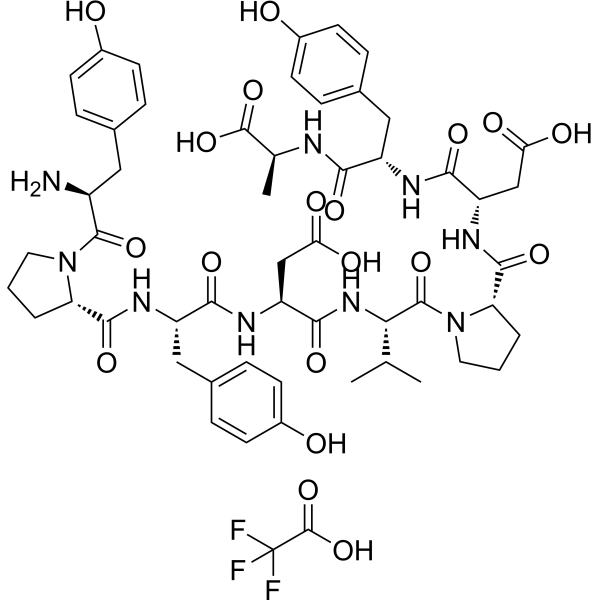
HA Peptide (TFA) is a nine amino acids peptide derived from the human influenza hemagglutinin (HA). HA Peptide (TFA) is extensively used to isolate, purify, detect, and track the protein of interest in cell biology and biochemistry.
For research use only. We do not sell to patients.
- Purity : 99.32%
- Formula: C55H68F3N9O19
- Molecular Weight:1216.17
-
Storage:
Sealed storage, away from moisture.
Powder -80°C, 2 years , -20°C, 1 year* In solvent : -80°C, 6 months; -20°C, 1 month (sealed storage, away from moisture)

To place orders, for customer services and technical support, please contact: MedChemExpress USA
Tel: 609-228-6898 E-mail: [email protected] [email protected]


-
 Biological Activity
-
Chemical Information
-
Solvent & Solubility
- Protocols
- Purity & Documentation
- References
-
 Help & FAQs


Publications Citing Use of MedChemExpress (MCE) HA Peptide TFA
More- Signal Transduct Target Ther. 2025 Jul 16;10(1):221. [Abstract]
- Cell Metab. 2023 Dec 5;35(12):2216-2230.e8. [Abstract]
- Mol Cell. 2020 Feb 20;77(4):734-747.e7. [Abstract]
- Theranostics. 2020 Apr 27;10(13):5845-5864. [Abstract]
- Adv Sci (Weinh). 2025 Aug 13:e07777. [Abstract]
- Cell Death Dis. 2025 Mar 1;16(1):147. [Abstract]
- Oncogene. 2025 Aug 30. [Abstract]
- Oncogene. 2019 Jan;38(5):747-764. [Abstract]
- Free Radic Biol Med. 2022 May 20;185:67-75. [Abstract]
- iScience. 2023 Oct 13;26(11):108207. [Abstract]
- Kaohsiung J Med Sci. 2026 Jan 22:e70174. [Abstract]
- bioRxiv. 2026 Jun 9:2026.06.01.729344. [Abstract]
- bioRxiv. 2026 Jan 9.
- bioRxiv. 2025 August 24.
- Heidelberg University. 2024.
- bioRxiv. 2023 Aug 19.


Biological Activity
Description
In Vitro
HA Peptide is a highly immunoreactive tag generally used for the separation of tagged proteins from cell culture supernatants and cell lysate under neutral pH conditions and thus are handy tools for coimmunoprecipitation but are also easily detected via western blot. HA Peptide is small and thus unlikely to interfere with the bioactivity and function of the fusion partner proteins. HA Peptide comes from human influenza hemagglutinin (HA) corresponding to amino acids 98-106 and is a strong immunoreactive epitope making it popular to isolate, purify, detect, and track the protein of interest. The recombinant HA-tagged proteins can be separated by highly specific anti-HA monoclonal antibody that is covalently immobilized on resin. The HA-tagged proteins can be eluted by mild elution approach with HA epitope at 1 mg/mL in TBS. On the other hand, three chemical elution options are available: 0.1 M glycine (pH 2-2.8), 3 M NaSCN, or 50 mM NaOH[1]. The nucleotide sequences encoding an N-terminal HA Peptide in the mammalian expression vectors is an essential element for the T7 promoter-driven expression in E. coli even without trans-acting T7 RNAP[2]. Research results suggest that HA Peptide is cleaved by caspase 3/7, and HA Peptide cleavage results in a total loss of immunoreactivity. Observations indicate that the use of HA to tag proteins and constructs to study cell death–related and apoptotic mechanisms can result in serious artifacts[3].
MedChemExpress (MCE) has not independently confirmed the accuracy of these methods. They are for reference only. Further protocols information, click here.


Chemical Information
-
Appearance Solid
-
Molecular Weight 1216.17
-
Formula C55H68F3N9O19
-
Color White to off-white
-
Sequence
Tyr-Pro-Tyr-Asp-Val-Pro-Asp-Tyr-Ala
-
Sequence Shortening
YPYDVPDYA
-
Structure Classification
-
Initial Source
-
Shipping
Room temperature in continental US; may vary elsewhere.
-
Storage
Sealed storage, away from moisture
Powder -80°C 2 years -20°C 1 year * In solvent : -80°C, 6 months; -20°C, 1 month (sealed storage, away from moisture)


Publications (16)
-
Journal Impact Factor
-
Most Recent
-
Signal Transduct Target Ther
DDX39B K63-linked ubiquitination mediated by TRIM28 promotes NSCLC metastasis by enhancing ECAD lysosomal degradation. [Abstract]2025 Jul 16;10(1):221. PMID: 40664668 -
Cell Metab
2023 Dec 5;35(12):2216-2230.e8. PMID: 37979583 -
Mol Cell
2020 Feb 20;77(4):734-747.e7. PMID: 31812350 -
Theranostics
Small-molecule activating SIRT6 elicits therapeutic effects and synergistically promotes anti-tumor activity of vitamin D3 in colorectal cancer. [Abstract]2020 Apr 27;10(13):5845-5864. PMID: 32483423 -
Adv Sci (Weinh)
2025 Aug 13:e07777. PMID: 40799131 -
Cell Death Dis
Chromatin assembly factor 1 subunit A promotes TLS pathway by recruiting E3 ubiquitin ligase RAD18 in cancer cells. [Abstract]2025 Mar 1;16(1):147. PMID: 40025006 -
Oncogene
2025 Aug 30. PMID: 40885854 -
Oncogene
EGF-induced nuclear localization of SHCBP1 activates β-catenin signaling and promotes cancer progression. [Abstract]2019 Jan;38(5):747-764. PMID: 30177836 -
Free Radic Biol Med
Suppression of cideb under endoplasmic reticulum stress exacerbated hepatic inflammation by inducing hepatic steatosis and oxidative stress. [Abstract]2022 May 20;185:67-75. PMID: 35489563 -
iScience
Exploring the role of SWI/SNF complex subunit BAF60c in lipid metabolism and inflammation in fish. [Abstract]2023 Oct 13;26(11):108207. PMID: 37942006 -
Kaohsiung J Med Sci
PRMT5 Mediates Sepsis-Associated Lung Injury by Modulating JAK1 Arginine Methylation: A Mechanism Study. [Abstract]2026 Jan 22:e70174. PMID: 41568710 -
bioRxiv
2026 Jun 9:2026.06.01.729344. PMID: 42282570 -
-
-
-


Solvent & Solubility
In Vitro:
DMSO : ≥ 100 mg/mL (82.23 mM; Hygroscopic DMSO has a significant impact on the solubility of product, please use newly opened DMSO)
H2O : 50 mg/mL (41.11 mM; Need ultrasonic)
* "≥" means soluble, but saturation unknown.
Please refer to the solubility information to select the appropriate solvent. Once prepared, please aliquot and store the solution to prevent product inactivation from repeated freeze-thaw cycles.
Storage method and period of stock solution: -80°C, 6 months; -20°C, 1 month (sealed storage, away from moisture). When stored at -80°C, please use it within 6 months. When stored at -20°C, please use it within 1 month.
* Note: If you choose water as the stock solution, please dilute it to the working solution, then filter and sterilize it with a 0.22 μm filter before use.
Please refer to the solubility information to select the appropriate solvent. Once prepared, please aliquot and store the solution to prevent product inactivation from repeated freeze-thaw cycles.
Storage method and period of stock solution: -80°C, 6 months; -20°C, 1 month (sealed storage, away from moisture). When stored at -80°C, please use it within 6 months. When stored at -20°C, please use it within 1 month.
* Note: If you choose water as the stock solution, please dilute it to the working solution, then filter and sterilize it with a 0.22 μm filter before use.
Concentration (start) × Volume (start) = Concentration (final) × Volume (final)
In Vivo:
Select the appropriate dissolution method based on your experimental animal and administration route.
- For the following dissolution methods, please ensure to first prepare a clear stock solution using an In Vitro approach and then sequentially add co-solvents:
- To ensure reliable experimental results, the clarified stock solution can be appropriately stored based on storage conditions. As for the working solution for In Vivo experiments, it is recommended to prepare freshly and use it on the same day.
- The percentages shown for the solvents indicate their volumetric ratio in the final prepared solution. If precipitation or phase separation occurs during preparation, heat and/or sonication can be used to aid dissolution.
Add each solvent one by one: 10% DMSO 40% PEG300 5% Tween-80 45% Saline
Solubility: 1.25 mg/mL (1.03 mM); Suspended solution; Need ultrasonic
This protocol yields a suspended solution of 1.25 mg/mL. Suspended solution can be used for oral and intraperitoneal injection.
Taking 1 mL working solution as an example, add 100 μL DMSO stock solution (12.5 mg/mL) to 400 μL PEG300, and mix evenly; then add 50 μL Tween-80 and mix evenly; then add 450 μL Saline to adjust the volume to 1 mL.
Preparation of Saline: Dissolve 0.9 g sodium chloride in ddH₂O and dilute to 100 mL to obtain a clear Saline solution.
Add each solvent one by one: 10% DMSO 90% (20% SBE-β-CD in Saline)
Solubility: ≥ 1.25 mg/mL (1.03 mM); Clear solution
This protocol yields a clear solution of ≥ 1.25 mg/mL (saturation unknown).
Taking 1 mL working solution as an example, add 100 μL DMSO stock solution (12.5 mg/mL) to 900 μL 20% SBE-β-CD in Saline, and mix evenly.
Preparation of 20% SBE-β-CD in Saline (4°C, storage for one week): 2 g SBE-β-CD powder is dissolved in 10 mL Saline, completely dissolve until clear.
In Vivo Dissolution Calculator
Please enter the basic information of animal experiments:
-
-
-
-
Recommended: Prepare an additional quantity of animals to account for potential losses during experiments.
Working solution concentration: 0.22 mg/mL
This product has good water solubility, please refer to the measured solubility data in water/PBS/Saline for details.

Protocols
-
Directly Induced Neuron Culture
Directly induced neuron culture converts somatic cells, most commonly fibroblasts, into induced neurons without passing through a pluripotent or neural progenitor stage; classic evidence shows that mouse fibroblasts can be converted by Ascl1, Brn2/Pou3f2, and Myt1l, human fibroblasts can be converted by defined neuronal transcription factors, and human fibroblasts can also be converted by miR-9/9-124 with neurogenic or subtype-specifying transcription factors. The readout is acquisition of neuronal identity and function, assessed by neuronal morphology, neuronal markers such as Tuj1/βIII-tubulin, MAP2, synapsin, and subtype markers when relevant, together with functional assays such as action-potential firing, synaptic activity, and electrophysiology.


Purity & Documentation
-
Data Sheet (290 KB)
-
SDS (252 KB)
- English - EN (252 KB)
- Français - FR (252 KB)
- Deutsch - DE (252 KB)
- Norwegian - NO (252 KB)
- Español - ES (252 KB)
- Swedish - SV (252 KB)
- Italian - IT (252 KB)
- Korean - KR (252 KB)
- Portuguese - PT (252 KB)
-
Handling Instructions (2659 KB)
References
[1]. Zhao X, et, al. Several affinity tags commonly used in chromatographic purification. J Anal Methods Chem. 2013;2013:581093. [Content Brief]
[2]. Moon JM, et, al. A new idea for simple and rapid monitoring of gene expression: requirement of nucleotide sequences encoding an N-terminal HA tag in the T7 promoter-driven expression in E. coli. Biotechnol Lett. 2012 Oct;34(10):1841-6. [Content Brief]
[3]. Schembri L, et, al. The HA tag is cleaved and loses immunoreactivity during apoptosis. Nat Methods. 2007 Feb;4(2):107-8. [Content Brief]


Complete Stock Solution Preparation Table
Please refer to the solubility information to select the appropriate solvent. Once prepared, please aliquot and store the solution to prevent product inactivation from repeated freeze-thaw cycles.
Storage method and period of stock solution: -80°C, 6 months; -20°C, 1 month (sealed storage, away from moisture). When stored at -80°C, please use it within 6 months. When stored at -20°C, please use it within 1 month.
| Optional Solvent | Concentration Solvent Mass | 1 mg | 5 mg | 10 mg | 25 mg |
|---|---|---|---|---|---|
| H2O / DMSO | 1 mM | 0.8223 mL | 4.1113 mL | 8.2225 mL | 20.5563 mL |
| 5 mM | 0.1645 mL | 0.8223 mL | 1.6445 mL | 4.1113 mL | |
| 10 mM | 0.0822 mL | 0.4111 mL | 0.8223 mL | 2.0556 mL | |
| 15 mM | 0.0548 mL | 0.2741 mL | 0.5482 mL | 1.3704 mL | |
| 20 mM | 0.0411 mL | 0.2056 mL | 0.4111 mL | 1.0278 mL | |
| 25 mM | 0.0329 mL | 0.1645 mL | 0.3289 mL | 0.8223 mL | |
| 30 mM | 0.0274 mL | 0.1370 mL | 0.2741 mL | 0.6852 mL | |
| 40 mM | 0.0206 mL | 0.1028 mL | 0.2056 mL | 0.5139 mL | |
| DMSO | 50 mM | 0.0164 mL | 0.0822 mL | 0.1645 mL | 0.4111 mL |
| 60 mM | 0.0137 mL | 0.0685 mL | 0.1370 mL | 0.3426 mL | |
| 80 mM | 0.0103 mL | 0.0514 mL | 0.1028 mL | 0.2570 mL |
* Note: If you choose water as the stock solution, please dilute it to the working solution, then filter and sterilize it with a 0.22 μm filter before use.


HA Peptide TFA Related Classifications
HY-P0239A Related Classifications
 Powered by Bioz