



Halofantrine
Based on 2 publication(s) in Google Scholar
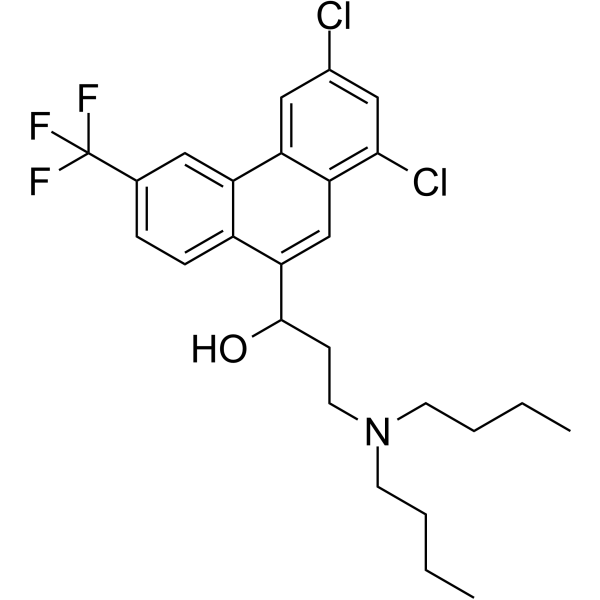
Halofantrine (SKF-102886 hydrochloride; WR-171669 hydrochloride) is a blocker that delays the delayed rectifier potassium current by inhibiting human ERG channels, and it is a potent antimalarial agent with oral activity. Halofantrine inhibits the Cap1-dependent oxidative stress response of Candida albicans, suppresses ROS responses, and enhances the antifungal (Fungal) activity of oxidative damage agents. Halofantrine exhibits antifungal activity in the Galleria mellonella model, and shows antimalarial activity against Plasmodium strains both in vitro and in animal models. Halofantrine can be used in studies related to invasive candidiasis, falciparum malaria, and vivax malaria.
Nur für Forschungszwecke. Wir verkaufen nicht an Patienten.
- CAS. Nr.: 69756-53-2
- Formel: C26H30Cl2F3NO
- Molecular Weight:500.42
-
Speicherung:
Please store the product under the recommended conditions in the Certificate of Analysis.

To place orders, for customer services and technical support, please contact: MedChemExpress USA
Tel: 609-228-6898 E-mail: [email protected] [email protected]


-
 Biologische Aktivität
-
Chemical Information
- Protokoll
- Reinheit & Dokumentation
- Verweise
-
 Help & FAQs


Publications Citing Use of MedChemExpress (MCE) Halofantrine
MoreAlle Parasite Isoform-spezifische Produkte anzeigen
More

Biologische Aktivität
Beschreibung
IC50 & Target
|
Plasmodium |
Cellular Effect
|
Cell Line

|
Type | Value | Description | References |
|---|---|---|---|---|
| CHO | IC50 |
1.9 μM
Compound: halofantrine
|
Inhibition of Cav1.2 current measured using QPatch automatic path clamp system in CHO cells expressing Cav1.2, beta-2 and alpha-2/delta-1 subunits
Inhibition of Cav1.2 current measured using QPatch automatic path clamp system in CHO cells expressing Cav1.2, beta-2 and alpha-2/delta-1 subunits
|
[PMID: 23812503] |
In Vitro
Halofantrine (24-48 h) acts synergistically with oxidative damage agents Plumbagin (HY-N1497), menadione, and H2O2 against Candida albicans strains SC5314 and SN152, with FICI values of 0.0938, 0.1563, and 0.2526, respectively[1].
The combination of halofantrine (24 h) and H2O2 retains synergistic activity against Candida albicans hog1Δ/Δ and rad53Δ/Δ strains (with FICI values of 0.5 and 0.2813, respectively), but shows no synergistic activity against cap1Δ/Δ, ybp1Δ/Δ or gpx3Δ/Δ strains when combined with H2O2, indicating that its oxidative stress inhibitory effect depends on the Cap1-Ybp1 pathway[1].
Halofantrine inhibits chloroquine (HY-17589A)-sensitive Plasmodium falciparum in vitro, with an IC50 value of 1.5-2.5 μg/L[2].
Halofantrine (1.3-3.9 μg/L) inhibits chloroquine-resistant Plasmodium falciparum in vitro, with an IC50 value of 1.3-3.9 μg/L[2].
Halofantrine (10 μM) inhibits glucose-dependent proton efflux in Plasmodium berghei-infected mouse erythrocytes at a concentration of 10 μmol/L in vitro[2].
Halofantrine inhibits Plasmodium falciparum in vitro, with an ID50 of 4.0 μg/L[2].
MedChemExpress (MCE) has not independently confirmed the accuracy of these methods. They are for reference only.
-
Cell Line:MDA-MB-231 TNBC
-
Concentration:0, 2.50, 5.00, 10.00, 20.00, 40.00, and 80.00 μM
-
Incubation Time:3 days
-
Result:IC50 was 7.73±0.23 μM.
In Vivo
Halofantrine (10-640 mg/kg; s.c.; p.o.; daily; single dose) exhibits potent in vivo antimalarial activity in mice infected with Plasmodium berghei, but shows poor oral bioavailability at doses up to 640 mg/kg[2].
Halofantrine (35-140 mg/kg; p.o.; 7-day regimen; single dose) alleviates Plasmodium falciparum infection in Aotus monkeys[2].
MedChemExpress (MCE) has not independently confirmed the accuracy of these methods. They are for reference only.
-
Animal Model:larvae (average weight 300 mg; inoculated with Candida albicans SN152)[1]
-
Dosage:0.5 mg/kg; 1 mg/kg; 2 mg/kg
-
Administration:injection; single dose
-
Result:Reduced larval mortality to 40% at 2 mg/kg over 8 days.
-
Animal Model:Mice[2]
-
Dosage:10-640 mg/kg
-
Administration:s.c.; single dose; p.o.; single dose; daily
-
Result:Exhibited potent in vivo antimalarial activity in mice infected with Plasmodium berghei, but showed poor oral bioavailability at doses up to 640 mg/kg
-
Animal Model:Aotus monkeys[2]
-
Dosage:35-140 mg/kg
-
Administration:p.o.; 7-day regimen; single dose
-
Result:Alleviated Plasmodium falciparum infection in Aotus monkeys


Chemical Information
-
CAS. Nr. 69756-53-2
-
Molecular Weight 500.42
-
Formel C26H30Cl2F3NO
-
SMILES
OC(CCN(CCCC)CCCC)C1=CC2=C(Cl)C=C(Cl)C=C2C3=CC(C(F)(F)F)=CC=C31
-
Synonyms
SKF-102886 free base; WR-171669
-
Versand
Room temperature in continental US; may vary elsewhere.
-
Speicherung
Please store the product under the recommended conditions in the Certificate of Analysis.


Publications (2)
-
Journal Impact Factor
-
Most Recent
-
Nat Mater
2024 Sep;23(9):1292-1299. PMID: 38413810 -


Reinheit & Dokumentation
Verweise
[1]. Xiong J, et al. Halofantrine Acts as an Antioxidant Ability Inhibitor That Enhances Oxidative Stress Damage to Candida albicans. Antioxidants (Basel). 2024 Feb 9;13(2):223. [Content Brief]
[2]. Bryson HM, et al. Halofantrine. A review of its antimalarial activity, pharmacokinetic properties and therapeutic potential. Drugs. 1992 Feb;43(2):236-58. [Content Brief]

Calculators
Konzentration (Stammlösung) × Volumen (Stammlösung) = Konzentration (Ziellösung) × Volumen (Ziellösung)


Halofantrine Related Classifications
HY-A0148 Related Classifications
 Powered by Bioz