



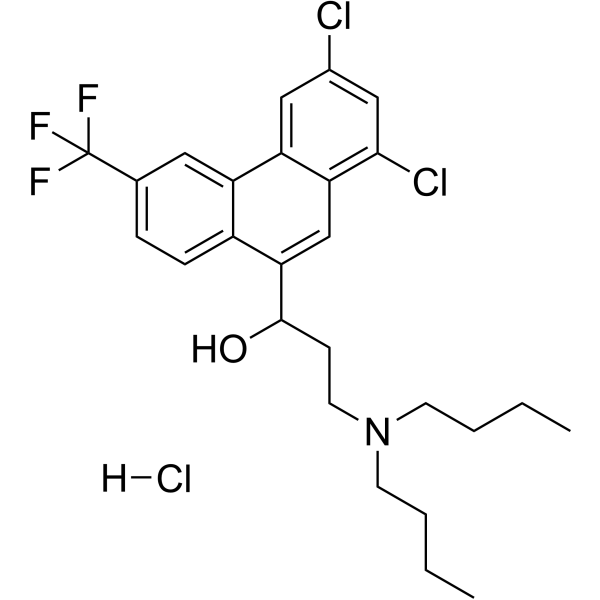
Halofantrine hydrochloride
Based on 2 publication(s) in Google Scholar
Halofantrine hydrochloride (SKF-102886 hydrochloride; WR-171669 hydrochloride) is a blocker that delays the delayed rectifier potassium current by inhibiting human ERG channels, and it is a potent antimalarial agent with oral activity. Halofantrine hydrochloride inhibits the Cap1-dependent oxidative stress response of Candida albicans, suppresses ROS responses, and enhances the antifungal (Fungal) activity of oxidative damage agents. Halofantrine hydrochloride exhibits antifungal activity in the Galleria mellonella model, and shows antimalarial activity against Plasmodium strains both in vitro and in animal models. Halofantrine hydrochloride can be used in studies related to invasive candidiasis, falciparum malaria, and vivax malaria.
For research use only. We do not sell to patients.
- Purity : 99.90%
- CAS No.: 36167-63-2
- Formula: C26H31Cl3F3NO
- Molecular Weight:536.88
-
Storage:
4°C, sealed storage, away from moisture
* In solvent : -80°C, 6 months; -20°C, 1 month (sealed storage, away from moisture)

To place orders, for customer services and technical support, please contact: MedChemExpress USA
Tel: 609-228-6898 E-mail: [email protected] [email protected]


-
 Biological Activity
-
Chemical Information
-
Solvent & Solubility
- Protocols
- Purity & Documentation
- References
-
 Help & FAQs


Publications Citing Use of MedChemExpress (MCE) Halofantrine hydrochloride
MoreAll Parasite Isoforms
More

Biological Activity
Description
IC50 & Target
|
Plasmodium |
In Vitro
Halofantrine (24-48 h) hydrochloride acts synergistically with oxidative damage agents Plumbagin (HY-N1497), menadione, and H2O2 against Candida albicans strains SC5314 and SN152, with FICI values of 0.0938, 0.1563, and 0.2526, respectively[1].
The combination of halofantrine (24 h) hydrochloride and H2O2 retains synergistic activity against Candida albicans hog1Δ/Δ and rad53Δ/Δ strains (with FICI values of 0.5 and 0.2813, respectively), but shows no synergistic activity against cap1Δ/Δ, ybp1Δ/Δ or gpx3Δ/Δ strains when combined with H2O2, indicating that its oxidative stress inhibitory effect depends on the Cap1-Ybp1 pathway[1].
Halofantrine hydrochloride inhibits chloroquine (HY-17589A)-sensitive Plasmodium falciparum in vitro, with an IC50 value of 1.5-2.5 μg/L[2].
Halofantrine (1.3-3.9 μg/L) hydrochloride inhibits chloroquine-resistant Plasmodium falciparum in vitro, with an IC50 value of 1.3-3.9 μg/L[2].
Halofantrine (10 μM) hydrochloride inhibits glucose-dependent proton efflux in Plasmodium berghei-infected mouse erythrocytes at a concentration of 10 μmol/L in vitro[2].
Halofantrine inhibits Plasmodium falciparum in vitro, with an ID50 of 4.0 μg/L[2].
MedChemExpress (MCE) has not independently confirmed the accuracy of these methods. They are for reference only. Further protocols information, click here.
In Vivo
Halofantrine (10-640 mg/kg; s.c.; p.o.; daily; single dose) hydrochloride exhibits potent in vivo antimalarial activity in mice infected with Plasmodium berghei, but shows poor oral bioavailability at doses up to 640 mg/kg[2].
Halofantrine (35-140 mg/kg; p.o.; 7-day regimen; single dose) hydrochloride alleviates Plasmodium falciparum infection in Aotus monkeys[2].
MedChemExpress (MCE) has not independently confirmed the accuracy of these methods. They are for reference only.
-
Animal Model:larvae (average weight 300 mg; inoculated with Candida albicans SN152)[1]
-
Dosage:0.5 mg/kg; 1 mg/kg; 2 mg/kg
-
Administration:injection; single dose
-
Result:Reduced larval mortality to 40% at 2 mg/kg over 8 days.
-
Animal Model:Mice[2]
-
Dosage:10-640 mg/kg
-
Administration:s.c.; single dose; p.o.; single dose; daily
-
Result:Exhibited potent in vivo antimalarial activity in mice infected with Plasmodium berghei, but showed poor oral bioavailability at doses up to 640 mg/kg
-
Animal Model:Aotus monkeys[2]
-
Dosage:35-140 mg/kg
-
Administration:p.o.; 7-day regimen; single dose
-
Result:Alleviated Plasmodium falciparum infection in Aotus monkeys


Chemical Information
-
CAS No. 36167-63-2
-
Appearance Solid
-
Molecular Weight 536.88
-
Formula C26H31Cl3F3NO
-
Color White to off-white
-
SMILES
OC(CCN(CCCC)CCCC)C1=CC2=C(Cl)C=C(Cl)C=C2C3=CC(C(F)(F)F)=CC=C31.[H]Cl
-
Synonyms
SKF-102886; WR-171669 hydrochloride
-
Shipping
Room temperature in continental US; may vary elsewhere.
-
Storage
4°C, sealed storage, away from moisture
* In solvent : -80°C, 6 months; -20°C, 1 month (sealed storage, away from moisture)


Publications (2)
-
Journal Impact Factor
-
Most Recent
-
Nat Mater
2024 Sep;23(9):1292-1299. PMID: 38413810 -


Solvent & Solubility
In Vitro:
DMSO : 30 mg/mL (55.88 mM; Need ultrasonic; Hygroscopic DMSO has a significant impact on the solubility of product, please use newly opened DMSO)
Please refer to the solubility information to select the appropriate solvent. Once prepared, please aliquot and store the solution to prevent product inactivation from repeated freeze-thaw cycles.
Storage method and period of stock solution: -80°C, 6 months; -20°C, 1 month (sealed storage, away from moisture). When stored at -80°C, please use it within 6 months. When stored at -20°C, please use it within 1 month.
Please refer to the solubility information to select the appropriate solvent. Once prepared, please aliquot and store the solution to prevent product inactivation from repeated freeze-thaw cycles.
Storage method and period of stock solution: -80°C, 6 months; -20°C, 1 month (sealed storage, away from moisture). When stored at -80°C, please use it within 6 months. When stored at -20°C, please use it within 1 month.
Concentration (start) × Volume (start) = Concentration (final) × Volume (final)
In Vivo:
Select the appropriate dissolution method based on your experimental animal and administration route.
- For the following dissolution methods, please ensure to first prepare a clear stock solution using an In Vitro approach and then sequentially add co-solvents:
- To ensure reliable experimental results, the clarified stock solution can be appropriately stored based on storage conditions. As for the working solution for In Vivo experiments, it is recommended to prepare freshly and use it on the same day.
- The percentages shown for the solvents indicate their volumetric ratio in the final prepared solution. If precipitation or phase separation occurs during preparation, heat and/or sonication can be used to aid dissolution.
In Vivo Dissolution Calculator
Please enter the basic information of animal experiments:
-
-
-
-
Recommended: Prepare an additional quantity of animals to account for potential losses during experiments.
Please enter your animal formula composition:
-
%DMSO +
Recommended: Keep the proportion of DMSO in working solution below 2% if your animal is weak.
-
%+
-
+%Tween-80 + +
-
%Saline +
The co-solvents required include: DMSO, . All of co-solvents are available by MedChemExpress (MCE). , Tween 80. All of co-solvents are available by MedChemExpress (MCE).
Working solution concentration: 0.22 mg/mL
Method for preparing stock solution: mg drug dissolved in μL DMSO. Stock solution concentration: mg/mL. * In solvent : -80°C, 6 months; -20°C, 1 month (sealed storage, away from moisture)
1. Take μL DMSO stock solution;
2. Add μL .
μL , mix evenly;
3. Then add μL Tween 80, mix evenly;
4. Then add μL
Please ensure that the stock solution in the first step is dissolved to a clear state, and add co-solvents in sequence. You can use ultrasonic heating (ultrasonic cleaner, recommended frequency 20-40 kHz), vortexing, etc. to assist dissolution.

Protocols
-
ROS/oxidative-stress fluorescent staining
ROS/oxidative-stress fluorescent staining uses cell-permeant fluorogenic probes that become fluorescent after oxidation inside cells or tissues; commonly used examples include DCFH-DA/DCFDA for broad cellular oxidant detection, DHE for superoxide-related signal detection, MitoSOX for mitochondrial superoxide-related signal detection, and CellROX probes for oxidative-stress-associated fluorescence readouts. The assay detects probe oxidation rather than a single ROS species unless the probe and analysis method have been chemically validated for that species. DCFH-DA enters cells, is deacetylated by intracellular esterases to DCFH, and produces fluorescent DCF after oxidation, so the readout is used as an operational measure of total cellular oxidative stress rather than a species-specific ROS measurement. DHE and MitoSOX can report superoxide-related oxidation, but red fluorescence alone can include non-specific ethidium-like oxidation products; HPLC or optimized spectral approaches are


Purity & Documentation
-
Data Sheet (280 KB)
-
SDS (393 KB)
- English - EN (393 KB)
- Français - FR (393 KB)
- Deutsch - DE (393 KB)
- Norwegian - NO (393 KB)
- Español - ES (393 KB)
- Swedish - SV (393 KB)
- Italian - IT (393 KB)
- Korean - KR (393 KB)
- Portuguese - PT (393 KB)
-
Handling Instructions (2659 KB)
References
[1]. Xiong J, et al. Halofantrine Hydrochloride Acts as an Antioxidant Ability Inhibitor That Enhances Oxidative Stress Damage to Candida albicans. Antioxidants (Basel). 2024 Feb 9;13(2):223. [Content Brief]
[2]. Bryson HM, et al. Halofantrine. A review of its antimalarial activity, pharmacokinetic properties and therapeutic potential. Drugs. 1992 Feb;43(2):236-58. [Content Brief]


Complete Stock Solution Preparation Table
Please refer to the solubility information to select the appropriate solvent. Once prepared, please aliquot and store the solution to prevent product inactivation from repeated freeze-thaw cycles.
Storage method and period of stock solution: -80°C, 6 months; -20°C, 1 month (sealed storage, away from moisture). When stored at -80°C, please use it within 6 months. When stored at -20°C, please use it within 1 month.
| Optional Solvent | Concentration Solvent Mass | 1 mg | 5 mg | 10 mg | 25 mg |
|---|---|---|---|---|---|
| DMSO | 1 mM | 1.8626 mL | 9.3131 mL | 18.6261 mL | 46.5653 mL |
| 5 mM | 0.3725 mL | 1.8626 mL | 3.7252 mL | 9.3131 mL | |
| 10 mM | 0.1863 mL | 0.9313 mL | 1.8626 mL | 4.6565 mL | |
| 15 mM | 0.1242 mL | 0.6209 mL | 1.2417 mL | 3.1044 mL | |
| 20 mM | 0.0931 mL | 0.4657 mL | 0.9313 mL | 2.3283 mL | |
| 25 mM | 0.0745 mL | 0.3725 mL | 0.7450 mL | 1.8626 mL | |
| 30 mM | 0.0621 mL | 0.3104 mL | 0.6209 mL | 1.5522 mL | |
| 40 mM | 0.0466 mL | 0.2328 mL | 0.4657 mL | 1.1641 mL | |
| 50 mM | 0.0373 mL | 0.1863 mL | 0.3725 mL | 0.9313 mL |


Halofantrine hydrochloride Related Classifications
HY-A0148A Related Classifications
 Powered by Bioz