



Icosabutate

Based on 1 Customer Validation
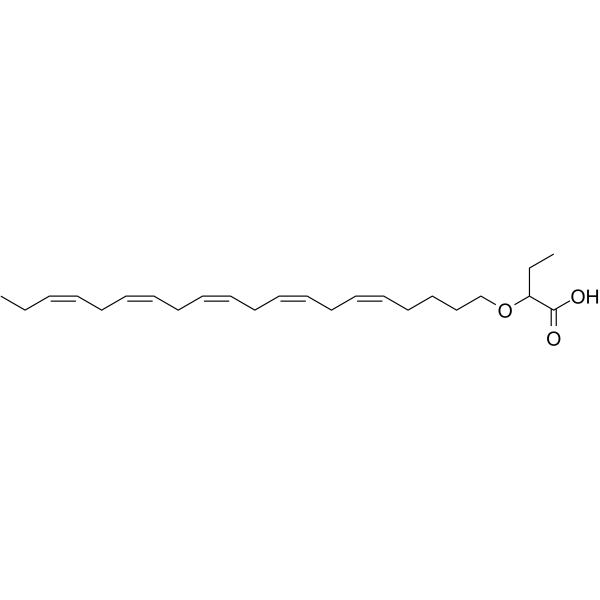
Icosabutate is an orally active engineered fatty acid and a dual FFAR1/FFAR4 (GPR40/GPR120) agonist with EC50 values of 10 μM and 15.5 μM, respectively. Icosabutate acts as a partial agonist of PPAR-α, with an EC50 of 208 nM. Icosabutate inhibits the arachidonic acid cascade and exhibits antioxidant and anti-apoptotic activities. Icosabutate can be used in the research of nonalcoholic steatohepatitis, metabolic dysfunction-associated steatohepatitis, and atherosclerosis.
For research use only. We do not sell to patients.
- Purity : 97.28%
- CAS No.: 1253909-57-7
- Formula: C24H38O3
- Molecular Weight:374.56
-
Storage:Pure form -20°C, 3 years ; In solvent -80°C, 6 months , -20°C, 1 month

To place orders, for customer services and technical support, please contact: MedChemExpress USA
Tel: 609-228-6898 E-mail: [email protected] [email protected]


-
 Biological Activity
-
Chemical Information
-
Solvent & Solubility
- Protocols
- Purity & Documentation
- References
-
 Help & FAQs





Biological Activity
Description
IC50 & Target
IC50: non-HDL-C[2]
In Vitro
Icosabutate fully activates the human FFAR4 β-arrestin2 pathway in a transfected cell line with an EC50 of 15 μM[4].
Icosabutate activates the human FFAR1 calcium flux pathway in transfected HEK293 cells with an EC50 of 10 μM and 90% maximum efficacy[4].
Icosabutate partially activates human PPAR-α in transfected HEK293 cells with an EC50 of 208 nM and 62% maximum efficacy[4].
Icosabutate significantly inhibits proliferation of LX-2 myofibroblasts[4].
MedChemExpress (MCE) has not independently confirmed the accuracy of these methods. They are for reference only.
In Vivo
Icosabutate (112 mg/kg; p.o.; once daily; for 20 weeks) reduces microvesicular steatosis, hepatic inflammation, fibrosis, lipotoxic lipid species, and oxidative stress in atherosclerotic model mice[1].
Icosabutate (45-135 mg/kg; p.o.; once daily; 4-8 weeks) dose-dependently attenuates hepatic steatosis, inflammation, oxidative stress, apoptosis and progressive fibrosis in established non-alcoholic steatohepatitis (NASH) of male ob/ob mice[3].
Icosabutate (112 mg/kg; p.o.; once daily; for 4 consecutive weeks) reduces plasma TAG and total cholesterol by 70% and 68%, respectively, in hyperlipidemic mice by enhancing hepatic VLDL remnant clearance and LDL-R-mediated cholesterol uptake[3].
Icosabutate (37.5 mg/kg; p.o.; once daily; 4.5 weeks, followed by 15 mg/kg; p.o.; once daily; 12.5 weeks) reduces total cholesterol exposure in mice by approximately 29%, and decreases the formation, severity and number of atherosclerotic lesions[3].
Administration of icosabutate (135 mg/kg; once daily; for 4 weeks) for 4 weeks significantly improves glycemic control and reduces plasma triglyceride, cholesterol and AST levels in obese Zucker rats[4].
MedChemExpress (MCE) has not independently confirmed the accuracy of these methods. They are for reference only.
-
Animal Model:ob/ob mice (male, 6-8 weeks old, genetic type 2 diabetes/insulin resistance model)[1]
-
Dosage:135 mg/kg/d
-
Administration:p.o.; daily; 5 weeks
-
Result:Significantly reduced blood glucose by 50%, blood hemoglobin A1c by 47%, plasma insulin by 76%, and HOMA-IR by 87% versus control.
Improved glucose tolerance, reducing the oral glucose tolerance test AUC0-120min by 60% versus control.
Significantly reduced plasma alanine aminotransferase by 33% versus control.
Did not affect body weight or plasma adiponectin levels.
-
Animal Model:APOE*3Leiden.CETP mice (male, 8-15 weeks old, high-fat/cholesterol-fed diet-induced NASH model)[1]
-
Dosage:112 mg/kg/d
-
Administration:p.o.; daily; 20 weeks
-
Result:Significantly reduced microvesicular steatosis by 35%, hepatocellular hypertrophy by 82%, and hepatic inflammatory cell aggregates by 62% versus control.
Significantly reduced serum amyloid A levels by 68%, hepatic collagen content by 32%, and fibrosis surface area by 26% versus control.
Reduced hepatic concentrations of multiple lipotoxic lipid species including free fatty acids, diacylglycerols, bile acids, arachidonic acid, ceramides, and hydroxyeicosatetraenoic acids.
Decreased hepatic oxidized glutathione (GSSG) while increasing the GSH/GSSG ratio.
Activated regulators involved in lipid metabolism and energy production, and inhibited pro-inflammatory regulators including STAT1 and NFκB complex, as well as down-regulated fibrogenic genes in hepatic stellate cells via transcriptome analysis.
-
Animal Model:B6.V-Lepob/JRj (ob/ob) (male, 5 weeks old at arrival, NASH model via AMLN diet for 18 weeks with biopsy confirmation of fibrosis stage ≥1 and steatosis score ≥2; separate screening group fed AMLN diet for 15 weeks without biopsy)[3]
-
Dosage:45 mg/kg bw/d; 90 mg/kg bw/d; 135 mg/kg bw/d (8-week treatment); 112 mg/kg bw/d (4-week screening study)
-
Administration:p.o.; daily; 8 weeks (45, 90, 135 mg/kg); p.o.; daily; 4 weeks (112 mg/kg)
-
Result:Reduced steatosis by 47%.
Reduced hepatic TAG by 17% (45 mg/kg), 35% (90 mg/kg), 40% (135 mg/kg).
Reduced plasma ALT by 32% (90 mg/kg) and 44% (135 mg/kg).
Significantly reduced hepatic galectin-3 content (all doses).
Reduced hepatic col1A1 % area by 27% (90 mg/kg) and total col1A1 by 32% (90 mg/kg) and 23% (135 mg/kg).
Minimized fibrosis progression (90 mg/kg, post-pre biopsy col1A1 change).
Reduced hepatic hydroxyproline (HYP) content in relative and total units (90 mg/kg and 135 mg/kg).
Reduced hepatic α-SMA % area and total content (90 mg/kg and 135 mg/kg).
Reduced post-pre biopsy α-SMA content (135 mg/kg).
Reduced hepatic free fatty acids (FFAs), diacylglycerols (DAG), ceramides, total HETEs by 45% (90 mg/kg) and 51% (135 mg/kg), phosphatidylcholine-arachidonic acid (PC-AA) by 32% (90 mg/kg) and 42% (135 mg/kg), oxidised glutathione (GSSG), and oxidised phospholipids (oxPL) by 31% (90 mg/kg) and 46% (135 mg/kg).
Increased hepatic GSH/GSSG ratio by 84% (135 mg/kg).
Reduced hepatic apoptotic cell numbers by 41% (45 mg/kg), 29% (90 mg/kg), and 44% (135 mg/kg).
Downregulated hepatic mRNA transcripts for genes regulating inflammatory responses (TNF-α, TGF-β1, TGFRβ, CCR2), stellate cell activation, fibrogenesis, and fibrolysis (112 mg/kg).
-
Animal Model:APOE*3Leiden.CETP transgenic (C57BL/6J background) (male, 7-10 weeks old, hyperlipidaemia model via 4-week run-in on Western-type diet with 0.25% cholesterol)[3]
-
Dosage:112 mg/kg bw/d
-
Administration:p.o.; daily; 4 weeks
-
Result:Reduced plasma TAG by 70% (P < .001) and total cholesterol by 68% (P < .001); no effect on HDL cholesterol.
Decreased plasma half-life of glycerol tri[3H]oleate by 40% (P = .008) and [14C]cholesteryl oleate by 52% (P = .001); increased hepatic uptake of both lipids.
Increased hepatic LDL-R protein expression compared to controls (P ≤ .05).
Reduced hepatic cholesteryl ester content (P ≤ .05) and faecal bile acid excretion (P ≤ .05); no effect on hepatic free cholesterol, TAG, or faecal neutral sterol excretion.
Upregulated hepatic gene pathways involved in fatty acid metabolism, β-oxidation, and (chole)sterol biosynthetic processes; downregulated pathways including complement activation, arachidonic acid cascade, innate immune response, and acute phase response.
-
Animal Model:APOE*3Leiden.CETP transgenic (C57BL/6J background) (female, 11-15 weeks old, atherosclerosis model via 4-week run-in on Western-type diet with 0.15% cholesterol)[3]
-
Dosage:37.5 mg/kg bw/d (first 4.5 weeks); 15 mg/kg bw/d (final 12.5 weeks)
-
Administration:p.o.; daily; 17 weeks (37.5 mg/kg for 4.5 weeks, then 15 mg/kg for 12.5 weeks)
-
Result:Reduced total cholesterol exposure by ~29% compared to controls (P < .001).
Reduced total aortic root lesion area by ~70% compared to controls (P < .001); reduced lesion number per cross section (P ≤ .05).
Increased undiseased aortic root segments to 44% (P < .01) and reduced severe type IV-V lesions to 18% compared to controls.
-
Animal Model:Obese Zucker rats[4]
-
Dosage:135 mg/kg
-
Administration:daily; 4 weeks
-
Result:Reduced plasma triglycerides from 17.3 mM to 9.6 mM.
Reduced plasma cholesterol from 10.1 mM to 5.4 mM.
Reduced blood glucose from 11.8 mM to 7.2 mM.
Reduced plasma insulin from 17.2 ng/mL to 9.4 ng/mL.
Reduced HbA1c from 7.8% to 5.6%.
Reduced HOMA-IR from 8.7 to 3.0.
Increased plasma LDL-cholesterol from 0.4 mM to 1.5 mM.
Reduced plasma AST from 167.3 U/L to 90.5 U/L.
Caused no significant change in body weight, food intake, plasma VLDL-cholesterol, plasma ALT, or plasma adiponectin.
Clinical Trial
| NCT Number | Sponsor | Condition | Start Date |
Phase

|
|---|---|---|---|---|
| NCT01329991 | 2011-05 | PHASE1 |


Chemical Information
-
CAS No. 1253909-57-7
-
Appearance Liquid
-
Molecular Weight 374.56
-
Formula C24H38O3
-
Color Colorless to light yellow
-
SMILES
CCC(OCCCC/C=C\C/C=C\C/C=C\C/C=C\C/C=C\CC)C(O)=O
-
Shipping
Room temperature in continental US; may vary elsewhere.
-
Storage
Pure form -20°C 3 years In solvent -80°C 6 months -20°C 1 month


Solvent & Solubility
In Vitro:
DMSO : 100 mg/mL (266.98 mM; Need ultrasonic; Hygroscopic DMSO has a significant impact on the solubility of product, please use newly opened DMSO)
Please refer to the solubility information to select the appropriate solvent. Once prepared, please aliquot and store the solution to prevent product inactivation from repeated freeze-thaw cycles.
Storage method and period of stock solution: -80°C, 6 months; -20°C, 1 month. When stored at -80°C, please use it within 6 months. When stored at -20°C, please use it within 1 month.
Please refer to the solubility information to select the appropriate solvent. Once prepared, please aliquot and store the solution to prevent product inactivation from repeated freeze-thaw cycles.
Storage method and period of stock solution: -80°C, 6 months; -20°C, 1 month. When stored at -80°C, please use it within 6 months. When stored at -20°C, please use it within 1 month.
Concentration (start) × Volume (start) = Concentration (final) × Volume (final)
In Vivo:
Select the appropriate dissolution method based on your experimental animal and administration route.
- For the following dissolution methods, please ensure to first prepare a clear stock solution using an In Vitro approach and then sequentially add co-solvents:
- To ensure reliable experimental results, the clarified stock solution can be appropriately stored based on storage conditions. As for the working solution for In Vivo experiments, it is recommended to prepare freshly and use it on the same day.
- The percentages shown for the solvents indicate their volumetric ratio in the final prepared solution. If precipitation or phase separation occurs during preparation, heat and/or sonication can be used to aid dissolution.
Add each solvent one by one: 10% DMSO 40% PEG300 5% Tween-80 45% Saline
Solubility: ≥ 2.5 mg/mL (6.67 mM); Clear solution
This protocol yields a clear solution of ≥ 2.5 mg/mL (saturation unknown).
Taking 1 mL working solution as an example, add 100 μL DMSO stock solution (25.0 mg/mL) to 400 μL PEG300, and mix evenly; then add 50 μL Tween-80 and mix evenly; then add 450 μL Saline to adjust the volume to 1 mL.
Preparation of Saline: Dissolve 0.9 g sodium chloride in ddH₂O and dilute to 100 mL to obtain a clear Saline solution.
Add each solvent one by one: 10% DMSO 90% (20% SBE-β-CD in Saline)
Solubility: 2.5 mg/mL (6.67 mM); Suspended solution; Need ultrasonic
This protocol yields a suspended solution of 2.5 mg/mL. Suspended solution can be used for oral and intraperitoneal injection.
Taking 1 mL working solution as an example, add 100 μL DMSO stock solution (25.0 mg/mL) to 900 μL 20% SBE-β-CD in Saline, and mix evenly.
Preparation of 20% SBE-β-CD in Saline (4°C, storage for one week): 2 g SBE-β-CD powder is dissolved in 10 mL Saline, completely dissolve until clear.
In Vivo Dissolution Calculator
Please enter the basic information of animal experiments:
-
-
-
-
Recommended: Prepare an additional quantity of animals to account for potential losses during experiments.
Please enter your animal formula composition:
-
%DMSO +
Recommended: Keep the proportion of DMSO in working solution below 2% if your animal is weak.
-
%+
-
+%Tween-80 + +
-
%Saline +
The co-solvents required include: DMSO, . All of co-solvents are available by MedChemExpress (MCE). , Tween 80. All of co-solvents are available by MedChemExpress (MCE).
Working solution concentration: 0.22 mg/mL
Method for preparing stock solution: mg drug dissolved in μL DMSO. Stock solution concentration: mg/mL.
1. Take μL DMSO stock solution;
2. Add μL .
μL , mix evenly;
3. Then add μL Tween 80, mix evenly;
4. Then add μL
Please ensure that the stock solution in the first step is dissolved to a clear state, and add co-solvents in sequence. You can use ultrasonic heating (ultrasonic cleaner, recommended frequency 20-40 kHz), vortexing, etc. to assist dissolution.


Purity & Documentation
-
Data Sheet (276 KB)
-
SDS (251 KB)
- English - EN (251 KB)
- Français - FR (251 KB)
- Deutsch - DE (251 KB)
- Norwegian - NO (251 KB)
- Español - ES (251 KB)
- Swedish - SV (251 KB)
- Italian - IT (251 KB)
- Korean - KR (251 KB)
- Portuguese - PT (251 KB)
-
Handling Instructions (2659 KB)
References
[1]. HY-121212-2.pdf [Content Brief]
[2]. HY-121212-1.pdf [Content Brief]


Complete Stock Solution Preparation Table
Please refer to the solubility information to select the appropriate solvent. Once prepared, please aliquot and store the solution to prevent product inactivation from repeated freeze-thaw cycles.
Storage method and period of stock solution: -80°C, 6 months; -20°C, 1 month. When stored at -80°C, please use it within 6 months. When stored at -20°C, please use it within 1 month.
| Optional Solvent | Concentration Solvent Mass | 1 mg | 5 mg | 10 mg | 25 mg |
|---|---|---|---|---|---|
| DMSO | 1 mM | 2.6698 mL | 13.3490 mL | 26.6980 mL | 66.7450 mL |
| 5 mM | 0.5340 mL | 2.6698 mL | 5.3396 mL | 13.3490 mL | |
| 10 mM | 0.2670 mL | 1.3349 mL | 2.6698 mL | 6.6745 mL | |
| 15 mM | 0.1780 mL | 0.8899 mL | 1.7799 mL | 4.4497 mL | |
| 20 mM | 0.1335 mL | 0.6674 mL | 1.3349 mL | 3.3372 mL | |
| 25 mM | 0.1068 mL | 0.5340 mL | 1.0679 mL | 2.6698 mL | |
| 30 mM | 0.0890 mL | 0.4450 mL | 0.8899 mL | 2.2248 mL | |
| 40 mM | 0.0667 mL | 0.3337 mL | 0.6674 mL | 1.6686 mL | |
| 50 mM | 0.0534 mL | 0.2670 mL | 0.5340 mL | 1.3349 mL | |
| 60 mM | 0.0445 mL | 0.2225 mL | 0.4450 mL | 1.1124 mL | |
| 80 mM | 0.0334 mL | 0.1669 mL | 0.3337 mL | 0.8343 mL | |
| 100 mM | 0.0267 mL | 0.1335 mL | 0.2670 mL | 0.6674 mL |


Icosabutate Related Classifications
HY-121212 Related Classifications
 Powered by Bioz