



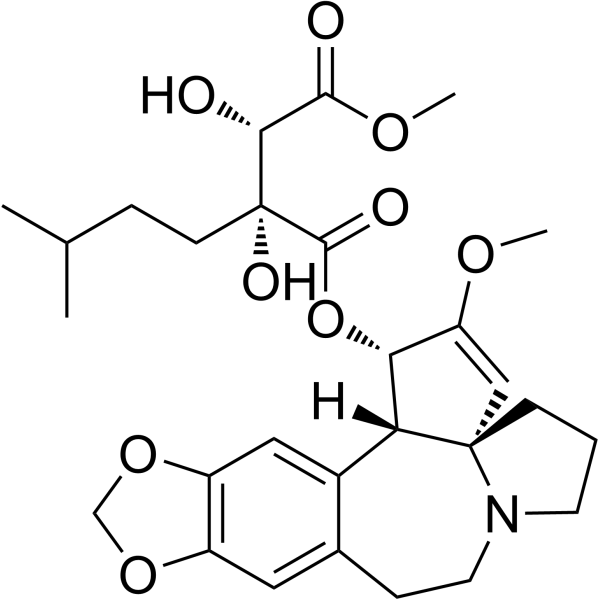
Isoharringtonine
Isoharringtonine is a natural alkaloid that can be purified from Cephalotaxus koreana Nakai. Isoharringtonine can inhibit cancer cell proliferation and migration, and induce cancer cell apoptosis. Isoharringtonine can be used for the research of cancers.
For research use only. We do not sell to patients.
- CAS No.: 26833-86-3
- Formula: C28H37NO9
- Molecular Weight:531.59
-
Storage:
Please store the product under the recommended conditions in the Certificate of Analysis.

To place orders, for customer services and technical support, please contact: MedChemExpress USA
Tel: 609-228-6898 E-mail: [email protected] [email protected]


-
 Biological Activity
-
Chemical Information
- Purity & Documentation
- References
-
 Help & FAQs




Biological Activity
|
Cell Line

|
Type | Value | Description | References |
|---|---|---|---|---|
| HCC1806 | IC50 |
100 nM
Compound: 31; IHT
|
Anticancer activity against human HCC1806 cells assessed as cell growth inhibition incubated for 24 hrs by MTS assay
Anticancer activity against human HCC1806 cells assessed as cell growth inhibition incubated for 24 hrs by MTS assay
|
[PMID: 33650861] |
| HCC1937 | IC50 |
500 nM
Compound: 31; IHT
|
Anticancer activity against human HCC1937 cells assessed as cell growth inhibition incubated for 24 hrs by MTS assay
Anticancer activity against human HCC1937 cells assessed as cell growth inhibition incubated for 24 hrs by MTS assay
|
[PMID: 33650861] |
-
Cell Line:HCC1806, HCC1937, MCF-7 breast cancer cell lines
-
Concentration:50, 100, 200, 300 nM (HCC1806); 300, 400, 500, 600 nM (HCC1937)
-
Incubation Time:24, 48 h
-
Result:Inhibited the proliferation of all three breast cancer cell lines in a dose-dependent manner.
-
Cell Line:HCC1806, HCC1937 breast cancer cell lines
-
Concentration:50, 100, 200, 300 nM (HCC1806); 300, 400, 500, 600 nM (HCC1937)
-
Incubation Time:16 h (HCC1806); 12 h (HCC1937)
-
Result:Prevented migration of both cell lines in a dose-dependent manner.
-
Cell Line:HCC1806, HCC1937 breast cancer cell lines
-
Concentration:50, 100, 200, 300 nM (HCC1806); 300, 400, 500, 600 nM (HCC1937)
-
Incubation Time:24 h
-
Result:Suppressed the levels of both p-STAT3 and total STAT3 in a dose-dependent manner in both cell lines.
Decreased band intensity for p-STAT3 and total STAT3 progressively with increasing concentration.
-
Cell Line:HCC1806, HCC1937 breast cancer cell lines
-
Concentration:50, 100, 200, 300 nM (HCC1806); 300, 400, 500, 600 nM (HCC1937)
-
Incubation Time:24 h
-
Result:Downregulated Nanog mRNA expression in a dose-dependent manner in both cell lines. cells with 600 nM.
-
Cell Line:3D NCI-H460 and A549 non-small cell lung cancer tumorspheroids
-
Concentration:0.001, 0.01, 0.1, 1, 10 µM
-
Incubation Time:72 h
-
Result:Inhibited the growth of NCI-H460 tumorspheroids in a dose-dependent manner, with an ED50 of 0.143 µM.
Inhibited the growth of A549 tumorspheroids with an ED50 of 9.6 µM.
-
Cell Line:2D NCI-H460 and A549 non-small cell lung cancer monolayer cultures
-
Concentration:0.01, 0.1, 1, 10 µM
-
Incubation Time:48 h
-
Result:Inhibited the viability of 2D NCI-H460 cells with an ED50 of 0.094 µM.
Inhibited the viability of 2D A549 cells with an ED50 of 0.481 µM.
Showed greater efficacy in 2D cultures than in 3D tumorspheroids for both cell lines.
-
Cell Line:3D NCI-H460 tumorspheroids and NR4A1-knockdown A549 tumorspheroids
-
Concentration:1, 3, 5 µM
-
Incubation Time:48, 72 h
-
Result:Induced dose-dependent decreases in viability of NCI-H460 tumorspheroids at both 48 and 72 h.
Caused significantly greater viability reduction in NR4A1-knockdown A549 tumorspheroids at all tested concentrations compared to control siRNA-transfected A549 tumorspheroids at both time points.
-
Cell Line:3D NCI-H460 and A549 non-small cell lung cancer tumorspheroids
-
Concentration:1, 3, 5 µM (NCI-H460); 1, 10 µM (A549)
-
Incubation Time:72 h
-
Result:Caused a dose-dependent increase in dead area relative to total area in NCI-H460 tumorspheroids.
Induced a large increase in dead area in NR4A1-knockdown A549 tumorspheroids at 10 µM, while control siRNA-transfected A549 tumorspheroids showed no significant increase in dead area.
-
Cell Line:3D NCI-H460 and A549 non-small cell lung cancer tumorspheroids
-
Concentration:1, 3, 5 µM
-
Incubation Time:72 h
-
Result:Caused a dose-dependent increase in apoptotic histone-complexed DNA fragments in NCI-H460 tumorspheroids.
Induced a dose-dependent increase in apoptotic fragments in NR4A1-knockdown A549 tumorspheroids, while control siRNA-transfected A549 tumorspheroids showed no significant increase.
-
Cell Line:Dissociated 3D NCI-H460 and A549 non-small cell lung cancer tumorspheroids
-
Concentration:1, 3, 5 µM
-
Incubation Time:72 h
-
Result:Caused a dose-dependent increase in the percentage of early and late apoptotic NCI-H460 cells.
Induced a dose-dependent increase in total apoptosis in NR4A1-knockdown A549 cells, while control siRNA-transfected A549 cells showed no significant increase in apoptosis.
-
Cell Line:3D NCI-H460 and A549 non-small cell lung cancer tumorspheroids
-
Concentration:1, 3 µM
-
Incubation Time:48 h
-
Result:Increased cleavage of caspase-9, caspase-7, and PARP, reduced levels of anti-apoptotic proteins Bcl-2, Mcl-1, Survivin, and XIAP, increased p53 levels, inhibited Stat3 phosphorylation, and reduced phospho-Akt levels in NCI-H460 tumorspheroids at 3 µM.
Reduced Survivin levels and inhibited Stat3 phosphorylation in control siRNA-transfected A549 tumorspheroids, with no activation of apoptosis markers.
Induced cleavage of caspase-9, caspase-7, and PARP, reduced Mcl-1 and XIAP levels, inhibited Stat3 phosphorylation, and reduced phospho-Akt levels in NR4A1-knockdown A549 tumorspheroids at 3 µM.
-
Animal Model:C. elegans jgIs25[1]
-
Dosage:10, 50, 100 µM (liquid culture); 5 µM (RNAi plates)
-
Administration:liquid culture; continuous incubation from L1 to adult stage; plate incubation; continuous incubation from L4 to F1 maturity
-
Result:Reduced relative multivulva formation.
Did not inhibit multivulva formation at 5 µM alone, but significantly reduced relative multivulva formation when combined with nhr-6 RNAi.
-
Animal Model:BALB/c nude (6-week-old)[1]
-
Dosage:20 µg/kg
-
Administration:intratumoral injection; twice weekly; 4 weeks
-
Result:Significantly suppressed tumor growth when combined with NR4A1 siRNA compared to controls.
Did not reduce tumor growth when administered alone.


Chemical Information
-
CAS No. 26833-86-3
-
Molecular Weight 531.59
-
Formula C28H37NO9
-
SMILES
COC([C@@H](O)[C@@](CCC(C)C)(O)C(O[C@H]1[C@]2([H])[C@]3(C=C1OC)N(CCC3)CCC4=CC(OCO5)=C5C=C42)=O)=O
-
Structure Classification
-
Initial Source
-
Shipping
Room temperature in continental US; may vary elsewhere.
-
Storage
Please store the product under the recommended conditions in the Certificate of Analysis.


Purity & Documentation
References
[1]. Lee JH, et al. Isoharringtonine Induces Apoptosis of Non-Small Cell Lung Cancer Cells in Tumorspheroids via the Intrinsic Pathway. Biomolecules. 2020 Nov 06;10(11):1521. [Content Brief]
[2]. Chen W, et al. Isoharringtonine inhibits breast cancer stem-like properties and STAT3 signaling. Biomedicine & pharmacotherapy = Biomedecine & pharmacotherapie. 2018 Jul;103:435-442. [Content Brief]

Calculators
Concentration (start) × Volume (start) = Concentration (final) × Volume (final)


Isoharringtonine Related Classifications
HY-N9954 Related Classifications
 Powered by Bioz