



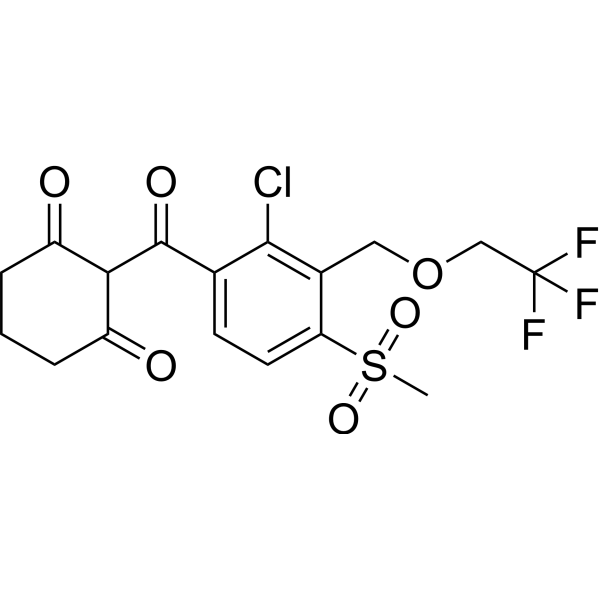
Tembotrione

Based on 1 Customer Validation
Tembotrione is a herbicide belonging to the HPPD (dioxygenase) inhibitor class with crop selectivity. Tembotrione effectively controls a variety of weeds including broadleaf and gramineous species by disrupting carotenoid synthesis, which leads to chlorophyll degradation and leaf whitening. Mixing Tembotrione with isoxaflutole or adding surfactants optimizes its efficacy and reduces phytotoxicity, with no residual impact on subsequent cruciferous crops, thus helping to increase maize grain yield. The activity of Tembotrione decreases under drought conditions, and under specific conditions (such as double-dose treatment), it may cause reversible yellowing and even yield reduction in crops such as poppy.
연구목적의 판매만을 진행합니다. 환자를 대상으로 한 판매는 하지 않습니다.
- Purity: 99.41%
- CAS No.: 335104-84-2
- 화학식: C17H16ClF3O6S
- 분자량:440.82
-
보관:Powder -20°C, 3 years , 4°C, 2 years ; In solvent -80°C, 6 months , -20°C, 1 month

To place orders, for customer services and technical support, please contact: MedChemExpress USA
Tel: 609-228-6898 E-mail: [email protected] [email protected]


-
 Biological Activity
-
Chemical Information
-
용액&용해도
- 순도&문서
- References
-
 Help & FAQs




Biological Activity
제품 설명
In Vivo
Tembotrione (120 g/ha; post-emergence spray; 15-20 DAS; with 1000 mL/ha surfactant) provides the most effective control of mixed grassy (including Bracharia ramosa) and non-grassy weeds in maize, resulting in maximum grain yields of 5333 kg/ha (2009) and 5483 kg/ha (2010) with no residual phytotoxicity to a succeeding mustard crop[2].
MedChemExpress (MCE) has not independently confirmed the accuracy of these methods. They are for reference only.
-
Animal Model:Botond[1]
-
Dosage:88 g a.i. ha-1 (single application); 176 g a.i. ha-1 (split dose); 88 g a.i. ha-1 (post mesotrione application)
-
Administration:post-emergence foliar spray; single application (88 g a.i. ha-1 single/split first dose); split application (176 g a.i. ha-1: POST 1 and POST 2); single application (88 g a.i. ha-1 POST 2, post mesotrione)
-
Result:Failed to significantly reduce total weed count or dry weight in 2012 or 2013; did not significantly reduce Chenopodium album, Fallopia convolvulus, Papaver rhoeas, or Polygonum aviculare count or dry weight in either year.
Caused transient yellowish discoloration (10-20% of foliage) 7-14 days after application, which resolved by 21 days post-treatment.
Significantly reduced total weed count in 2012 and 2013, and total weed dry weight in 2012 and 2013; significantly reduced Chenopodium album count and dry weight in both years, and Polygonum aviculare count and dry weight in both years; did not significantly reduce Fallopia convolvulus or Papaver rhoeas count or dry weight in either year.
Caused transient yellowish foliar discoloration (10-20% of foliage) 7-14 days after application, which resolved by 21 days post-treatment.


Chemical Information
-
CAS No. 335104-84-2
-
Appearance Solid
-
분자량 440.82
-
화학식 C17H16ClF3O6S
-
Color White to light yellow
-
SMILES
O=C1C(C(C2=CC=C(S(=O)(C)=O)C(COCC(F)(F)F)=C2Cl)=O)C(CCC1)=O
-
선적
Room temperature in continental US; may vary elsewhere.
-
보관
Powder -20°C 3 years 4°C 2 years In solvent -80°C 6 months -20°C 1 month


용액&용해도
In Vitro:
DMSO : 100 mg/mL (226.85 mM; Need ultrasonic; Hygroscopic DMSO has a significant impact on the solubility of product, please use newly opened DMSO)
Please refer to the solubility information to select the appropriate solvent. Once prepared, please aliquot and store the solution to prevent product inactivation from repeated freeze-thaw cycles.
Storage method and period of stock solution: -80°C, 6 months; -20°C, 1 month. When stored at -80°C, please use it within 6 months. When stored at -20°C, please use it within 1 month.
Please refer to the solubility information to select the appropriate solvent. Once prepared, please aliquot and store the solution to prevent product inactivation from repeated freeze-thaw cycles.
Storage method and period of stock solution: -80°C, 6 months; -20°C, 1 month. When stored at -80°C, please use it within 6 months. When stored at -20°C, please use it within 1 month.
Concentration (start) × Volume (start) = Concentration (final) × Volume (final)
In Vivo:
Select the appropriate dissolution method based on your experimental animal and administration route.
- For the following dissolution methods, please ensure to first prepare a clear stock solution using an In Vitro approach and then sequentially add co-solvents:
- To ensure reliable experimental results, the clarified stock solution can be appropriately stored based on storage conditions. As for the working solution for In Vivo experiments, it is recommended to prepare freshly and use it on the same day.
- The percentages shown for the solvents indicate their volumetric ratio in the final prepared solution. If precipitation or phase separation occurs during preparation, heat and/or sonication can be used to aid dissolution.
Add each solvent one by one: 10% DMSO 40% PEG300 5% Tween-80 45% Saline
Solubility: ≥ 2.5 mg/mL (5.67 mM); Clear solution
This protocol yields a clear solution of ≥ 2.5 mg/mL (saturation unknown).
Taking 1 mL working solution as an example, add 100 μL DMSO stock solution (25.0 mg/mL) to 400 μL PEG300, and mix evenly; then add 50 μL Tween-80 and mix evenly; then add 450 μL Saline to adjust the volume to 1 mL.
Preparation of Saline: Dissolve 0.9 g sodium chloride in ddH₂O and dilute to 100 mL to obtain a clear Saline solution.
In Vivo Dissolution Calculator
Please enter the basic information of animal experiments:
-
-
-
-
Recommended: Prepare an additional quantity of animals to account for potential losses during experiments.
Please enter your animal formula composition:
-
%DMSO +
Recommended: Keep the proportion of DMSO in working solution below 2% if your animal is weak.
-
%+
-
+%Tween-80 + +
-
%Saline +
The co-solvents required include: DMSO, . All of co-solvents are available by MedChemExpress (MCE). , Tween 80. All of co-solvents are available by MedChemExpress (MCE).
Working solution concentration: 0.22 mg/mL
Method for preparing stock solution: mg drug dissolved in μL DMSO. Stock solution concentration: mg/mL.
1. Take μL DMSO stock solution;
2. Add μL .
μL , mix evenly;
3. Then add μL Tween 80, mix evenly;
4. Then add μL
Please ensure that the stock solution in the first step is dissolved to a clear state, and add co-solvents in sequence. You can use ultrasonic heating (ultrasonic cleaner, recommended frequency 20-40 kHz), vortexing, etc. to assist dissolution.


순도&문서
-
Data Sheet (276 KB)
-
SDS (701 KB)
- English - EN (701 KB)
- Français - FR (701 KB)
- Deutsch - DE (701 KB)
- Norwegian - NO (701 KB)
- Español - ES (701 KB)
- Swedish - SV (701 KB)
- Italian - IT (701 KB)
- Korean - KR (701 KB)
- Portuguese - PT (701 KB)
-
Handling Instructions (2659 KB)
References


Complete Stock Solution Preparation Table
Please refer to the solubility information to select the appropriate solvent. Once prepared, please aliquot and store the solution to prevent product inactivation from repeated freeze-thaw cycles.
Storage method and period of stock solution: -80°C, 6 months; -20°C, 1 month. When stored at -80°C, please use it within 6 months. When stored at -20°C, please use it within 1 month.
| Optional Solvent | Concentration Solvent Mass | 1 mg | 5 mg | 10 mg | 25 mg |
|---|---|---|---|---|---|
| DMSO | 1 mM | 2.2685 mL | 11.3425 mL | 22.6850 mL | 56.7125 mL |
| 5 mM | 0.4537 mL | 2.2685 mL | 4.5370 mL | 11.3425 mL | |
| 10 mM | 0.2268 mL | 1.1342 mL | 2.2685 mL | 5.6712 mL | |
| 15 mM | 0.1512 mL | 0.7562 mL | 1.5123 mL | 3.7808 mL | |
| 20 mM | 0.1134 mL | 0.5671 mL | 1.1342 mL | 2.8356 mL | |
| 25 mM | 0.0907 mL | 0.4537 mL | 0.9074 mL | 2.2685 mL | |
| 30 mM | 0.0756 mL | 0.3781 mL | 0.7562 mL | 1.8904 mL | |
| 40 mM | 0.0567 mL | 0.2836 mL | 0.5671 mL | 1.4178 mL | |
| 50 mM | 0.0454 mL | 0.2268 mL | 0.4537 mL | 1.1342 mL | |
| 60 mM | 0.0378 mL | 0.1890 mL | 0.3781 mL | 0.9452 mL | |
| 80 mM | 0.0284 mL | 0.1418 mL | 0.2836 mL | 0.7089 mL | |
| 100 mM | 0.0227 mL | 0.1134 mL | 0.2268 mL | 0.5671 mL |


Tembotrione Related Classifications
HY-137910 Related Classifications
 Powered by Bioz