



LT052
Based on 3 publication(s) in Google Scholar
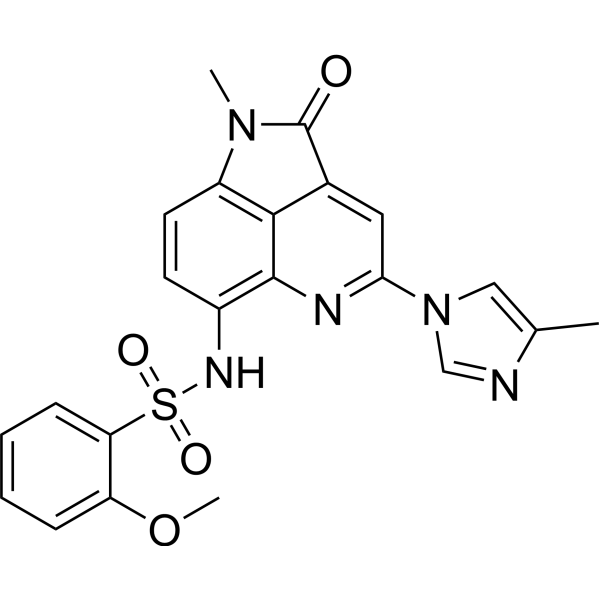
LT052 is a highly selective BET BD1 inhibitor with an IC50 of 87.7 nM. LT052 exhibits nanomolar BRD4 BD1 potency and 138-fold selectivity over BRD4 BD2 (IC50=12.130 μM). LT052 has anti-inflammatory?activity and can be used for acute gout arthritis research.
商品は「研究用試薬」です。人や動物の医療用・臨床診断用・食品用の製品ではありません。
研究用途以外に使用した場合、当社は一切の責任を負いかねます。
- 純度 : 98.02%
- CAS 番号: 2543545-44-2
- 分子式: C22H19N5O4S
- 分子量:449.48
-
保管条件:Powder -20°C, 3 years , 4°C, 2 years ; In solvent -80°C, 6 months , -20°C, 1 month

To place orders, for customer services and technical support, please contact: MedChemExpress USA
Tel: 609-228-6898 E-mail: [email protected] [email protected]


-
 生物活性
生物活性
-
化学情報
-
溶剤 & 溶解度
- プロトコル
- 純度とドキュメンテーション
- 参考文献
-
 Help & FAQs


MedChemExpress(MCE)の使用を引用している文献 LT052
More

生物活性
製品説明
IC50 & Target
[1]|
BRD4 BD1 87.7 nM (IC50) |
BRD3 BD1 246.3 nM (IC50) |
BRDT BD1 357.1 nM (IC50) |
BRPF1b 567.5 nM (IC50) |
体外実験
LT052 (1 μM) inhibits NF-κB transcriptional activity in HUVECs cells and inhibit nitric oxide (NO) production (inhibition rate: 101.89%) in RAW264.7 cells. In the evaluation of in vitro inflammatory activity, LT052 maintains comparable or better anti-inflammatory activity than the pan-BET inhibitor (JQ1) compared to the protein weak activity[1].LT052 displays the highinhibitory activity against BRD4(1) (IC50: 87.7±4.9 nM), BRD3(1) (IC50: 246.3±20.2 nM), and BRDT(1) (IC50: 357.1±8.3 nM). LT052 also has inhibitory activities against BRPF1b (IC50: 567.5±16.9 nM). Additionlly, LT052 shows a 238-fold selectivity toward BD1 over BD2 with Kd of 105 nM and >25 μM for BD1 and BD2, respectively[1].LT052 (1 μM; 1 hour) inhibits MSU-induced pyroptosis of THP-1 cells through BRD4/NF-κB/NLRP3 signaling pathways[1].
MedChemExpress (MCE) has not independently confirmed the accuracy of these methods. They are for reference only.
体内実験
LT052 suppresses pyroptosis of macrophages in rat synovial tissues through regulating BRD4/NF-κB/NLRP3 signaling pathway[1].
LT052 has a high clearance rate in the range of 93.517 μL/min/mg proteins to 146.685 μL/min/mg proteins in liver microsomes of multiple species (human, monkey, dog, rat). Overall, LT052 exhibits moderately stable levels of in vitro liver microsomal metabolism[1].
MedChemExpress (MCE) has not independently confirmed the accuracy of these methods. They are for reference only.
-
Animal Model:Male Adult Sprague-Dawley rats (250-280 g) (acute gouty arthritis animal models)[1]
-
Dosage:1 mg/kg
-
Administration:Intra-articular injection
-
Result:Restored the joint circumference to normal level.


化学情報
-
CAS 番号 2543545-44-2
-
性状 Solid
-
分子量 449.48
-
分子式 C22H19N5O4S
-
Color Yellow to orange
-
SMILES
O=S(C1=CC=CC=C1OC)(NC2=C3N=C(N4C=C(C)N=C4)C=C5C3=C(N(C)C5=O)C=C2)=O
-
輸送条件
Room temperature in continental US; may vary elsewhere.
-
保管条件
Powder -20°C 3 years 4°C 2 years In solvent -80°C 6 months -20°C 1 month


Publications (3)
-
Journal Impact Factor
-
Most Recent
-
ACS Nano
Nanopore Discrimination of Protein-Small-Molecule Drug Complexes at Near-Atomic Resolution. [Abstract]2026 May 12;20(18):13624-13635. PMID: 42046448 -
Noncoding RNA
Bromodomain and Extra-Terminal Family Proteins BRD2, BRD3, and BRD4 Contribute to H19-Dependent Transcriptional Regulation of Cell Adhesion Molecules, Modulating Metastatic Dissemination Program in Prostate Cancer. [Abstract]2025 Apr 29;11(3):33. PMID: 40407591 -
Tissue Cell
2026 Jul 16;104(Pt 1):103797. PMID: 42475798


溶剤 & 溶解度
体外:
DMSO : 10.42 mg/mL (23.18 mM; Need ultrasonic; Hygroscopic DMSO has a significant impact on the solubility of product, please use newly opened DMSO)
Please refer to the solubility information to select the appropriate solvent. Once prepared, please aliquot and store the solution to prevent product inactivation from repeated freeze-thaw cycles.
Storage method and period of stock solution: -80°C, 6 months; -20°C, 1 month. When stored at -80°C, please use it within 6 months. When stored at -20°C, please use it within 1 month.
Please refer to the solubility information to select the appropriate solvent. Once prepared, please aliquot and store the solution to prevent product inactivation from repeated freeze-thaw cycles.
Storage method and period of stock solution: -80°C, 6 months; -20°C, 1 month. When stored at -80°C, please use it within 6 months. When stored at -20°C, please use it within 1 month.
濃度 (開始) × 体積 (開始) = 濃度 (終了) × 体積 (終了)


純度とドキュメンテーション
-
データシート (281 KB)
-
SDS (251 KB)
- English - EN (251 KB)
- Français - FR (251 KB)
- Deutsch - DE (251 KB)
- Norwegian - NO (251 KB)
- Español - ES (251 KB)
- Swedish - SV (251 KB)
- Italian - IT (251 KB)
- Korean - KR (251 KB)
- Portuguese - PT (251 KB)
-
取扱説明書 (2659 KB)
参考文献
[1]. Jiang F, et al. Discovery of Benzo[cd]indol-2(1H)-ones and Pyrrolo[4,3,2-de]quinolin-2(1H)-ones as Bromodomain and Extra-Terminal Domain (BET) Inhibitors with Selectivity for the First Bromodomain with Potential High Efficiency against Acute Gouty Arthritis. J Med Chem. 2019 Dec 26;62(24):11080-11107. [Content Brief]


Complete Stock Solution Preparation Table
Please refer to the solubility information to select the appropriate solvent. Once prepared, please aliquot and store the solution to prevent product inactivation from repeated freeze-thaw cycles.
Storage method and period of stock solution: -80°C, 6 months; -20°C, 1 month. When stored at -80°C, please use it within 6 months. When stored at -20°C, please use it within 1 month.
| Optional Solvent | Concentration Solvent Mass | 1 mg | 5 mg | 10 mg | 25 mg |
|---|---|---|---|---|---|
| DMSO | 1 mM | 2.2248 mL | 11.1240 mL | 22.2479 mL | 55.6198 mL |
| 5 mM | 0.4450 mL | 2.2248 mL | 4.4496 mL | 11.1240 mL | |
| 10 mM | 0.2225 mL | 1.1124 mL | 2.2248 mL | 5.5620 mL | |
| 15 mM | 0.1483 mL | 0.7416 mL | 1.4832 mL | 3.7080 mL | |
| 20 mM | 0.1112 mL | 0.5562 mL | 1.1124 mL | 2.7810 mL |


LT052 関連分類
HY-130622 関連分類
 Powered by Bioz