



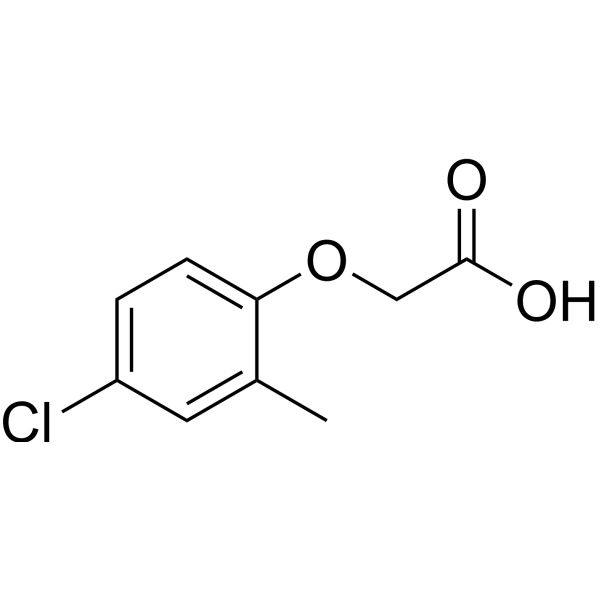
MCPA
Based on 1 publication(s) in Google Scholar
MCPA is an orally active phenoxyacetic acid herbicide. MCPA interferes with membrane integrity, energy metabolism (decreases ATP levels), and redox balance in plant cells. MCPA increases hepatic cytochrome P-450 levels and increases aniline hydroxylase and 7-ethoxycoumarin O-deethylase activities. MCPA can be used to control broadleaf weeds.
For research use only. We do not sell to patients.
- Purity : 98.17%
- CAS No.: 94-74-6
- Formula: C9H9ClO3
- Molecular Weight:200.62
-
Storage:
4°C, protect from light
* In solvent : -80°C, 6 months; -20°C, 1 month (protect from light)

To place orders, for customer services and technical support, please contact: MedChemExpress USA
Tel: 609-228-6898 E-mail: [email protected] [email protected]


-
 Biological Activity
-
Chemical Information
-
Solvent & Solubility
- Protocols
- Purity & Documentation
- References
-
 Help & FAQs



Publications Citing Use of MedChemExpress (MCE) MCPA
More

Biological Activity
Description
In Vitro
MCPA (50 μM) is taken up by Caco-2 cells mainly via monocarboxylic acid transporters shared with benzoic acid and partially via L-lactic acid[1].
MCPA (20-120 μM; 4 weeks) inhibits growth of non-green potato tuber calli, disrupts membrane integrity, reduces energy charge, and affects redox state and antioxidant enzyme activities[2].
MedChemExpress (MCE) has not independently confirmed the accuracy of these methods. They are for reference only.
In Vivo
MCPA (14C-MCPA; 5-100 mg/kg; p.o.; single or multiple doses) is rapidly absorbed and excreted mainly in urine in rats, with limited metabolism to HMCPA and glycine conjugate[5].
MedChemExpress (MCE) has not independently confirmed the accuracy of these methods. They are for reference only.


Chemical Information
-
CAS No. 94-74-6
-
Appearance Solid
-
Molecular Weight 200.62
-
Formula C9H9ClO3
-
SMILES
O=C(O)COC1=CC=C(Cl)C=C1C
-
Shipping
Room temperature in continental US; may vary elsewhere.
-
Storage
4°C, protect from light
* In solvent : -80°C, 6 months; -20°C, 1 month (protect from light)


Publications (1)
-
Journal Impact Factor
-
Most Recent
-
Anal Chem
Exposome-Scale Investigation of Cl-/Br-Containing Chemicals Using High-Resolution Mass Spectrometry, Multistage Machine Learning, and Cloud Computing. [Abstract]2025 Jun 3;97(21):11099-11109. PMID: 40401576


Solvent & Solubility
In Vitro:
DMSO : 50 mg/mL (249.23 mM; Need ultrasonic; Hygroscopic DMSO has a significant impact on the solubility of product, please use newly opened DMSO)
Please refer to the solubility information to select the appropriate solvent. Once prepared, please aliquot and store the solution to prevent product inactivation from repeated freeze-thaw cycles.
Storage method and period of stock solution: -80°C, 6 months; -20°C, 1 month (protect from light). When stored at -80°C, please use it within 6 months. When stored at -20°C, please use it within 1 month.
Please refer to the solubility information to select the appropriate solvent. Once prepared, please aliquot and store the solution to prevent product inactivation from repeated freeze-thaw cycles.
Storage method and period of stock solution: -80°C, 6 months; -20°C, 1 month (protect from light). When stored at -80°C, please use it within 6 months. When stored at -20°C, please use it within 1 month.
Concentration (start) × Volume (start) = Concentration (final) × Volume (final)
In Vivo:
Select the appropriate dissolution method based on your experimental animal and administration route.
- For the following dissolution methods, please ensure to first prepare a clear stock solution using an In Vitro approach and then sequentially add co-solvents:
- To ensure reliable experimental results, the clarified stock solution can be appropriately stored based on storage conditions. As for the working solution for In Vivo experiments, it is recommended to prepare freshly and use it on the same day.
- The percentages shown for the solvents indicate their volumetric ratio in the final prepared solution. If precipitation or phase separation occurs during preparation, heat and/or sonication can be used to aid dissolution.
Add each solvent one by one: 10% DMSO 90% (20% SBE-β-CD in Saline)
Solubility: ≥ 2.5 mg/mL (12.46 mM); Clear solution
This protocol yields a clear solution of ≥ 2.5 mg/mL (saturation unknown).
Taking 1 mL working solution as an example, add 100 μL DMSO stock solution (25.0 mg/mL) to 900 μL 20% SBE-β-CD in Saline, and mix evenly.
Preparation of 20% SBE-β-CD in Saline (4°C, storage for one week): 2 g SBE-β-CD powder is dissolved in 10 mL Saline, completely dissolve until clear.
In Vivo Dissolution Calculator
Please enter the basic information of animal experiments:
-
-
-
-
Recommended: Prepare an additional quantity of animals to account for potential losses during experiments.
Please enter your animal formula composition:
-
%DMSO +
Recommended: Keep the proportion of DMSO in working solution below 2% if your animal is weak.
-
%+
-
+%Tween-80 + +
-
%Saline +
The co-solvents required include: DMSO, . All of co-solvents are available by MedChemExpress (MCE). , Tween 80. All of co-solvents are available by MedChemExpress (MCE).
Working solution concentration: 0.22 mg/mL
Method for preparing stock solution: mg drug dissolved in μL DMSO. Stock solution concentration: mg/mL. * In solvent : -80°C, 6 months; -20°C, 1 month (protect from light)
1. Take μL DMSO stock solution;
2. Add μL .
μL , mix evenly;
3. Then add μL Tween 80, mix evenly;
4. Then add μL
Please ensure that the stock solution in the first step is dissolved to a clear state, and add co-solvents in sequence. You can use ultrasonic heating (ultrasonic cleaner, recommended frequency 20-40 kHz), vortexing, etc. to assist dissolution.


Purity & Documentation
-
Data Sheet (273 KB)
-
SDS (759 KB)
- English - EN (759 KB)
- Français - FR (759 KB)
- Deutsch - DE (759 KB)
- Norwegian - NO (759 KB)
- Español - ES (759 KB)
- Swedish - SV (759 KB)
- Italian - IT (759 KB)
- Korean - KR (759 KB)
- Portuguese - PT (759 KB)
-
Handling Instructions (2659 KB)
References
[1]. Kimura O, et al. Uptake of 4-chloro-2-methylphenoxyacetic acid (MCPA) from the apical membrane of Caco-2 cells by the monocarboxylic acid transporter. Toxicol Appl Pharmacol. 2008 Mar 15;227(3):325-30. [Content Brief]
[4]. Inomata N, et al. Effects of MCPA and other phenoxyacid compounds on hepatic xenobiotic metabolism in rats. Tohoku J Exp Med. 1991 Nov;165(3):171-82. [Content Brief]
[5]. van Ravenzwaay B, et al. Absorption, distribution, metabolism and excretion of 4-chloro-2-methylphenoxyacetic acid (MCPA) in rats. Food Chem Toxicol. 2004 Jan;42(1):115-25. [Content Brief]


Complete Stock Solution Preparation Table
Please refer to the solubility information to select the appropriate solvent. Once prepared, please aliquot and store the solution to prevent product inactivation from repeated freeze-thaw cycles.
Storage method and period of stock solution: -80°C, 6 months; -20°C, 1 month (protect from light). When stored at -80°C, please use it within 6 months. When stored at -20°C, please use it within 1 month.
| Optional Solvent | Concentration Solvent Mass | 1 mg | 5 mg | 10 mg | 25 mg |
|---|---|---|---|---|---|
| DMSO | 1 mM | 4.9845 mL | 24.9227 mL | 49.8455 mL | 124.6137 mL |
| 5 mM | 0.9969 mL | 4.9845 mL | 9.9691 mL | 24.9227 mL | |
| 10 mM | 0.4985 mL | 2.4923 mL | 4.9845 mL | 12.4614 mL | |
| 15 mM | 0.3323 mL | 1.6615 mL | 3.3230 mL | 8.3076 mL | |
| 20 mM | 0.2492 mL | 1.2461 mL | 2.4923 mL | 6.2307 mL | |
| 25 mM | 0.1994 mL | 0.9969 mL | 1.9938 mL | 4.9845 mL | |
| 30 mM | 0.1662 mL | 0.8308 mL | 1.6615 mL | 4.1538 mL | |
| 40 mM | 0.1246 mL | 0.6231 mL | 1.2461 mL | 3.1153 mL | |
| 50 mM | 0.0997 mL | 0.4985 mL | 0.9969 mL | 2.4923 mL | |
| 60 mM | 0.0831 mL | 0.4154 mL | 0.8308 mL | 2.0769 mL | |
| 80 mM | 0.0623 mL | 0.3115 mL | 0.6231 mL | 1.5577 mL | |
| 100 mM | 0.0498 mL | 0.2492 mL | 0.4985 mL | 1.2461 mL |


MCPA Related Classifications
HY-B0859 Related Classifications
 Powered by Bioz