



N-Nitrosodiethylamine
Based on 7 publication(s) in Google Scholar
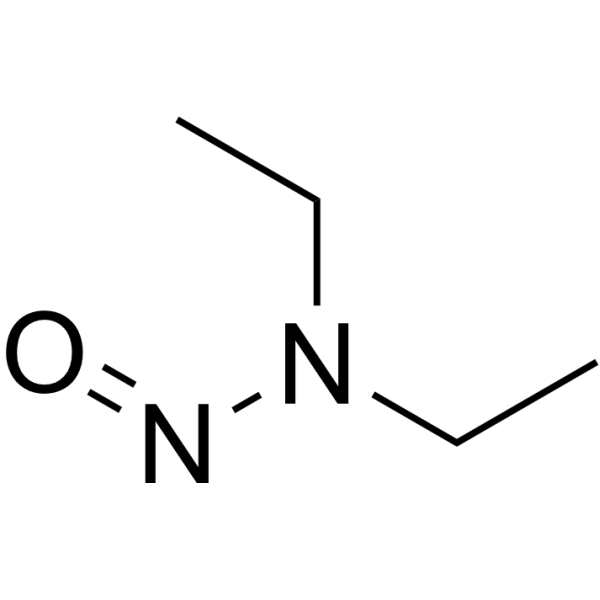
N-Nitrosodiethylamine (Diethylnitrosamine) is a potent hepatocarcinogenic dialkylnitrosoamine. N-Nitrosodiethylamine is mainly present in tobacco smoke, water, cheddar cheese, cured, fried meals and many alcoholic beverages. N-Nitrosodiethylamine is responsible for the changes in the nuclear enzymes associated with DNA repair/replication. N-Nitrosodiethylamine results in various tumors in all animal species. The main target organs are the nasal cavity, trachea, lung, esophagus and liver.
For research use only. We do not sell to patients.
- Purity : 99.98%
- CAS No.: 55-18-5
- Formula: C4H10N2O
- Molecular Weight:102.14
-
Storage:
4°C, protect from light
* In solvent : -80°C, 6 months; -20°C, 1 month (protect from light)

To place orders, for customer services and technical support, please contact: MedChemExpress USA
Tel: 609-228-6898 E-mail: [email protected] [email protected]


-
 Biological Activity
-
Chemical Information
-
Solvent & Solubility
- Purity & Documentation
- References
-
 Help & FAQs





Publications Citing Use of MedChemExpress (MCE) N-Nitrosodiethylamine
More- Drug Resist Updat. 2026 Feb 8;86:101375.
- Drug Resist Updat. 2026 Feb 8:86:101375. [Abstract]
- Cancer Lett. 2025 Aug 10:217978. [Abstract]
- Int J Biol Macromol. 2024 Mar;260(Pt 1):129432. [Abstract]
- J Agric Food Chem. 2025 Dec 31;73(52):33215-33230. [Abstract]
- Oncol Rep. 2023 Jul;50(1):142. [Abstract]
- ScieRxiv. 2025.
 Customer Validation & Images

-
WB
-
RT-PCR
-
In Vivo Efficacy Study
-
IHC
-
WB
All DNA/RNA Synthesis Isoforms
More

Biological Activity
Description
Induced Disease Models
Please do not refer to only one article to determine the experimental conditions. It is recommended to determine the optimal experimental conditions (animal strain, age, dosage, frequency and cycle, detection time and indicators, etc.) through preliminary experiments before the formal experiment.
N-Nitrosodiethylamine can be used to create hepatocellular carcinoma models. In beagle dogs, after intravenous administration, the plasma concentration of N-Nitrosodiethylamine shows a biphasic decline, with an average distribution half-life of 19 minutes, an average elimination half-life of 73 minutes, an average total body clearance of 43.3 mL/min/kg, a steady-state distribution volume of 1.9 L/kg, and an average residence time of 45 minutes. The average bioavailability of the lowest oral dose reaches 93%[3].
Administration: 0.01% NDEA through drinking water for 15 weeks • or 200 mg/kg • i.p. • single dose
(2)The rats were sacrificed by decapitation following overnight fast.
Molecular changes: A decrease in the activities of SOD, CAT, GPx, GR, G6PD and GSH.
MedChemExpress (MCE) has not independently confirmed the accuracy of these methods. They are for reference only.


Chemical Information
-
CAS No. 55-18-5
-
Appearance Liquid (Density: 0.95 g/cm3)
-
Molecular Weight 102.14
-
Formula C4H10N2O
-
Color Colorless to light yellow
-
SMILES
CCN(CC)N=O
-
Synonyms
Diethylnitrosamine; DEN; DENA
-
Structure Classification
-
Initial Source
-
Shipping
Room temperature in continental US; may vary elsewhere.
-
Storage
4°C, protect from light
* In solvent : -80°C, 6 months; -20°C, 1 month (protect from light)


Publications (7)
-
Journal Impact Factor
-
Most Recent
-
-
Drug Resist Updat
RNF26 regulating tumor immunogenicity of hepatocellular carcinoma by degrading GRP78 and instigating ER stress. [Abstract]2026 Feb 8:86:101375. PMID: 41687462 -
Cancer Lett
LGR5/mTORC2 axis regulates cellular metabolic plasticity to maintain tumorigenesis in hepatocellular carcinoma. [Abstract]2025 Aug 10:217978. PMID: 40796068
N-Nitrosodiethylamine purchased from MedChemExpress. Usage Cited in: Cancer Lett. 2025 Aug 10:217978. [Abstract]
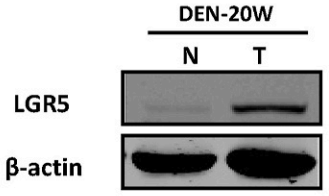
N-Nitrosodiethylamine (DEN; 200 mg/kg; ip). The protein and mRNA levels of LGR5 were tested in tumor (T) and para-tumor (N) of DEN-induced hepatoma via western blot.
N-Nitrosodiethylamine purchased from MedChemExpress. Usage Cited in: Cancer Lett. 2025 Aug 10:217978. [Abstract]
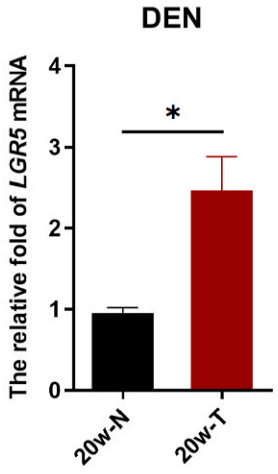
N-Nitrosodiethylamine (DEN; 200 mg/kg; ip). The protein and mRNA levels of LGR5 were tested in tumor (T) and para-tumor (N) of DEN-induced hepatoma via RT-qPCR.
-
Int J Biol Macromol
Structural abnormality of hepatic glycogen in rat liver with diethylnitrosamine-induced carcinogenic injury. [Abstract]2024 Mar;260(Pt 1):129432. PMID: 38228208 -
J Agric Food Chem
Nε-Carboxymethyl-Lysine Drives Centrosome Amplification and Hepatocarcinogenesis via Pathological Dysregulation of the PLK1-CEP20-CCDC116 Axis. [Abstract]2025 Dec 31;73(52):33215-33230. PMID: 41401801 -
Oncol Rep
Lentinan induces apoptosis of mouse hepatocellular carcinoma cells through the EGR1/PTEN/AKT signaling axis. [Abstract]2023 Jul;50(1):142. PMID: 37264970
N-Nitrosodiethylamine purchased from MedChemExpress. Usage Cited in: Oncol Rep. 2023 Jul;50(1):142. [Abstract]
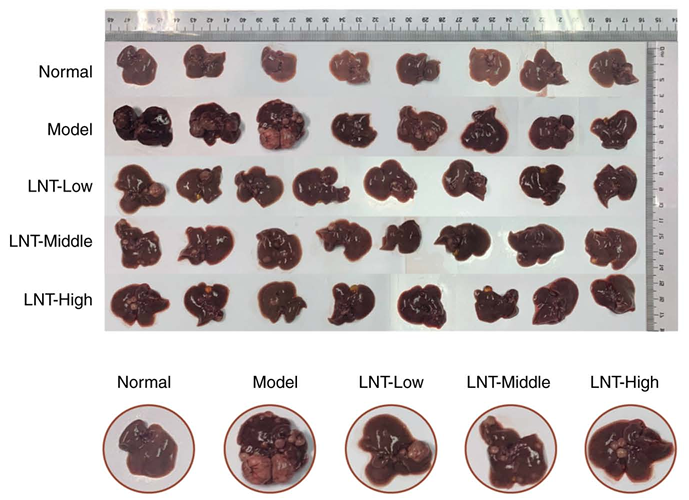
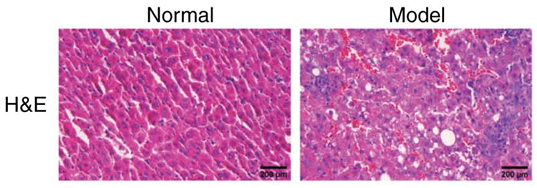
N-Nitrosodiethylamine (DEN; 40 mg/kg; ip). Histopathology of liver tissue from mice with DEN-induced primary liver cancer after LNT treatment. Histopathology of mouse liver tissues.
N-Nitrosodiethylamine purchased from MedChemExpress. Usage Cited in: Oncol Rep. 2023 Jul;50(1):142. [Abstract]
N-Nitrosodiethylamine (DEN; 40 mg/kg; ip). Histopathology of liver tissue from mice with DEN-induced primary liver cancer. H&E staining of liver tissue sections from mice.
N-Nitrosodiethylamine purchased from MedChemExpress. Usage Cited in: Oncol Rep. 2023 Jul;50(1):142. [Abstract]
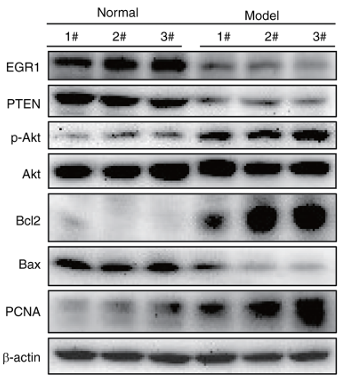
N-Nitrosodiethylamine (DEN; 40 mg/kg; ip). Inhibitory effect of LNT on DEN-induced primary liver cancer in mice. The expression levels of EGR1, PTEN and other proteins in the liver tissues of the normal group and the model group, as analyzed by WB.
-


Solvent & Solubility
In Vitro:
DMSO : 100 mg/mL (979.05 mM; Need ultrasonic; Hygroscopic DMSO has a significant impact on the solubility of product, please use newly opened DMSO)
H2O : 100 mg/mL (979.05 mM; Need ultrasonic)
Please refer to the solubility information to select the appropriate solvent. Once prepared, please aliquot and store the solution to prevent product inactivation from repeated freeze-thaw cycles.
Storage method and period of stock solution: -80°C, 6 months; -20°C, 1 month (protect from light). When stored at -80°C, please use it within 6 months. When stored at -20°C, please use it within 1 month.
* Note: If you choose water as the stock solution, please dilute it to the working solution, then filter and sterilize it with a 0.22 μm filter before use.
Please refer to the solubility information to select the appropriate solvent. Once prepared, please aliquot and store the solution to prevent product inactivation from repeated freeze-thaw cycles.
Storage method and period of stock solution: -80°C, 6 months; -20°C, 1 month (protect from light). When stored at -80°C, please use it within 6 months. When stored at -20°C, please use it within 1 month.
* Note: If you choose water as the stock solution, please dilute it to the working solution, then filter and sterilize it with a 0.22 μm filter before use.
Concentration (start) × Volume (start) = Concentration (final) × Volume (final)
In Vivo:
Select the appropriate dissolution method based on your experimental animal and administration route.
- For the following dissolution methods, please ensure to first prepare a clear stock solution using an In Vitro approach and then sequentially add co-solvents:
- To ensure reliable experimental results, the clarified stock solution can be appropriately stored based on storage conditions. As for the working solution for In Vivo experiments, it is recommended to prepare freshly and use it on the same day.
- The percentages shown for the solvents indicate their volumetric ratio in the final prepared solution. If precipitation or phase separation occurs during preparation, heat and/or sonication can be used to aid dissolution.
Add each solvent one by one: 10% DMSO 40% PEG300 5% Tween-80 45% Saline
Solubility: ≥ 2.5 mg/mL (24.48 mM); Clear solution
This protocol yields a clear solution of ≥ 2.5 mg/mL (saturation unknown).
Taking 1 mL working solution as an example, add 100 μL DMSO stock solution (25.0 mg/mL) to 400 μL PEG300, and mix evenly; then add 50 μL Tween-80 and mix evenly; then add 450 μL Saline to adjust the volume to 1 mL.
Preparation of Saline: Dissolve 0.9 g sodium chloride in ddH₂O and dilute to 100 mL to obtain a clear Saline solution.
Add each solvent one by one: 10% DMSO 90% (20% SBE-β-CD in Saline)
Solubility: ≥ 2.5 mg/mL (24.48 mM); Clear solution
This protocol yields a clear solution of ≥ 2.5 mg/mL (saturation unknown).
Taking 1 mL working solution as an example, add 100 μL DMSO stock solution (25.0 mg/mL) to 900 μL 20% SBE-β-CD in Saline, and mix evenly.
Preparation of 20% SBE-β-CD in Saline (4°C, storage for one week): 2 g SBE-β-CD powder is dissolved in 10 mL Saline, completely dissolve until clear.
For the following dissolution methods, please prepare the working solution directly:
It is recommended to prepare fresh solutions and use them promptly within a short period of time.
The percentages shown for the solvents indicate their volumetric ratio in the final prepared solution. If precipitation or phase separation occurs during preparation, heat and/or sonication can be used to aid dissolution.
Add each solvent one by one: PBS
Solubility: 100 mg/mL (979.05 mM); Clear solution; Need ultrasonic and warming and heat to 60°C
In Vivo Dissolution Calculator
Please enter the basic information of animal experiments:
-
-
-
-
Recommended: Prepare an additional quantity of animals to account for potential losses during experiments.
Working solution concentration: 0.22 mg/mL
This product has good water solubility, please refer to the measured solubility data in water/PBS/Saline for details.


Purity & Documentation
-
Data Sheet (277 KB)
-
SDS (420 KB)
- English - EN (420 KB)
- Français - FR (420 KB)
- Deutsch - DE (420 KB)
- Norwegian - NO (420 KB)
- Español - ES (420 KB)
- Swedish - SV (420 KB)
- Italian - IT (420 KB)
- Korean - KR (420 KB)
- Portuguese - PT (420 KB)
-
Handling Instructions (2659 KB)
References
[1]. Ramakrishnan G, et al. Suppression of N-nitrosodiethylamine induced hepatocarcinogenesis by silymarin in rats. Chem Biol Interact. 2006 Jun 10;161(2):104-14. [Content Brief]
[2]. Bansal AK, et al. Protective role of Vitamin E pre-treatment on N-nitrosodiethylamine induced oxidative stress in rat liver. Chem Biol Interact. 2005 Oct 20;156(2-3):101-11. [Content Brief]
[3]. Gombar CT, et al. Pharmacokinetics of N-nitrosodimethylamine in beagles. Cancer Res. 1987 Jan 15;47(2):343-7. [Content Brief]
[4]. Verna L, et al. N-nitrosodiethylamine mechanistic data and risk assessment: bioactivation, DNA-adduct formation, mutagenicity, and tumor initiation. Pharmacol Ther. 1996;71(1-2):57-81. [Content Brief]


Complete Stock Solution Preparation Table
Please refer to the solubility information to select the appropriate solvent. Once prepared, please aliquot and store the solution to prevent product inactivation from repeated freeze-thaw cycles.
Storage method and period of stock solution: -80°C, 6 months; -20°C, 1 month (protect from light). When stored at -80°C, please use it within 6 months. When stored at -20°C, please use it within 1 month.
| Optional Solvent | Concentration Solvent Mass | 1 mg | 5 mg | 10 mg | 25 mg |
|---|---|---|---|---|---|
| DMSO / H2O | 1 mM | 9.7905 mL | 48.9524 mL | 97.9048 mL | 244.7621 mL |
| 5 mM | 1.9581 mL | 9.7905 mL | 19.5810 mL | 48.9524 mL | |
| 10 mM | 0.9790 mL | 4.8952 mL | 9.7905 mL | 24.4762 mL | |
| 15 mM | 0.6527 mL | 3.2635 mL | 6.5270 mL | 16.3175 mL | |
| 20 mM | 0.4895 mL | 2.4476 mL | 4.8952 mL | 12.2381 mL | |
| 25 mM | 0.3916 mL | 1.9581 mL | 3.9162 mL | 9.7905 mL | |
| 30 mM | 0.3263 mL | 1.6317 mL | 3.2635 mL | 8.1587 mL | |
| 40 mM | 0.2448 mL | 1.2238 mL | 2.4476 mL | 6.1191 mL | |
| 50 mM | 0.1958 mL | 0.9790 mL | 1.9581 mL | 4.8952 mL | |
| 60 mM | 0.1632 mL | 0.8159 mL | 1.6317 mL | 4.0794 mL | |
| 80 mM | 0.1224 mL | 0.6119 mL | 1.2238 mL | 3.0595 mL | |
| 100 mM | 0.0979 mL | 0.4895 mL | 0.9790 mL | 2.4476 mL |
* Note: If you choose water as the stock solution, please dilute it to the working solution, then filter and sterilize it with a 0.22 μm filter before use.


N-Nitrosodiethylamine Related Classifications
HY-N7434 Related Classifications
 Powered by Bioz
Keywords