



PF-5081090

Based on 1 Customer Validation
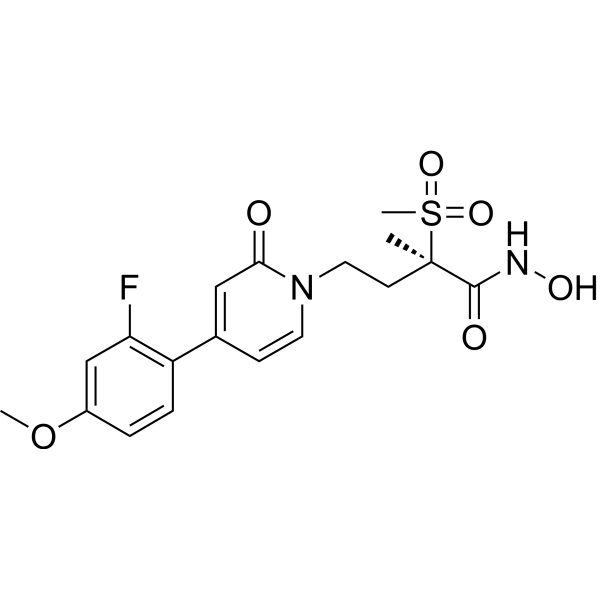
PF-5081090 (LpxC-4) is a potent LpxC inhibitor, is a rapidly bactericidal with broad-spectrum activity. PF-5081090 serves as a regulator of lipid A biosynthesis in Gram-negative pathogens.
For research use only. We do not sell to patients.
- Purity : 99.42%
- CAS No.: 1312473-63-4
- Formula: C18H21FN2O6S
- Molecular Weight:412.43
-
Storage:Powder -20°C, 3 years ; In solvent -80°C, 6 months , -20°C, 1 month

To place orders, for customer services and technical support, please contact: MedChemExpress USA
Tel: 609-228-6898 E-mail: [email protected] [email protected]


-
 Biological Activity
-
Chemical Information
-
Solvent & Solubility
- Protocols
- Purity & Documentation
- References
-
 Help & FAQs


All Antibiotic Isoforms
More

Biological Activity
Description
In Vitro
PF-5081090 shows strong potency against a broad spectrum of Gram-negative pathogens with IC50s of 1.1 nM (P. aeruginosa), 0.069 nM (K. pneumonia) and MIC90s of 1 μg/mL (P. aeruginosa, K. pneumoniae), 0.25 μg/mL (E. coli), 0.5 μg/mL (Enterobacter spp), 2 μg/mL (S. maltophilia)[1].
PF-5081090 (0.25 μg/mL; 0-50 h) demonstrates sustained bactericidal activities against P. aeruginosa UC12120 (A), PA-1955 (B), and K. pneumoniae KP-1487[1].
PF-5081090 (32 mg/L) increases antibiotic susceptibility in Acinetobacter baumannii with rifampicin, vancomycin, azithromycin, imipenem and amikacin[2].
PF-5081090 (32 mg/L) inhibits lipid A biosynthesis, and significantly increases cell permeability in A. baumannii[2].
MedChemExpress (MCE) has not independently confirmed the accuracy of these methods. They are for reference only.
In Vivo
PF-5081090 shows potent efficacies against sentinel strains of P. aeruginosa and K. pneumonia in CD-1 mice, with effective dose (ED50) ranging from 7.4-55.9 mg/kg (against acute septicemia model), <25 mg/kg (against pneumonia model), and 16.8 mg/kg (against neutropenic thigh model) in mice infected with P. aeruginosa PA-1950[1].
Pharmacokinetics of PF-5081090 in CD-1 micea[1]
| Dose (mg/kg) | Cmax (mg/L) | Tmax (h) | AUC (h mg/L) | Free AUC (h mg/L) | T1/2 (h) | CL (L/h/kg) | Vss (L/kg) |
| 18.75 | 5.02 | 0.25 | 5.09 | 1.58 | 0.6 | 3.79 | 2.20 |
| 75 | 15.50 | 0.33 | 17.60 | 5.46 | 0.69 | 4.32 | 3.30 |
| 300 | 75.40 | 0.33 | 76.30 | 23.70 | 0.68 | 3.92 | 2.53 |
MedChemExpress (MCE) has not independently confirmed the accuracy of these methods. They are for reference only.


Chemical Information
-
CAS No. 1312473-63-4
-
Appearance Solid
-
Molecular Weight 412.43
-
Formula C18H21FN2O6S
-
Color White to off-white
-
SMILES
FC1=C(C2=CC(N(CC[C@](S(C)(=O)=O)(C)C(NO)=O)C=C2)=O)C=CC(OC)=C1
-
Synonyms
LpxC-4
-
Shipping
Room temperature in continental US; may vary elsewhere.
-
Storage
Powder -20°C 3 years In solvent -80°C 6 months -20°C 1 month


Solvent & Solubility
In Vitro:
DMSO : 100 mg/mL (242.47 mM; Need ultrasonic; Hygroscopic DMSO has a significant impact on the solubility of product, please use newly opened DMSO)
Please refer to the solubility information to select the appropriate solvent. Once prepared, please aliquot and store the solution to prevent product inactivation from repeated freeze-thaw cycles.
Storage method and period of stock solution: -80°C, 6 months; -20°C, 1 month. When stored at -80°C, please use it within 6 months. When stored at -20°C, please use it within 1 month.
Please refer to the solubility information to select the appropriate solvent. Once prepared, please aliquot and store the solution to prevent product inactivation from repeated freeze-thaw cycles.
Storage method and period of stock solution: -80°C, 6 months; -20°C, 1 month. When stored at -80°C, please use it within 6 months. When stored at -20°C, please use it within 1 month.
Concentration (start) × Volume (start) = Concentration (final) × Volume (final)
In Vivo:
Select the appropriate dissolution method based on your experimental animal and administration route.
- For the following dissolution methods, please ensure to first prepare a clear stock solution using an In Vitro approach and then sequentially add co-solvents:
- To ensure reliable experimental results, the clarified stock solution can be appropriately stored based on storage conditions. As for the working solution for In Vivo experiments, it is recommended to prepare freshly and use it on the same day.
- The percentages shown for the solvents indicate their volumetric ratio in the final prepared solution. If precipitation or phase separation occurs during preparation, heat and/or sonication can be used to aid dissolution.
Add each solvent one by one: 10% DMSO 40% PEG300 5% Tween-80 45% Saline
Solubility: ≥ 2.5 mg/mL (6.06 mM); Clear solution
This protocol yields a clear solution of ≥ 2.5 mg/mL (saturation unknown).
Taking 1 mL working solution as an example, add 100 μL DMSO stock solution (25.0 mg/mL) to 400 μL PEG300, and mix evenly; then add 50 μL Tween-80 and mix evenly; then add 450 μL Saline to adjust the volume to 1 mL.
Preparation of Saline: Dissolve 0.9 g sodium chloride in ddH₂O and dilute to 100 mL to obtain a clear Saline solution.
Add each solvent one by one: 10% DMSO 90% (20% SBE-β-CD in Saline)
Solubility: ≥ 2.5 mg/mL (6.06 mM); Clear solution
This protocol yields a clear solution of ≥ 2.5 mg/mL (saturation unknown).
Taking 1 mL working solution as an example, add 100 μL DMSO stock solution (25.0 mg/mL) to 900 μL 20% SBE-β-CD in Saline, and mix evenly.
Preparation of 20% SBE-β-CD in Saline (4°C, storage for one week): 2 g SBE-β-CD powder is dissolved in 10 mL Saline, completely dissolve until clear.
In Vivo Dissolution Calculator
Please enter the basic information of animal experiments:
-
-
-
-
Recommended: Prepare an additional quantity of animals to account for potential losses during experiments.
Please enter your animal formula composition:
-
%DMSO +
Recommended: Keep the proportion of DMSO in working solution below 2% if your animal is weak.
-
%+
-
+%Tween-80 + +
-
%Saline +
The co-solvents required include: DMSO, . All of co-solvents are available by MedChemExpress (MCE). , Tween 80. All of co-solvents are available by MedChemExpress (MCE).
Working solution concentration: 0.22 mg/mL
Method for preparing stock solution: mg drug dissolved in μL DMSO. Stock solution concentration: mg/mL.
1. Take μL DMSO stock solution;
2. Add μL .
μL , mix evenly;
3. Then add μL Tween 80, mix evenly;
4. Then add μL
Please ensure that the stock solution in the first step is dissolved to a clear state, and add co-solvents in sequence. You can use ultrasonic heating (ultrasonic cleaner, recommended frequency 20-40 kHz), vortexing, etc. to assist dissolution.


Purity & Documentation
-
Data Sheet (274 KB)
-
SDS (252 KB)
- English - EN (252 KB)
- Français - FR (252 KB)
- Deutsch - DE (252 KB)
- Norwegian - NO (252 KB)
- Español - ES (252 KB)
- Swedish - SV (252 KB)
- Italian - IT (252 KB)
- Korean - KR (252 KB)
- Portuguese - PT (252 KB)
-
Handling Instructions (2659 KB)
References
[1]. Tomaras AP, et al. LpxC inhibitors as new antibacterial agents and tools for studying regulation of lipid A biosynthesis in Gram-negative pathogens. mBio. 2014 Sep 30;5(5):e01551-14. [Content Brief]
[2]. García-Quintanilla M, et al. Inhibition of LpxC Increases Antibiotic Susceptibility in Acinetobacter baumannii. Antimicrob Agents Chemother. 2016 Jul 22;60(8):5076-9. [Content Brief]


Complete Stock Solution Preparation Table
Please refer to the solubility information to select the appropriate solvent. Once prepared, please aliquot and store the solution to prevent product inactivation from repeated freeze-thaw cycles.
Storage method and period of stock solution: -80°C, 6 months; -20°C, 1 month. When stored at -80°C, please use it within 6 months. When stored at -20°C, please use it within 1 month.
| Optional Solvent | Concentration Solvent Mass | 1 mg | 5 mg | 10 mg | 25 mg |
|---|---|---|---|---|---|
| DMSO | 1 mM | 2.4247 mL | 12.1233 mL | 24.2465 mL | 60.6163 mL |
| 5 mM | 0.4849 mL | 2.4247 mL | 4.8493 mL | 12.1233 mL | |
| 10 mM | 0.2425 mL | 1.2123 mL | 2.4247 mL | 6.0616 mL | |
| 15 mM | 0.1616 mL | 0.8082 mL | 1.6164 mL | 4.0411 mL | |
| 20 mM | 0.1212 mL | 0.6062 mL | 1.2123 mL | 3.0308 mL | |
| 25 mM | 0.0970 mL | 0.4849 mL | 0.9699 mL | 2.4247 mL | |
| 30 mM | 0.0808 mL | 0.4041 mL | 0.8082 mL | 2.0205 mL | |
| 40 mM | 0.0606 mL | 0.3031 mL | 0.6062 mL | 1.5154 mL | |
| 50 mM | 0.0485 mL | 0.2425 mL | 0.4849 mL | 1.2123 mL | |
| 60 mM | 0.0404 mL | 0.2021 mL | 0.4041 mL | 1.0103 mL | |
| 80 mM | 0.0303 mL | 0.1515 mL | 0.3031 mL | 0.7577 mL | |
| 100 mM | 0.0242 mL | 0.1212 mL | 0.2425 mL | 0.6062 mL |


PF-5081090 Related Classifications
HY-103251 Related Classifications
 Powered by Bioz