



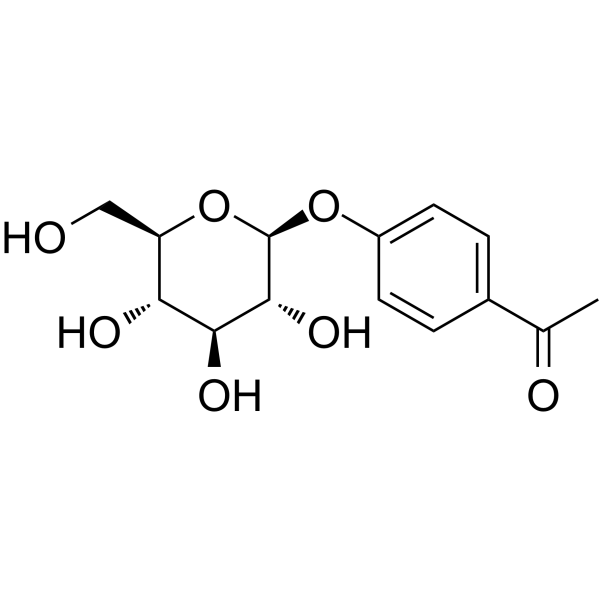
Picein
Based on 1 publication(s) in Google Scholar
Picein is an antioxidant and anti-inflammatory agent. Picein can be isolated from the leaves of Picrorhiza kurroa. Picein reduces MDA levels and increases the levels of SOD, GPX and TAC. Picein alleviates oxidative stress and promotes bone regeneration in osteoporotic bone defects by inhibiting Ferroptosis (via activation of the Nrf2/HO-1/GPX4 pathway). Picein prevents scopolamine (HY-N0296)-induced passive avoidance memory impairment in rats. Picein can be used in research related to osteoporotic bone defects and Alzheimer's disease.
연구목적의 판매만을 진행합니다. 환자를 대상으로 한 판매는 하지 않습니다.
- Purity : 99.98%
- CAS No.: 530-14-3
- 화학식: C14H18O7
- 분자량:298.29
-
보관:
4°C, protect from light
* In solvent : -80°C, 6 months; -20°C, 1 month (protect from light)

To place orders, for customer services and technical support, please contact: MedChemExpress USA
Tel: 609-228-6898 E-mail: [email protected] [email protected]


-
 Biological Activity
-
Chemical Information
-
용액&용해도
- Protocol
- 순도&문서
- References
-
 Help & FAQs


Publications Citing Use of MedChemExpress (MCE) Picein
More

Biological Activity
제품 설명
IC50 & Target
[1]|
HO-1 |
GPX4 |
Cellular Effect
|
Cell Line

|
Type | Value | Description | References |
|---|---|---|---|---|
| HepG2 2.2.15 | CC50 |
>3947.9 μM
Compound: 2
|
Cytotoxicity against human HepG 2.2.15 cells by MTT assay
Cytotoxicity against human HepG 2.2.15 cells by MTT assay
|
[PMID: 25737008] |
| HepG2 2.2.15 | IC50 |
>3947.9 μM
Compound: 2
|
Antiviral activity against hepatitis B viral in human HepG2.2.15 cells assessed as surface antigen HBeAg secretion after 72 hrs by ELISA
Antiviral activity against hepatitis B viral in human HepG2.2.15 cells assessed as surface antigen HBeAg secretion after 72 hrs by ELISA
|
[PMID: 25737008] |
| HepG2 2.2.15 | IC50 |
>3947.9 μM
Compound: 2
|
Antiviral activity against hepatitis B viral in human HepG2.2.15 cells assessed as surface antigen HBsAg secretion after 72 hrs by ELISA
Antiviral activity against hepatitis B viral in human HepG2.2.15 cells assessed as surface antigen HBsAg secretion after 72 hrs by ELISA
|
[PMID: 25737008] |
| HepG2 2.2.15 | IC50 |
227.8 μM
Compound: 2
|
Antiviral activity against hepatitis B viral in human HepG2.2.15 cells assessed as decrease in viral DNA replication treated for 7 days by real time PCR analysis
Antiviral activity against hepatitis B viral in human HepG2.2.15 cells assessed as decrease in viral DNA replication treated for 7 days by real time PCR analysis
|
[PMID: 25737008] |
In Vitro
Picein (10-80 μM; 24 h) shows no toxicity to rat bone marrow mesenchymal stem cells (BMSCs), and Picein (80 μM; 2 h pretreatment followed by 24, 48, 72 h erastin incubation) significantly restores the viability of rat BMSCs impaired by Erastin[1].
Picein (80 μM) significantly restores the viability of HUVECs impaired by Erastin[1].
Picein (80 μM; 48 h) significantly promotes M2 polarization of Raw 264.7 macrophages and reverses the inhibitory effect of 5 μM erastin[1].
Picein (for 7-21 days) significantly reverses the inhibitory effect of 5 μM erastin on osteogenic differentiation of rat bone marrow mesenchymal stem cells (BMSCs), which is verified by increased alkaline phosphatase (ALP) activity, enhanced mineralization level, and upregulated expression of osteogenesis-related proteins and genes[1].
Picein reduces ROS levels and restores mitochondrial function in neuroblastoma SH-SY5Y cells treated with Menadione (HY-B0332), indicating its potential as a neuroprotective agent[3].
MedChemExpress (MCE) has not independently confirmed the accuracy of these methods. They are for reference only.
In Vivo
Picein (1.25-5 mg/kg; i.c.v.; daily; 7 days), most potently at 2.5 mg/kg, reduces hippocampal oxidative stress, increases neuronal density, and reverses scopolamine-induced passive avoidance memory impairment in male Wistar rats[3].
MedChemExpress (MCE) has not independently confirmed the accuracy of these methods. They are for reference only.


Chemical Information
-
CAS No. 530-14-3
-
Appearance Solid
-
분자량 298.29
-
화학식 C14H18O7
-
Color Off-white to light yellow
-
SMILES
O[C@H]([C@H]([C@@H]([C@H](O1)CO)O)O)[C@@H]1OC2=CC=C(C=C2)C(C)=O
-
Structure Classification
-
Initial Source
-
선적
Room temperature in continental US; may vary elsewhere.
-
보관
4°C, protect from light
* In solvent : -80°C, 6 months; -20°C, 1 month (protect from light)


Publications (1)
-
Journal Impact Factor
-
Most Recent
-
Environ Toxicol
Picein alleviates oxidative stress and promotes bone regeneration in osteoporotic bone defect by inhibiting ferroptosis via Nrf2/HO-1/GPX4 pathway. [Abstract]2024 Jul;39(7):4066-4085. PMID: 38727095


용액&용해도
In Vitro:
DMSO : 200 mg/mL (670.49 mM; Need ultrasonic; Hygroscopic DMSO has a significant impact on the solubility of product, please use newly opened DMSO)
Please refer to the solubility information to select the appropriate solvent. Once prepared, please aliquot and store the solution to prevent product inactivation from repeated freeze-thaw cycles.
Storage method and period of stock solution: -80°C, 6 months; -20°C, 1 month (protect from light). When stored at -80°C, please use it within 6 months. When stored at -20°C, please use it within 1 month.
Please refer to the solubility information to select the appropriate solvent. Once prepared, please aliquot and store the solution to prevent product inactivation from repeated freeze-thaw cycles.
Storage method and period of stock solution: -80°C, 6 months; -20°C, 1 month (protect from light). When stored at -80°C, please use it within 6 months. When stored at -20°C, please use it within 1 month.
Concentration (start) × Volume (start) = Concentration (final) × Volume (final)
In Vivo:
Select the appropriate dissolution method based on your experimental animal and administration route.
- For the following dissolution methods, please ensure to first prepare a clear stock solution using an In Vitro approach and then sequentially add co-solvents:
- To ensure reliable experimental results, the clarified stock solution can be appropriately stored based on storage conditions. As for the working solution for In Vivo experiments, it is recommended to prepare freshly and use it on the same day.
- The percentages shown for the solvents indicate their volumetric ratio in the final prepared solution. If precipitation or phase separation occurs during preparation, heat and/or sonication can be used to aid dissolution.
Add each solvent one by one: 10% DMSO 40% PEG300 5% Tween-80 45% Saline
Solubility: ≥ 5 mg/mL (16.76 mM); Clear solution
This protocol yields a clear solution of ≥ 5 mg/mL (saturation unknown).
Taking 1 mL working solution as an example, add 100 μL DMSO stock solution (50.0 mg/mL) to 400 μL PEG300, and mix evenly; then add 50 μL Tween-80 and mix evenly; then add 450 μL Saline to adjust the volume to 1 mL.
Preparation of Saline: Dissolve 0.9 g sodium chloride in ddH₂O and dilute to 100 mL to obtain a clear Saline solution.
Add each solvent one by one: 10% DMSO 90% (20% SBE-β-CD in Saline)
Solubility: ≥ 5 mg/mL (16.76 mM); Clear solution
This protocol yields a clear solution of ≥ 5 mg/mL (saturation unknown).
Taking 1 mL working solution as an example, add 100 μL DMSO stock solution (50.0 mg/mL) to 900 μL 20% SBE-β-CD in Saline, and mix evenly.
Preparation of 20% SBE-β-CD in Saline (4°C, storage for one week): 2 g SBE-β-CD powder is dissolved in 10 mL Saline, completely dissolve until clear.
In Vivo Dissolution Calculator
Please enter the basic information of animal experiments:
-
-
-
-
Recommended: Prepare an additional quantity of animals to account for potential losses during experiments.
Please enter your animal formula composition:
-
%DMSO +
Recommended: Keep the proportion of DMSO in working solution below 2% if your animal is weak.
-
%+
-
+%Tween-80 + +
-
%Saline +
The co-solvents required include: DMSO, . All of co-solvents are available by MedChemExpress (MCE). , Tween 80. All of co-solvents are available by MedChemExpress (MCE).
Working solution concentration: 0.22 mg/mL
Method for preparing stock solution: mg drug dissolved in μL DMSO. Stock solution concentration: mg/mL. * In solvent : -80°C, 6 months; -20°C, 1 month (protect from light)
1. Take μL DMSO stock solution;
2. Add μL .
μL , mix evenly;
3. Then add μL Tween 80, mix evenly;
4. Then add μL
Please ensure that the stock solution in the first step is dissolved to a clear state, and add co-solvents in sequence. You can use ultrasonic heating (ultrasonic cleaner, recommended frequency 20-40 kHz), vortexing, etc. to assist dissolution.


순도&문서
-
Data Sheet (277 KB)
-
SDS (252 KB)
- English - EN (252 KB)
- Français - FR (252 KB)
- Deutsch - DE (252 KB)
- Norwegian - NO (252 KB)
- Español - ES (252 KB)
- Swedish - SV (252 KB)
- Italian - IT (252 KB)
- Korean - KR (252 KB)
- Portuguese - PT (252 KB)
-
Handling Instructions (2659 KB)
References
[1]. Huang L, et al. Picein alleviates oxidative stress and promotes bone regeneration in osteoporotic bone defect by inhibiting ferroptosis via Nrf2/HO-1/GPX4 pathway. Environ Toxicol. 2024;39(7):4066-4085. [Content Brief]
[2]. Kant K, et al. Evaluation of Antioxidant Activity of Picrorhiza kurroa (Leaves) Extracts. Indian J Pharm Sci. 2013;75(3):324-329. [Content Brief]
[3]. Elyasi L, et al. The Effect of Picein on Inhibitory Avoidance Memory and Activity of Antioxidant Enzymes in Hippocampus of Male Rats with Scopolamine-Induced Injury. Mol Neurobiol. 2025;62(6):7835-7845. [Content Brief]


Complete Stock Solution Preparation Table
Please refer to the solubility information to select the appropriate solvent. Once prepared, please aliquot and store the solution to prevent product inactivation from repeated freeze-thaw cycles.
Storage method and period of stock solution: -80°C, 6 months; -20°C, 1 month (protect from light). When stored at -80°C, please use it within 6 months. When stored at -20°C, please use it within 1 month.
| Optional Solvent | Concentration Solvent Mass | 1 mg | 5 mg | 10 mg | 25 mg |
|---|---|---|---|---|---|
| DMSO | 1 mM | 3.3524 mL | 16.7622 mL | 33.5244 mL | 83.8111 mL |
| 5 mM | 0.6705 mL | 3.3524 mL | 6.7049 mL | 16.7622 mL | |
| 10 mM | 0.3352 mL | 1.6762 mL | 3.3524 mL | 8.3811 mL | |
| 15 mM | 0.2235 mL | 1.1175 mL | 2.2350 mL | 5.5874 mL | |
| 20 mM | 0.1676 mL | 0.8381 mL | 1.6762 mL | 4.1906 mL | |
| 25 mM | 0.1341 mL | 0.6705 mL | 1.3410 mL | 3.3524 mL | |
| 30 mM | 0.1117 mL | 0.5587 mL | 1.1175 mL | 2.7937 mL | |
| 40 mM | 0.0838 mL | 0.4191 mL | 0.8381 mL | 2.0953 mL | |
| 50 mM | 0.0670 mL | 0.3352 mL | 0.6705 mL | 1.6762 mL | |
| 60 mM | 0.0559 mL | 0.2794 mL | 0.5587 mL | 1.3969 mL | |
| 80 mM | 0.0419 mL | 0.2095 mL | 0.4191 mL | 1.0476 mL | |
| 100 mM | 0.0335 mL | 0.1676 mL | 0.3352 mL | 0.8381 mL |


Picein Related Classifications
HY-N8698 Related Classifications
 Powered by Bioz
Keywords
- Picein
- 530-14-3
- SOD
- Ferroptosis
- Keap1-Nrf2
- Heme Oxygenase (HO)
- Glutathione Peroxidase
- endothelial cells
- osteoporotic bone defect rat models
- scopolamine-injured rats
- bone marrow mesenchymal stem cells
- SH-SY5Y cells
- M2 macrophages
- ferroptosis
- HUVECs
- Raw 264.7 macrophages
- Nrf2/HO-1/GPX4 pathway
- Inhibitor
- inhibitor
- inhibit