



PROTAC IRAK3 degrader-1
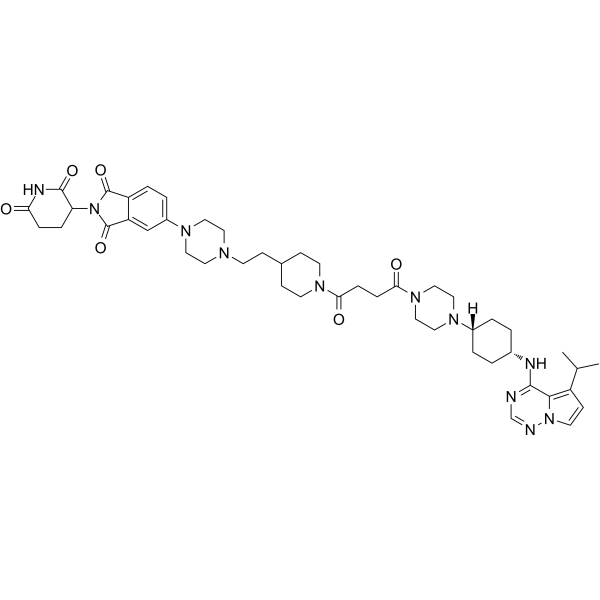
PROTAC IRAK3 degrader-1 is a potent and selective IRAK3 degrader with a DC50 of 0.002 μM. PROTAC IRAK3 degrader-1 induces proteasome-dependent degradation of IRAK3 via ternary complex formation with IRAK3 and CRBN. PROTAC IRAK3 degrader-1 can be used for cancer research.
(Pink: IRAK3 Target protein ligand; Blue: Cereblon ligand (HY-14658); Black: linker).
For research use only. We do not sell to patients.
- CAS No.: 2712600-00-3
- Formula: C47H63N11O6
- Molecular Weight:878.07
-
Storage:
Please store the product under the recommended conditions in the Certificate of Analysis.

To place orders, for customer services and technical support, please contact: MedChemExpress USA
Tel: 609-228-6898 E-mail: [email protected] [email protected]


-
 Biological Activity
-
Chemical Information
- Purity & Documentation
- References
-
 Help & FAQs


All PROTACs Isoforms
More

Biological Activity
Description
IC50 & Target
[1]|
IRAK3 5 nM (IC50) |
IRAK4 1.4 μM (IC50) |
In Vitro
PROTAC IRAK3 degrader-1 (compound 23) potently and selectively binds to recombinant IRAK3 with an IC50 of 5 nM, with 280-fold selectivity over IRAK4[1].
PROTAC IRAK3 degrader-1 binds to recombinant CRBN with an IC50 of 460 nM[1].
PROTAC IRAK3 degrader-1 shows primary selectivity for recombinant IRAK3 in a 400-kinase panel, with weaker inhibition of CDK11, CDK8, TRKC, and GSG2[1].
PROTAC IRAK3 degrader-1 selectively binds to IRAK3 in a chemoproteomic assay, with an apparent binding constant of 34 nM and >20-fold selectivity over all other detected targets[1].
PROTAC IRAK3 degrader-1 (0.0003-10 μM; 2-48 h) potently degrades IRAK3 in THP1 cells, sustained degradation[1].
PROTAC IRAK3 degrader-1 (0.1 μM; 8 h) selectively decreases IRAK3 protein levels in THP1 cells, with only minimal off-target effects on DHCR24 and no degradation of IKZF1, GSPT1, IRAK1, or IRAK4[1].
PROTAC IRAK3 degrader-1 (0.3 μM; 8-32 h) induces significant, sustained IRAK3 degradation in primary human macrophages, and this activity is unaffected by LPS stimulation[1].
MedChemExpress (MCE) has not independently confirmed the accuracy of these methods. They are for reference only. .
-
Cell Line:THP1 monocytic cancer cells
-
Concentration:0.0003; 0.001; 0.003; 0.01; 0.03; 0.1; 0.3; 1; 3; 10 μM
-
Incubation Time:2; 4; 6; 8; 16; 24; 48 h
-
Result:Induced potent IRAK3 degradation with a DC50 of 2 nM and maximum degradation (Dmax) of 98% after 16 h.
Achieved maximal degradation at 0.1 μM after 24 h.
Detected degradation as early as 2 h after treatment with 0.1 μM, which persisted up to 48 h.
Allowed full IRAK3 recovery 24 h after compound washout.
-
Cell Line:THP1 monocytic cancer cells
-
Concentration:0.1; 0.3; 1; 3; 10 μM
-
Incubation Time:6; 24 h
-
Result:Fully rescued IRAK3 degradation when cells were pretreated with proteasome inhibitor MG132 or NEDD8-activating enzyme inhibitor MLN4924.
Prevented IRAK3 degradation when cells were pretreated with excess IRAK3 ligand 5 or thalidomide.


Chemical Information
-
CAS No. 2712600-00-3
-
Molecular Weight 878.07
-
Formula C47H63N11O6
-
SMILES
O=C1C2=CC(N3CCN(CC3)CCC4CCN(CC4)C(CCC(N5CCN([C@@]6([H])CC[C@H](CC6)NC7=NC=NN8C7=C(C(C)C)C=C8)CC5)=O)=O)=CC=C2C(N1C9C(NC(CC9)=O)=O)=O
-
Shipping
Room temperature in continental US; may vary elsewhere.
-
Storage
Please store the product under the recommended conditions in the Certificate of Analysis.


Purity & Documentation
References

Calculators
Concentration (start) × Volume (start) = Concentration (final) × Volume (final)


PROTAC IRAK3 degrader-1 Related Classifications
HY-142662 Related Classifications
 Powered by Bioz