



PT-129

Based on 1 Customer Validation
PT-129 is a G3BP1/G3BP2 PROTAC degrader. PT-129 inhibits the formation of stress granules, disassembles pre-existing stress granules, disrupts stress granule-mediated ATF4 trafficking via migratory exocytosis, and suppresses cancer cell proliferation. PT-129 is applicable to the research of lung cancer and melanoma.
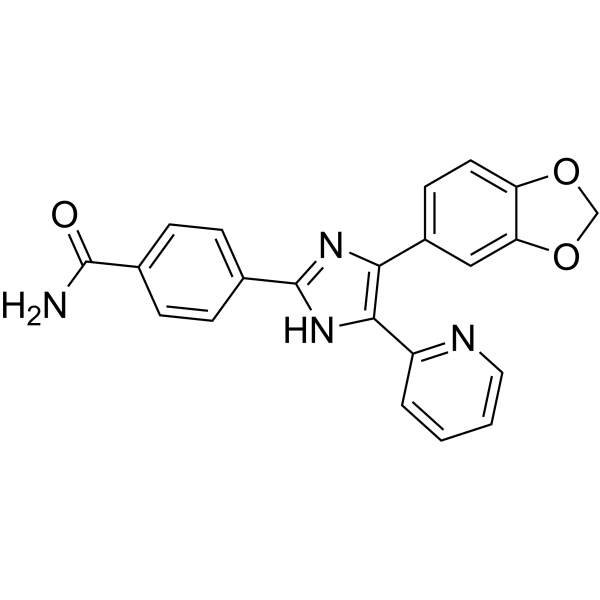
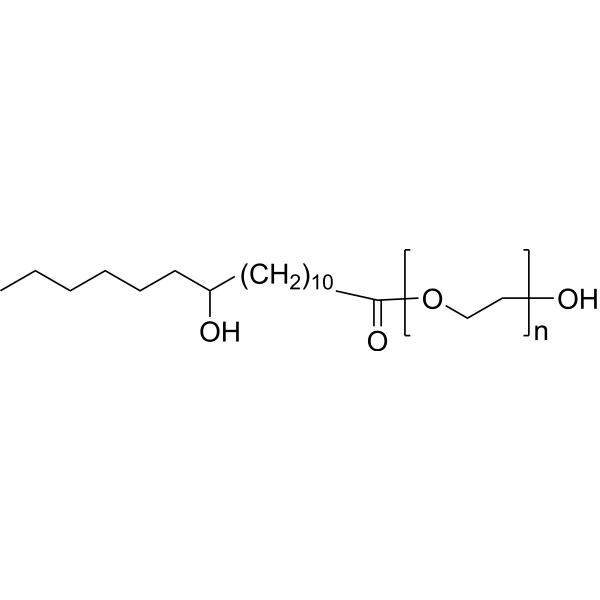
(Pink: G3BP1 and G3BP2 ligand (HY-170873); Blue: Cereblon ligand (HY-41547); Black: linker (HY-W040165)).
For research use only. We do not sell to patients.
- Purity : 98.66%
- CAS No.: 3126212-40-3
- Formula: C46H48N8O12S
- Molecular Weight:936.98
-
Storage:Powder -20°C, 3 years ; In solvent -80°C, 6 months , -20°C, 1 month


To place orders, for customer services and technical support, please contact: MedChemExpress USA
Tel: 609-228-6898 E-mail: [email protected] [email protected]


-
 Biological Activity
-
Chemical Information
-
Solvent & Solubility
- Protocols
- Purity & Documentation
- References
-
 Help & FAQs




Biological Activity
Description
IC50 & Target
G3BP1/2, ATF4[1]
In Vitro
PT-129 (0.1-10 μM; 0-12 h) induces proteasome-dependent, dose- and time-dependent degradation of G3BP1 and G3BP2 in L929 cells, with maximum degradation (95% for G3BP1) achieved at 5 or 10 μM after 12 h of treatment[1].
PT-129 (5 μM; 3 h pretreatment) inhibits arsenate-induced stress granule formation in 293T cells expressing GFP-Caprin1, and (10 μM; 0.5-4 h) dissolves preformed stress granules in these cells, reducing granule counts to near 0 by 4 h[1].
PT-129 (5 μM; 0-24 h) selectively depletes G3BP1/2 and downregulates their associated signaling proteins, as well as core stress granule proteins, in A549 cells, with progressive reductions in target protein levels observed over 24 h of treatment[1].
PT-129 (5 μM; 12 h) pretreatment of CAFs inhibits the ability of CAFs to promote the proliferation of cocultured A549 mCherry cells[1].
PT-129 (5 μM; 12 h) pretreatment of L929 TSPAN4-GFP cells disrupts stress granule-dependent transport of ATF4 from fibroblasts to cocultured LLC-RFP cancer cells under arsenate stress conditions[1].
MedChemExpress (MCE) has not independently confirmed the accuracy of these methods. They are for reference only.
-
Cell Line:A549 cells
-
Concentration:5 μM
-
Incubation Time:12 h; 0, 4, 8, 12, 24 h (time-course)
-
Result:Significantly reduced levels of G3BP1, G3BP2, STAT1, STAT3, EIF4B, JAK1, and RELA in A549 cells.
Decreased levels of G3BP1, G3BP2, STAT1, STAT3, EIF4B, JAK1, and RELA progressively over 24 h, with the largest reductions observed at 24 h.
Downregulated 34 key stress granule core proteins in PT-129-treated A549 cells.
-
Cell Line:A549 mCherry cells, cancer-associated fibroblasts (CAFs)
-
Concentration:5 μM (CAF pretreatment)
-
Incubation Time:12 h (CAF pretreatment); 48 h (coculture)
-
Result:Caused a significant reduction in relative proliferation of A549 mCherry cells cocultured with PT-129-pretreated CAFs compared to cells cocultured with DMSO-pretreated CAFs.
In Vivo
PT-129 (5 μM; subcutaneous injection; single administration) improves survival rate, reduces the number of pulmonary metastatic nodules, decreases the expression of G3BP1 and ATF4 in lung tissues, and inhibits the formation of stress granules in cancer-associated fibroblasts (CAFs) in a C57BL/6 mouse melanoma metastasis model[1].
MedChemExpress (MCE) has not independently confirmed the accuracy of these methods. They are for reference only.
-
Animal Model:BALB/c[1]
-
Dosage:5 μM (in vitro pretreatment of CAFs/NFs)
-
Administration:subcutaneous injection; single administration
-
Result:Significantly reduced tumor volume compared to DMSO-pretreated CAFs group.
Significantly reduced G3BP1 and ATF4 protein expression in tumor tissues.
-
Animal Model:C57BL/6[1]
-
Dosage:5 μM (in vitro pretreatment of CAFs/NFs)
-
Administration:subcutaneous injection; single administration
-
Result:Improved survival compared to DMSO-pretreated CAFs group.
Significantly reduced number of melanoma metastatic nodules in lung tissues.
Significantly reduced G3BP1 and ATF4 protein expression in lung tissues.
Significantly inhibited stress granule formation in CAFs isolated from lung tissues.
- BrdU Incorporation Assay
- Somatic Cell Culture
- CFSE Dye Dilution Proliferation Assay
- Dye-dilution cell tracking and proliferation staining
- CCK-8/WST-8 Cell Proliferation Assay
- Protocol for Cell Cycle
- Cell Counting-Based Growth Curve Assay
- Colony Formation (Clonogenic) Assay
- Cell Viability Determination by MTT Colorimetric Assay
- EdU Incorporation Assay (Click Chemistry-Based DNA Synthesis Measurement)
- Ki-67 Immunostaining Proliferation Assay
- PCNA Immunodetection Proliferation Assay
- Protocol for Cell Counting and Cell Density Analysis
- MTT Cell Proliferation Assay


Chemical Information
-
CAS No. 3126212-40-3
-
Appearance Solid
-
Molecular Weight 936.98
-
Formula C46H48N8O12S
-
Color Light yellow to yellow
-
SMILES
O=C(NC1=CC=C(NC(CCOCCOCCOCCNC2=CC=CC(C(N3C(CC4)C(NC4=O)=O)=O)=C2C3=O)=O)C=C1)[C@@H](NS(=O)(CC(N5N=CC6=C5C=CC=C6)=O)=O)CC7=CC=CC=C7
-
Shipping
Room temperature in continental US; may vary elsewhere.
-
Storage
Powder -20°C 3 years In solvent -80°C 6 months -20°C 1 month


Solvent & Solubility
In Vitro:
DMSO : 100 mg/mL (106.73 mM; Need ultrasonic; Hygroscopic DMSO has a significant impact on the solubility of product, please use newly opened DMSO)
Please refer to the solubility information to select the appropriate solvent. Once prepared, please aliquot and store the solution to prevent product inactivation from repeated freeze-thaw cycles.
Storage method and period of stock solution: -80°C, 6 months; -20°C, 1 month. When stored at -80°C, please use it within 6 months. When stored at -20°C, please use it within 1 month.
Please refer to the solubility information to select the appropriate solvent. Once prepared, please aliquot and store the solution to prevent product inactivation from repeated freeze-thaw cycles.
Storage method and period of stock solution: -80°C, 6 months; -20°C, 1 month. When stored at -80°C, please use it within 6 months. When stored at -20°C, please use it within 1 month.
Concentration (start) × Volume (start) = Concentration (final) × Volume (final)
In Vivo:
Select the appropriate dissolution method based on your experimental animal and administration route.
- For the following dissolution methods, please ensure to first prepare a clear stock solution using an In Vitro approach and then sequentially add co-solvents:
- To ensure reliable experimental results, the clarified stock solution can be appropriately stored based on storage conditions. As for the working solution for In Vivo experiments, it is recommended to prepare freshly and use it on the same day.
- The percentages shown for the solvents indicate their volumetric ratio in the final prepared solution. If precipitation or phase separation occurs during preparation, heat and/or sonication can be used to aid dissolution.
Add each solvent one by one: 10% DMSO 40% PEG300 5% Tween-80 45% Saline
Solubility: ≥ 2.5 mg/mL (2.67 mM); Clear solution
This protocol yields a clear solution of ≥ 2.5 mg/mL (saturation unknown).
Taking 1 mL working solution as an example, add 100 μL DMSO stock solution (25.0 mg/mL) to 400 μL PEG300, and mix evenly; then add 50 μL Tween-80 and mix evenly; then add 450 μL Saline to adjust the volume to 1 mL.
Preparation of Saline: Dissolve 0.9 g sodium chloride in ddH₂O and dilute to 100 mL to obtain a clear Saline solution.
In Vivo Dissolution Calculator
Please enter the basic information of animal experiments:
-
-
-
-
Recommended: Prepare an additional quantity of animals to account for potential losses during experiments.
Please enter your animal formula composition:
-
%DMSO +
Recommended: Keep the proportion of DMSO in working solution below 2% if your animal is weak.
-
%+
-
+%Tween-80 + +
-
%Saline +
The co-solvents required include: DMSO, . All of co-solvents are available by MedChemExpress (MCE). , Tween 80. All of co-solvents are available by MedChemExpress (MCE).
Working solution concentration: 0.22 mg/mL
Method for preparing stock solution: mg drug dissolved in μL DMSO. Stock solution concentration: mg/mL.
1. Take μL DMSO stock solution;
2. Add μL .
μL , mix evenly;
3. Then add μL Tween 80, mix evenly;
4. Then add μL
Please ensure that the stock solution in the first step is dissolved to a clear state, and add co-solvents in sequence. You can use ultrasonic heating (ultrasonic cleaner, recommended frequency 20-40 kHz), vortexing, etc. to assist dissolution.


Purity & Documentation
-
Data Sheet (280 KB)
-
SDS (252 KB)
- English - EN (252 KB)
- Français - FR (252 KB)
- Deutsch - DE (252 KB)
- Norwegian - NO (252 KB)
- Español - ES (252 KB)
- Swedish - SV (252 KB)
- Italian - IT (252 KB)
- Korean - KR (252 KB)
- Portuguese - PT (252 KB)
-
Handling Instructions (2659 KB)
References


Complete Stock Solution Preparation Table
Please refer to the solubility information to select the appropriate solvent. Once prepared, please aliquot and store the solution to prevent product inactivation from repeated freeze-thaw cycles.
Storage method and period of stock solution: -80°C, 6 months; -20°C, 1 month. When stored at -80°C, please use it within 6 months. When stored at -20°C, please use it within 1 month.
| Optional Solvent | Concentration Solvent Mass | 1 mg | 5 mg | 10 mg | 25 mg |
|---|---|---|---|---|---|
| DMSO | 1 mM | 1.0673 mL | 5.3363 mL | 10.6726 mL | 26.6815 mL |
| 5 mM | 0.2135 mL | 1.0673 mL | 2.1345 mL | 5.3363 mL | |
| 10 mM | 0.1067 mL | 0.5336 mL | 1.0673 mL | 2.6681 mL | |
| 15 mM | 0.0712 mL | 0.3558 mL | 0.7115 mL | 1.7788 mL | |
| 20 mM | 0.0534 mL | 0.2668 mL | 0.5336 mL | 1.3341 mL | |
| 25 mM | 0.0427 mL | 0.2135 mL | 0.4269 mL | 1.0673 mL | |
| 30 mM | 0.0356 mL | 0.1779 mL | 0.3558 mL | 0.8894 mL | |
| 40 mM | 0.0267 mL | 0.1334 mL | 0.2668 mL | 0.6670 mL | |
| 50 mM | 0.0213 mL | 0.1067 mL | 0.2135 mL | 0.5336 mL | |
| 60 mM | 0.0178 mL | 0.0889 mL | 0.1779 mL | 0.4447 mL | |
| 80 mM | 0.0133 mL | 0.0667 mL | 0.1334 mL | 0.3335 mL | |
| 100 mM | 0.0107 mL | 0.0534 mL | 0.1067 mL | 0.2668 mL |


PT-129 Related Classifications
HY-170872 Related Classifications
 Powered by Bioz