



PT-65

Based on 1 Customer Validation
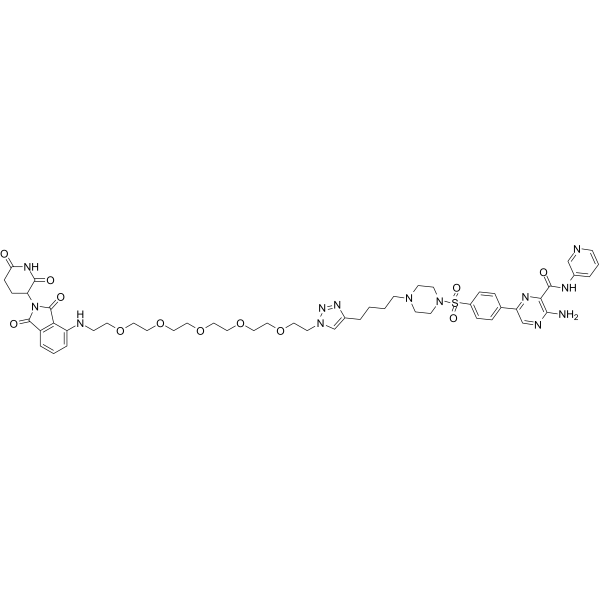
PT-65 is a GSK3α and GSK3β PROTAC degrader with DC50 values of 28.3 nM and 34.2 nM, respectively. PT-65 inhibits excessive tau phosphorylation mediated by GSK3β, Aβ and Okadaic acid (HY-N6785). PT-65 is applicable for the research of Alzheimer's disease.
(Pink: GSK-3α and GSK-3β ligand (HY-15761); Blue: Cereblon ligand (HY-10984); Black: linker).
Nos produits utilisent uniquement pour la recherche. Nous ne vendons pas aux patients.
- Pureté : 99.48%
- CAS No.: 2721998-87-2
- Formule: C51H63N13O12S
- Masse moléculaire:1082.19
-
Stockage:Powder -20°C, 3 years ; In solvent -80°C, 6 months , -20°C, 1 month

To place orders, for customer services and technical support, please contact: MedChemExpress USA
Tel: 609-228-6898 E-mail: [email protected] [email protected]


-
 Activité biologique
-
Chemical Information
-
Solvant et solubilité
- Protocole
- Pureté et documentation
- Références
-
 Help & FAQs


Voir tous les produits spécifiques à Isoform PROTACs
More

Activité biologique
Description
IC50 & Target
[1]|
GSK-3α 28.3 nM (DC50) |
GSK-3β 34.2 nM (DC50) |
In Vitro
PT-65 (62.5-1000 nM; 48 h) dose-dependently reduces GSK3β-mediated tau hyperphosphorylation at serine 396, serine 404, and threonine 205 sites in GSK3β-overexpressing HEK-293T cells by inducing GSK3β degradation, with phosphorylated tau levels recovering fully 12 h after compound washout[1].
PT-65 (0-100 μM; 72 h) protects SH-SY5Y cells from Aβ42-induced neurotoxicity by dose-dependently reducing GSK3 levels and subsequent tau hyperphosphorylation, with no intrinsic cytotoxicity up to 100 μM[1].
MedChemExpress (MCE) has not independently confirmed the accuracy of these methods. They are for reference only. Further protocols information, click here.
-
Cell Line:GSK3β-overexpressing HEK-293T cells
-
Concentration:62.5, 125, 250, 500 and 1000 nM (24 h dose-dependent); 1 μM (washout recovery)
-
Incubation Time:24 h (dose-dependent); 24 h treatment followed by up to 36 h washout recovery
-
Result:Induced dose-dependent degradation of GSK3β, accompanied by dose-dependent reduction of phosphorylated tau at serine 396, serine 404, and threonine 205 sites; total tau levels remained unchanged.
Recovered GSK3β levels gradually after washout of 1 μM PT-65, and restored phosphorylated tau levels fully by 12 h post-washout.
In Vivo
MedChemExpress (MCE) has not independently confirmed the accuracy of these methods. They are for reference only.
-
Animal Model:Sprague-Dawley (male, 3 months old, 280-300 g, unilateral hippocampal microinjection of okadaic acid to induce AD-like pathology)[1]
-
Dosage:200 μM/5 μL; 600 μM/5 μL
-
Administration:i.c.v.; two doses: 72 h pre-model establishment and 72 h post-model establishment
-
Result:Reduced escape latency times on day 3, day 4, and day 5 posttreatment (high dose: 600 μM/5 μL) compared to OA-treated rats.
Reduced escape latency compared to OA-treated rats (low dose: 200 μM/5 μL).
Increased time spent in the target quadrant in probe trial compared to OA-treated rats (both doses).
Dose-dependently reduced hippocampal levels of GSK3α, GSK3β, and hyperphosphorylated tau at the S404, S396, and T205 sites compared to OA-treated rats.
Reduced the density of p-T205-tau-positive staining in hippocampal tissue compared to OA-treated rats.


Chemical Information
-
CAS No. 2721998-87-2
-
Appearance Solid
-
Masse moléculaire 1082.19
-
Formule C51H63N13O12S
-
Color Light yellow to green yellow
-
SMILES
O=C(C1=C(N)N=CC(C2=CC=C(S(=O)(N3CCN(CCCCC4=CN(CCOCCOCCOCCOCCOCCNC5=CC=CC(C(N6C7C(NC(CC7)=O)=O)=O)=C5C6=O)N=N4)CC3)=O)C=C2)=N1)NC8=CC=CN=C8
-
Livraison
Room temperature in continental US; may vary elsewhere.
-
Stockage
Powder -20°C 3 years In solvent -80°C 6 months -20°C 1 month


Solvant et solubilité
In Vitro:
DMSO : 100 mg/mL (92.41 mM; Need ultrasonic; Hygroscopic DMSO has a significant impact on the solubility of product, please use newly opened DMSO)
Please refer to the solubility information to select the appropriate solvent. Once prepared, please aliquot and store the solution to prevent product inactivation from repeated freeze-thaw cycles.
Storage method and period of stock solution: -80°C, 6 months; -20°C, 1 month. When stored at -80°C, please use it within 6 months. When stored at -20°C, please use it within 1 month.
Please refer to the solubility information to select the appropriate solvent. Once prepared, please aliquot and store the solution to prevent product inactivation from repeated freeze-thaw cycles.
Storage method and period of stock solution: -80°C, 6 months; -20°C, 1 month. When stored at -80°C, please use it within 6 months. When stored at -20°C, please use it within 1 month.
Concentration (start) × Volume (start) = Concentration (final) × Volume (final)
In Vivo:
Select the appropriate dissolution method based on your experimental animal and administration route.
- For the following dissolution methods, please ensure to first prepare a clear stock solution using an In Vitro approach and then sequentially add co-solvents:
- To ensure reliable experimental results, the clarified stock solution can be appropriately stored based on storage conditions. As for the working solution for In Vivo experiments, it is recommended to prepare freshly and use it on the same day.
- The percentages shown for the solvents indicate their volumetric ratio in the final prepared solution. If precipitation or phase separation occurs during preparation, heat and/or sonication can be used to aid dissolution.
Add each solvent one by one: 10% DMSO 40% PEG300 5% Tween-80 45% Saline
Solubility: ≥ 2.5 mg/mL (2.31 mM); Clear solution
This protocol yields a clear solution of ≥ 2.5 mg/mL (saturation unknown).
Taking 1 mL working solution as an example, add 100 μL DMSO stock solution (25.0 mg/mL) to 400 μL PEG300, and mix evenly; then add 50 μL Tween-80 and mix evenly; then add 450 μL Saline to adjust the volume to 1 mL.
Preparation of Saline: Dissolve 0.9 g sodium chloride in ddH₂O and dilute to 100 mL to obtain a clear Saline solution.
In Vivo Dissolution Calculator
Please enter the basic information of animal experiments:
-
-
-
-
Recommended: Prepare an additional quantity of animals to account for potential losses during experiments.
Please enter your animal formula composition:
-
%DMSO +
Recommended: Keep the proportion of DMSO in working solution below 2% if your animal is weak.
-
%+
-
+%Tween-80 + +
-
%Saline +
The co-solvents required include: DMSO, . All of co-solvents are available by MedChemExpress (MCE). , Tween 80. All of co-solvents are available by MedChemExpress (MCE).
Working solution concentration: 0.22 mg/mL
Method for preparing stock solution: mg drug dissolved in μL DMSO. Stock solution concentration: mg/mL.
1. Take μL DMSO stock solution;
2. Add μL .
μL , mix evenly;
3. Then add μL Tween 80, mix evenly;
4. Then add μL
Please ensure that the stock solution in the first step is dissolved to a clear state, and add co-solvents in sequence. You can use ultrasonic heating (ultrasonic cleaner, recommended frequency 20-40 kHz), vortexing, etc. to assist dissolution.

Protocole
-
Kinase activity and phosphorylation assays
Kinase activity assays measure the ability of kinases to transfer phosphate groups from ATP to specific substrates, while phosphorylation assays detect the presence and levels of phosphorylated proteins. Common methods include radiolabeled ATP incorporation (e. g. ,), ADP release detection via bioluminescence (e. g. ,[3]), enzyme-linked immunosorbent assays (ELISA) for phospho-specific epitopes (e. g. ,[6]), and microtiter-based formats for high-throughput screening (e. g. ,[8]). The ADP-Glo assay quantifies kinase activity by measuring ADP produced during phosphorylation using a luciferase-based system. Radiometric assays involve autoradiography or scintillation counting after incorporation of 32P-labeled ATP into substrate proteins. ELISA-based approaches rely on phospho-specific antibodies to detect activated kinases in cell lysates or purified samples.
-
Western Blot
Western blotting (WB) is a commonly used experimental method in molecular biology, biochemistry, and immunogenetics for identifying and quantifying target proteins. It combines gel electrophoresis with immunoassay, enabling researchers to analyze protein expression, post-translational modifications, and molecular weight.
-
Protocol for Kinase activity and phosphorylation assays
Kinase activity assays measure transfer of phosphate from ATP to a protein or peptide substrate, generating phosphorylated substrate, ADP, or incorporated radiolabeled phosphate as the readout; phosphorylation assays measure site-specific phosphorylation in cells or tissues as a proxy for kinase-pathway activation, inhibition, or substrate regulation. Phosphorylation can be detected by phospho-specific Western blot, immunoprecipitation kinase assay, phospho-immunofluorescence, phospho-flow cytometry, luminescent ADP detection, radiolabeled ATP incorporation, or reporter-based pathway assays, and these readouts can be applied to cancer cells, primary neurons, mouse tumors, organoids, inflammatory macrophages, ferroptosis studies, and mitophagy studies when the kinase target is biologically relevant.
-
Alzheimer’s Disease Modeling
Alzheimer’s Disease (AD) is a neurodegenerative disorder characterized by a progressive decline in cognitive functions and loss of specific types of neurons and synapses. Alzheimer's symptoms can be simulated in mice by injecting drugs (such as Aβ) or genetically modified.


Pureté et documentation
-
Fiche technique (271 KB)
-
SDS (252 KB)
- English - EN (252 KB)
- Français - FR (252 KB)
- Deutsch - DE (252 KB)
- Norwegian - NO (252 KB)
- Español - ES (252 KB)
- Swedish - SV (252 KB)
- Italian - IT (252 KB)
- Korean - KR (252 KB)
- Portuguese - PT (252 KB)
-
Instruction de manipulation (2659 KB)
Références


Complete Stock Solution Preparation Table
Please refer to the solubility information to select the appropriate solvent. Once prepared, please aliquot and store the solution to prevent product inactivation from repeated freeze-thaw cycles.
Storage method and period of stock solution: -80°C, 6 months; -20°C, 1 month. When stored at -80°C, please use it within 6 months. When stored at -20°C, please use it within 1 month.
| Optional Solvent | Concentration Solvent Mass | 1 mg | 5 mg | 10 mg | 25 mg |
|---|---|---|---|---|---|
| DMSO | 1 mM | 0.9241 mL | 4.6203 mL | 9.2405 mL | 23.1013 mL |
| 5 mM | 0.1848 mL | 0.9241 mL | 1.8481 mL | 4.6203 mL | |
| 10 mM | 0.0924 mL | 0.4620 mL | 0.9241 mL | 2.3101 mL | |
| 15 mM | 0.0616 mL | 0.3080 mL | 0.6160 mL | 1.5401 mL | |
| 20 mM | 0.0462 mL | 0.2310 mL | 0.4620 mL | 1.1551 mL | |
| 25 mM | 0.0370 mL | 0.1848 mL | 0.3696 mL | 0.9241 mL | |
| 30 mM | 0.0308 mL | 0.1540 mL | 0.3080 mL | 0.7700 mL | |
| 40 mM | 0.0231 mL | 0.1155 mL | 0.2310 mL | 0.5775 mL | |
| 50 mM | 0.0185 mL | 0.0924 mL | 0.1848 mL | 0.4620 mL | |
| 60 mM | 0.0154 mL | 0.0770 mL | 0.1540 mL | 0.3850 mL | |
| 80 mM | 0.0116 mL | 0.0578 mL | 0.1155 mL | 0.2888 mL |


PT-65 Related Classifications
HY-153166 Related Classifications
 Powered by Bioz