



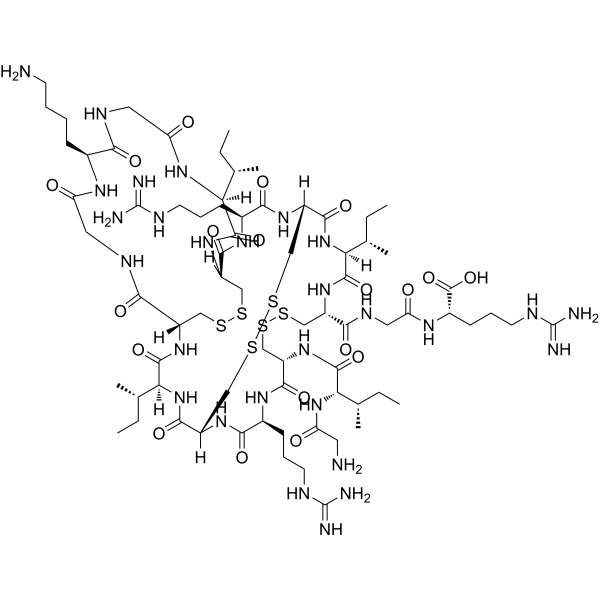
Retrocyclin-101
Retrocyclin-101 (RC-101) is a synthetic cyclic θ-defensin, a broad-spectrum antimicrobial peptide with anti-pathogen (covering viruses, bacteria and fungi) activity and anti-inflammatory activity. Retrocyclin-101 exhibits significant inhibitory activity against HIV, SARS-CoV-2, flaviviruses, influenza viruses, HSV-1/2, Staphylococcus aureus and others. Retrocyclin-101 inhibits TLR4 and TLR2-mediated signal transduction and reduces pro-inflammatory cytokine expression.
For research use only. We do not sell to patients.
- CAS No.: 536757-16-1
- Formula: C74H130N28O19S6
- Molecular Weight:1908.39
-
Storage:
Please store the product under the recommended conditions in the Certificate of Analysis.

To place orders, for customer services and technical support, please contact: MedChemExpress USA
Tel: 609-228-6898 E-mail: [email protected] [email protected]


-
 Biological Activity
-
Chemical Information
- Protocols
- Purity & Documentation
- References
-
 Help & FAQs




Biological Activity
Description
In Vitro
Retrocyclin-101 (50 μM; 1 h) inhibits the infection of H1299 cells by SARS-CoV-2 spike protein-pseudotyped lentivirus, but this effect is only observed when it is pre-incubated with viral particles (no such effect occurs when pre-incubated with cells), and serum abrogates this effect[1].
Retrocyclin-101 (0.5-5 μM; 1 h) inhibits the binding of recombinant prefusion-stabilized SARS-CoV-2 spike protein to ACE2 in a concentration-dependent manner, and reduces the binding rate to approximately 25% of that in the control group at 5 μM after pre-incubation at 37°C[1].
Retrocyclin-101 (3-50 μM; 1-24 h) inhibits natural SARS-CoV-2 infection in Vero E6 cells; its IC50 is 29 μM without pre-incubation with the virus; when pre-incubated with the virus for 1 h under serum-free conditions, it exerts strong inhibitory activity at a concentration of 50 μM[1].
Retrocyclin-101 (0-50 μM; 47 h) potently inhibits ZIKV PRVABC59 infection in Vero cells, with an IC50 of 7.033 μM[2].
Retrocyclin-101 (0-50 μM; 71 h) inhibits ZIKV MR766 infection in Vero cells, with an IC50 of 15.58 μM[2].
Retrocyclin-101 (0-100 μM) significantly reduces the viral titers of ZIKV PRVABC59 and MR766 in Vero cells and U251 glioma cells in a dose-dependent manner[2].
Retrocyclin-101 (40 μM; 48-72 h) inhibits infections by ZIKV PRVABC59 and MR766 in Vero cells during the viral entry and replication stages, but does not act through direct virucidal activity or blocking cellular receptors[2].
Retrocyclin-101 (25-50 μM; 50 h) inhibits ZIKV replication in BHK-21 cells but has no effect on the translation of initial replicon RNA[2].
Retrocyclin-101 (0-50 μM; 24 h) inhibits the activity of JEV NS2B-NS3 serine protease in BHK-21 cells, reduces the expression level of NS3 and increases the content of unprocessed polyprotein precursors at lower concentrations[2].
Retrocyclin-101 (0-50 μM; 24 h) inhibits JEV AT31 infection in BHK-21 and U251 cells, with an IC50 of 10.67 μM[2].
Retrocyclin-101 (50 μM; 24 h) inhibits wild-type (WT), N154A, H144A, and Q258A strains of JEV in BHK-21 cells, whereas the DE mutant and T410A JEV strains are resistant to RC-101[2].
Retrocyclin-101 can be cleaved from its GFP fusion partner in vitro by Factor Xa protease; partial cleavage occurs naturally in chloroplast extracts of plastid-transformed tobacco due to endogenous Factor Xa-like activity[3].
Retrocyclin-101 (2.5-20 μM; 16 h) potently inhibits the growth of Staphylococcus aureus nasal colonizing strains D20-7, D535-6, D30 and clinical strain USA300 in a concentration-dependent manner; specifically, at a concentration of 20 μM, the growth inhibition duration of nasal colonizing strains exceeds 10 h, and that of USA300 reaches 5 h[4].
Retrocyclin-101 (2.5-10 μM; 0.25-9 h) is a rapidly acting, concentration-dependent bactericide active against Staphylococcus aureus nasal carriage strains D20-7, D535-6, D30 and clinical strain USA300; it achieves complete growth inhibition within 30 min at 10 μM and retains activity even against high bacterial inocula[4].
Retrocyclin-101 (1-10 μg/tissue; 9 h) inhibits the adhesion and survival of Staphylococcus aureus nasal colonization strains D20-7, D535-6, D30 and clinical strain USA300 on human nasal epithelial cells (RPMI 2650), with 10 μg/tissue completely blocking bacterial adhesion[4].
Retrocyclin-101 (4-20 μg/tissue; 9 h) completely inhibits the adhesion of S. aureus nasal colonization strain D20-7 to organotypic human airway epithelium at a concentration of 20 μg/tissue[4].
Retrocyclin-101 (30 μg/mL; 30-60 min) inhibits TRIF- and MyD88-dependent TLR4-mediated proinflammatory cytokine gene expression in human monocyte-derived macrophages[5].
MedChemExpress (MCE) has not independently confirmed the accuracy of these methods. They are for reference only.
-
Cell Line:human monocyte-derived macrophages
-
Concentration:30 μg/mL with 100 ng/mL LPS
-
Incubation Time:30, 60 min
-
Result:Inhibited LPS-induced IL-6, IFN-β, TNF-α, and IL-1β mRNA expression at 30 and 60 min post-stimulation.
Caused significant reduction of all measured cytokines compared to mock-treated cells.
-
Cell Line:HEK293T cells transfected with TLR4-FLAG and TLR4-CFP
-
Concentration:30 μg/mL
-
Incubation Time:30 min
-
Result:Did not inhibit the co-immunoprecipitation of TLR4-CFP with TLR4-FLAG, indicating no disruption of ligand-independent TLR4 oligomerization.
In Vivo
Retrocyclin-101 (100 μg/mouse; i.v.; daily; days 2-6 post-infection) confers significant protection against influenza A virus (PR8) infection in mice, increasing survival and reducing clinical severity when administered therapeutically starting 2 days post-infection[5].
MedChemExpress (MCE) has not independently confirmed the accuracy of these methods. They are for reference only.
-
Animal Model:C57BL/6J (female, 6-8-week-old, WT)[5]
-
Dosage:100 μg/mouse
-
Administration:i.v.; daily; days 2-6 post-infection
-
Result:Increased mouse survival post-PR8 infection.
Reduced PR8-induced clinical symptoms, with lower mean clinical scores (ranging 0-5, with 5 = moribund) compared to controls over the 14-day monitoring period.


Chemical Information
-
CAS No. 536757-16-1
-
Molecular Weight 1908.39
-
Formula C74H130N28O19S6
-
Synonyms
RC-101
-
Sequence
Gly-Ile-Cys-Arg-Cys-Ile-Cys-Gly-Lys-Gly-Ile-Cys-Arg-Cys-Ile-Cys-Gly-Arg (Disulfide bridge:Cys3-Cys16;Cys5-Cys14;Cys7-Cys12)
-
Sequence Shortening
GICRCICGKGICRCICGR (Disulfide bridge:Cys3-Cys16;Cys5-Cys14;Cys7-Cys12)
-
Shipping
Room temperature in continental US; may vary elsewhere.
-
Storage
Please store the product under the recommended conditions in the Certificate of Analysis.


Purity & Documentation
References
[1]. Kudryashova E, et al. Inhibition of SARS-CoV-2 Infection by Human Defensin HNP1 and Retrocyclin RC-101. J Mol Biol. 2022;434(6):167225. [Content Brief]
[2]. Jia X, et al. Mechanism through Which Retrocyclin Targets Flavivirus Multiplication. J Virol. 2021;95(15):e0056021. [Content Brief]
[3]. Lee SB, et al. Expression and characterization of antimicrobial peptides Retrocyclin-101 and Protegrin-1 in chloroplasts to control viral and bacterial infections. Plant Biotechnol J. 2011;9(1):100-115. [Content Brief]
[4]. Lamers RP, et al. Characterization of the retrocyclin analogue RC-101 as a preventative of Staphylococcus aureus nasal colonization. Antimicrob Agents Chemother. 2011;55(11):5338-5346. [Content Brief]
[5].
Prantner D, et al. The θ-defensin retrocyclin 101 inhibits TLR4- and TLR2-dependent signaling and protects mice against influenza infection. J Leukoc Biol. 2017 Oct;102(4):1103-1113.
[Content Brief]
[6]. Lee SB, et al. Expression and characterization of antimicrobial peptides Retrocyclin-101 and Protegrin-1 in chloroplasts to control viral and bacterial infections. Plant Biotechnol J. 2011 Jan;9(1):100-15. [Content Brief]

Calculators
Concentration (start) × Volume (start) = Concentration (final) × Volume (final)


Retrocyclin-101 Related Classifications
HY-P5642 Related Classifications
 Powered by Bioz
Keywords
- Retrocyclin-101
- 536757-16-1
- RC-101
- Retrocyclin101
- Retrocyclin 101
- RC101
- RC 101
- Bacterial
- HSV
- Fungal
- Influenza Virus
- Toll-like Receptor (TLR)
- Flavivirus
- Ser/Thr Protease
- SARS-CoV
- HIV
- SARS-CoV-2 Spike protein
- Japanese encephalitis virus E protein DIII DE loop
- Erwinia carotovora
- TLR4
- Staphylococcus aureus
- Zika virus NS2B-NS3 serine protease
- TLR2
- HIV-1
- tobacco mosaic virus
- ACE2
- Inhibitor
- inhibitor
- inhibit