



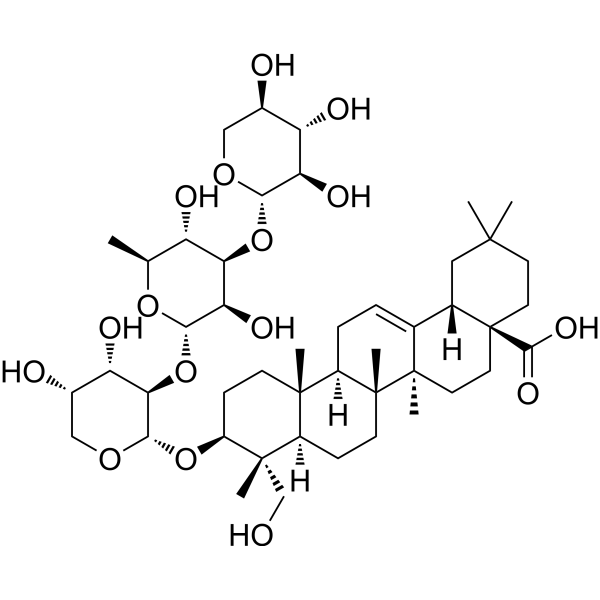
Sapindoside B

Based on 1 Customer Validation
Sapindoside B is a substance with hepatoprotective activity, and also acts as a cytochrome P-450 (cytochrome P-450) inhibitor, antibacterial agent and membrane-disrupting agent. Sapindoside B reversibly inhibits the content of cytochrome P-450 in liver microsomes, suppresses the phenobarbital-induced increase in enzyme content, reduces the production of active metabolites mediated by cytochrome P-450, and alleviates hepatotoxic injury. Sapindoside B binds to Cutibacterium acnes lipase, reduces lipase activity, inhibits biofilm formation, and decreases bacterial adhesion. Sapindoside B exhibits cytotoxicity against human cancer, liver cancer, leukemia and glioblastoma cells. Sapindoside B inhibits mycelial growth of phytopathogenic fungal strains, possesses antibacterial activity against dermatophytes, and also has hemolytic/membrane-lytic activity. Sapindoside B can be used in research related to liver injury, Cutibacterium acnes biofilm-associated infections, gastric cancer, carcinoma, promyelocytic leukemia, glioblastoma, apple scab and grape gray mold.
Nos produits utilisent uniquement pour la recherche. Nous ne vendons pas aux patients.
- Pureté : 96.68%
- CAS No.: 30994-75-3
- Formule: C46H74O16
- Masse moléculaire:883.07
-
Stockage:
4°C, protect from light
* In solvent : -80°C, 6 months; -20°C, 1 month (protect from light)

To place orders, for customer services and technical support, please contact: MedChemExpress USA
Tel: 609-228-6898 E-mail: [email protected] [email protected]


-
 Activité biologique
-
Chemical Information
- Protocole
- Pureté et documentation
- Références
-
 Help & FAQs




Activité biologique
Description
In Vitro
Sapindoside B (0.1MIC-0.5MIC; 3 d) dose-dependently inhibits early biofilm formation and mature biofilms of Cutibacterium acnes ATCC 6919 at sub-MIC concentrations, suppresses the adhesion of Cutibacterium acnes ATCC 6919, reduces cell surface hydrophobicity, decreases extracellular polysaccharide production in biofilms, inhibits lipase activity in biofilms, and disrupts the structure of early-formed biofilms[3].
Sapindoside B (0.5MIC; 3 d) reduces the biomass, thickness and diffusion distance of early-formed Cutibacterium acnes ATCC 6919 biofilms, while increases their roughness. It downregulates the expression of biofilm-related genes[3].
Sapindoside B (0.5-50 μM; 72 h) exhibits moderate cytotoxicity against human gastric cancer cells SGC-7901, human hepatocellular carcinoma cells HepG2, human promyelocytic leukemia cells HL-60, and human glioblastoma cells U251MG, with IC50 values ranging from 4.24 μM to 15.37 μM[4].
Sapindoside B (5 mg per 100 mL; treated for 21 days against *V. inaequalis* and 4 days against *B. cinerea*) inhibits mycelial growth of *Venturia inaequalis* V1 by 46% and mycelial growth of *Botrytis cinerea* B05.10 by 43% under in vitro conditions[5].
MedChemExpress (MCE) has not independently confirmed the accuracy of these methods. They are for reference only.
-
Cell Line:human gastric carcinoma SGC-7901 cells, human liver hepatoma HepG2 cells, human promyelocytic leukemia HL-60 cells, human glioblastoma U251MG cells
-
Concentration:0.5, 2, 10, 50 μM
-
Incubation Time:72 h
-
Result:Exhibited cytotoxic activity against all four tested cancer cell lines, with IC50 values of 10.32 μM for SGC-7901, 4.24 μM for HepG2, 6.58 μM for HL-60, and 15.37 μM for U251MG.
In Vivo
MedChemExpress (MCE) has not independently confirmed the accuracy of these methods. They are for reference only.
-
Animal Model:Kunming (male, 20-24 g)[1]
-
Dosage:20 mg/kg
-
Administration:s.c.; 2 or 3 times at 8-hour intervals
-
Result:Reduced hepatic microsomal cytochrome P-450 content by 55%.
Reduced hepatic microsomal cytochrome P-450 content by 60%.
- Research Protocol for Infectious Diseases
- Cell Cytotoxicity Assay
- Mammalian live/dead viability and cytotoxicity staining
- Filamentous Fungal Mold Culture and Sporulation
- Liver Cancer Modeling
- Fungal Biofilm Culture
- Bacterial live/dead nucleic-acid viability staining
- Cell Viability Determination by MTT Colorimetric Assay


Chemical Information
-
CAS No. 30994-75-3
-
Appearance Solid
-
Masse moléculaire 883.07
-
Formule C46H74O16
-
Color White to off-white
-
SMILES
C[C@@]12C([C@@]3([H])[C@@](CC2)(CCC(C)(C3)C)C(O)=O)=CC[C@@]4([H])[C@]1(CC[C@]5([H])[C@@]4(CC[C@@H]([C@@]5(C)CO)O[C@H]6[C@@H]([C@H]([C@H](CO6)O)O)O[C@H]7[C@@H]([C@@H]([C@H]([C@@H](O7)C)O)O[C@H]8[C@@H]([C@H]([C@@H](CO8)O)O)O)O)C)C
-
Structure Classification
-
Initial Source
-
Livraison
Room temperature in continental US; may vary elsewhere.
-
Stockage
4°C, protect from light
* In solvent : -80°C, 6 months; -20°C, 1 month (protect from light)


Pureté et documentation
-
Fiche technique (281 KB)
-
SDS (252 KB)
- English - EN (252 KB)
- Français - FR (252 KB)
- Deutsch - DE (252 KB)
- Norwegian - NO (252 KB)
- Español - ES (252 KB)
- Swedish - SV (252 KB)
- Italian - IT (252 KB)
- Korean - KR (252 KB)
- Portuguese - PT (252 KB)
-
Instruction de manipulation (2659 KB)
Références
[2]. Sawada H, et al. Saponins from leaves of Acanthopanax sieboldianus. Phytochemistry. 1993;34(4):1117-1121. [Content Brief]
[3]. Wei MP, et al. Synergistic combination of Sapindoside A and B: A novel antibiofilm agent against Cutibacterium acnes. Microbiol Res. 2022;254:126912. [Content Brief]
[4]. Zhao M, et al. Cytotoxic triterpenoid saponins from Clematis tangutica. Phytochemistry. 2016;130:228-237. [Content Brief]
[5]. Porsche FM, et al. Antifungal Activity of Saponins from the Fruit Pericarp of Sapindus mukorossi against Venturia inaequalis and Botrytis cinerea. Plant Dis. 2018;102(5):991-1000. [Content Brief]

Calculators
Concentration (start) × Volume (start) = Concentration (final) × Volume (final)


Sapindoside B Related Classifications
HY-N11546 Related Classifications
 Powered by Bioz
Keywords
- Sapindoside B
- 30994-75-3
- Cytochrome P450
- Bacterial
- Fungal
- human gastric carcinoma SGC-7901
- human promyelocytic leukemia HL-60
- human glioblastoma U251MG
- human liver hepatoma HepG2
- Sapindus mukorossi
- Botrytis cinerea
- cytochrome P-450
- Kunming strain male mice
- Venturia inaequalis
- Cutibacterium acnes
- Inhibitor
- inhibitor
- inhibit