1. Search Result
Search Result
Results for "

BRCA proteins

" in MedChemExpress (MCE) Product Catalog:

17

Inhibitors & Agonists

1

Screening Libraries

1

Peptides

1

Oligonucleotides

Cat. No. Product Name Target Research Areas Chemical Structure
  • HY-W327122
    BAP1-IN-1
    1 Publications Verification

    Deubiquitinase Cancer
    BAP1-IN-1 (Compound 8) is a BRCA1 associated protein 1 (BAP1) catalytic activity inhibitor with an IC50 of 0.1-1 μM .
    BAP1-IN-1
  • HY-150147
    CAM833
    1 Publications Verification

    RAD51 Apoptosis Cancer
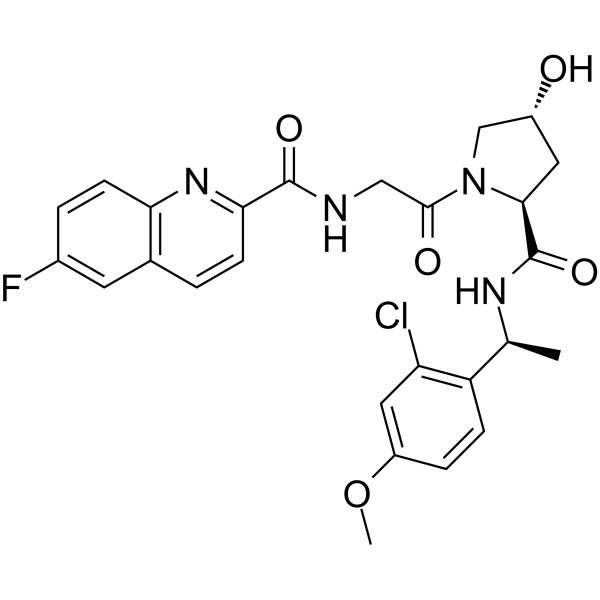
    CAM833 is a potent orthosteric inhibitor of the interaction between BRCA2 and RAD51 with a Kd of 366 nM against the ChimRAD51 protein. CAM833 also inhibits RAD51 oligomerization. CAM833 increases the progression of G2/M-arrested cells into apoptosis .
    CAM833
  • HY-162706
    BSJ-5-63
    1 Publications Verification

    PROTACs CDK Cancer
    BSJ-5-63 is a potent CDK12, CDK7, CDK9 PROTAC degrader. BSJ-5-63 BSJ-5-63 decreases the protein expression of CDK12, CDK7, CDK9, RNAPII, Cyclin K. BSJ-5-63 decreases the mRNA expression of BRCA1, BRCA2. BSJ-5-63 shows anticancer activity and has the potential for the research of prostate cancer (Pink: ligand for target protein (HY-150948); black: linker (HY-W140827); Blue: E3 ligase ligand (HY-112078)) .
    BSJ-5-63
  • HY-100862
    BRCA1-IN-2
    3 Publications Verification

    PARP Cancer
    BRCA1-IN-2 (compound 15) is a cell-permeable protein-protein interaction (PPI) inhibitor for BRCA1 with an IC50 of 0.31 μM and a Kd of 0.3 μM, which shows antitumor activities via the disruption of BRCA1 (BRCT)2/protein interactions .
    BRCA1-IN-2
  • HY-148183

    RAD51 Cancer
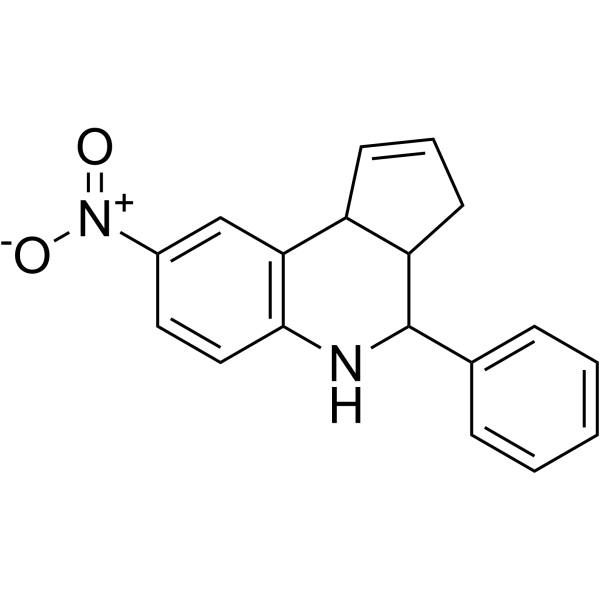
    Homologous recombination-IN-1 is a novel RAD51-BRCA2 protein-protein interaction inhibitor (EC50=19 μM). Homologous recombination-IN-1 can interfere with homologous recombination .
    Homologous recombination-IN-1
  • HY-W116007

    Environmental Pollutants DNA/RNA Synthesis Endocrinology
    Octamethylcyclotetrasiloxane promotes the anchorage-independent growth of MCF-10A and MCF-10F cells. Octamethylcyclotetrasiloxane induces DNA damage, inhibits the expression of DNA-repairing protein BRCA1 under long-term and high-concentration exposure. Octamethylcyclotetrasiloxane exhibits intrinsic estrogenic activity .
    Octamethylcyclotetrasiloxane
  • HY-W101585

    Isopentyl benzoate

    Environmental Pollutants Inflammation/Immunology
    Isoamyl benzoate (Isopentyl benzoate) is a natural aromatic ester compound. Isoamyl benzoate exhibits free radical scavenging capabilities against DPPH and ABTS, with its IC50 values being 9.55 μg/mL and 7455.54 μM TE/g respectively. Isoamyl benzoate can be used in antioxidant research .
    Isoamyl benzoate
  • HY-168993

    Reactive Oxygen Species (ROS) Inflammation/Immunology Cancer
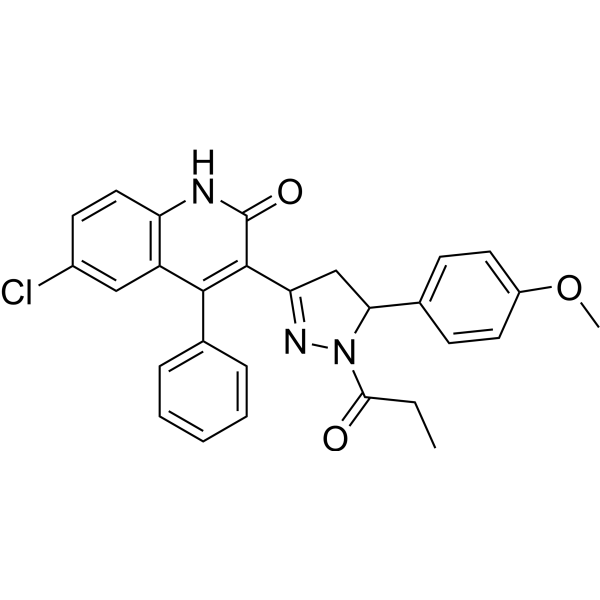
    BRCA2-IN-2 (Compound 3i) has a strong binding affinity to the BRCA2 protein. BRCA2-IN-2 can inhibit the proliferation of breast cancer cells and scavenge DPPH free radicals. BRCA2-IN-2 has anti-tumor and antioxidant activities .
    BRCA2-IN-2
  • HY-150958

    RAD51 Cancer
    RAD51-IN-8, a new RAD51 binder, is a RAD51-BRCA2 inhibitor that inhibits the RAD51 BRCA2 protein protein interaction. RAD51-IN-8 also is a proteinprotein interaction (PPI) inhibitor. RAD51-IN-8 has inhibitory activity for H4A4 with an EC50 value of 19 μM .
    RAD51-IN-8
  • HY-P10516

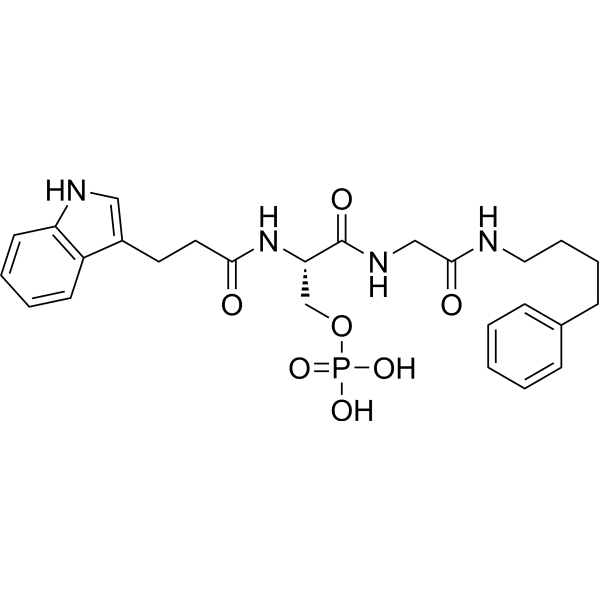
    DNA/RNA Synthesis RAD51 Cancer
    BRC4 peptide is a specific peptide in BRCA2 protein that interacts with RAD51 protein to help repair broken DNA chains. BRC4 peptide can be used to study DNA repair mechanisms and cancer occurrence .
    BRC4 peptide
  • HY-168722

    PARP PROTACs Cancer
    PROTAC PARP1 degrader-3 (Compound C6) is a PROTAC degrader for PARP1 with a DC50 of 58.14 nM. PROTAC PARP1 degrader-3 exhibits cytotoxicity in cancer cell SW-620 and LOVO with IC50 of 1.63 μM and 2.84 μM. PROTAC PARP1 degrader-3 exhibits a synergistic effect with SN-38 (HY-13704) in BRCA-mutated colon cancer cell with a combination index (CI) of 0.487. (Blue: Ligand for E3 ligase Cereblon (HY-23095); Pink: Ligand for target protein (HY-10619); Black: Linker (HY-16872))
    PROTAC PARP1 degrader-3
  • HY-174563

    mRNA Cancer
    Human OLA1 mRNA encodes the human Obg like ATPase 1 (OLA1) protein, a member of the GTPase protein family. OLA1 interacts with breast cancer-associated gene 1 (BRCA1) and BRCA1-associated RING domain protein (BARD1), and is involved in centrosome regulation.
    Human OLA1 mRNA
  • HY-168094

    PARP Cancer
    PARP1-IN-30 (Compound 3) is a specific and potent PARP1 inhibitor with cytotoxicity. PARP1-IN-30 allows precise inhibition of PARP1 in tumor cells with breast cancer 1 protein (BRCA1) or BRCA2 deficiencies. PARP1-IN-30 is promising for research of cancers .
    PARP1-IN-30
  • HY-100862R

    PARP Reference Standards Cancer
    BRCA1-IN-2 (Standard) is the analytical standard of BRCA1-IN-2 (HY-100862). This product is intended for research and analytical applications. BRCA1-IN-2 (compound 15) is a cell-permeable protein-protein interaction (PPI) inhibitor for BRCA1 with an IC50 of 0.31 μM and a Kd of 0.3 μM, which shows antitumor activities via the disruption of BRCA1 (BRCT)2/protein interactions .
    BRCA1-IN-2 (Standard)
  • HY-181561

    RAD51 Cancer
    BRCA2-RAD51-IN-3 is a RAD51-BRCA2 protein-protein interaction inhibitor with an EC50 of 29.35 μM and a Kd of 75.14 μM. BRCA2-RAD51-IN-3 blocks RAD51-BRCA2 binding, impairs homologous recombination in cancer cells, and induces synthetic lethality. BRCA2-RAD51-IN-3 acts in human pancreatic cancer cells and shows no activity in normal pancreatic cells. BRCA2-RAD51-IN-3 can be used for the research of pancreatic cancer .
    BRCA2-RAD51-IN-3
  • HY-185459

    PARP Epigenetic Reader Domain Cancer
    PCIP-1 is a PARP2 inhibitor. PCIP-1 recruits BET proteins to PARP2 to inhibit DNA repair, acts via event-driven pharmacology, and does not inhibit PARP-catalyzed PARylation. PCIP-1 inhibits DNA repair, thereby inducing synthetic lethality in homologous recombination-deficient cancer cells and increasing the sensitivity of PARP1-knockout cells. PCIP-1 can be used in the research of homologous recombination-deficient cancers, T-cell acute lymphoblastic leukemia, and BRCA-mutant cancers .
    PCIP-1
  • HY-171171

    DNA/RNA Synthesis Cancer
    NERx 329 is a replication protein A (RPA) inhibitor with an IC50 of 4.9 μM. NERx 329 blocks the interaction between RPA and single-stranded DNA, and induces functional RPA depletion, loss of single-stranded DNA gap protection, chromosome fragmentation and cell death. NERx 329 inhibits the DNA damage response signaling pathway, exhibits broad single-agent anticancer activity, and enhances the activity of DNA-damaging agents. NERx 329 can be used in research related to brca1-deficient breast cancer, non-small cell lung cancer, and brca1-deficient ovarian cancer .
    NERx 329

Inquiry Online

Your information is safe with us. * Required Fields.

Salutation


Country or Region *

Applicant Name *


Organization Name *

Department *


Email Address *


Product Name *

Cat. No.


Requested quantity *

Phone Number *


Remarks

Inquiry Online

Inquiry Information

Product Name:
Cat. No.:
Quantity:
MCE Japan Authorized Agent:

