
1. Search Result
Search Result
Results for "

Copper(I)

" in MedChemExpress (MCE) Product Catalog:

19

Inhibitors & Agonists

7

Fluorescent Dyes

1

Biochemical Assay Reagents

2

Click Chemistry

Targets Recommended:
Cat. No. Nombre del producto Target Áreas de investigación Chemical Structure
  • HY-141511
    Coppersensor 1
    25+ Cited Publications

    Fluorescent Dye Neurological Disease Cancer
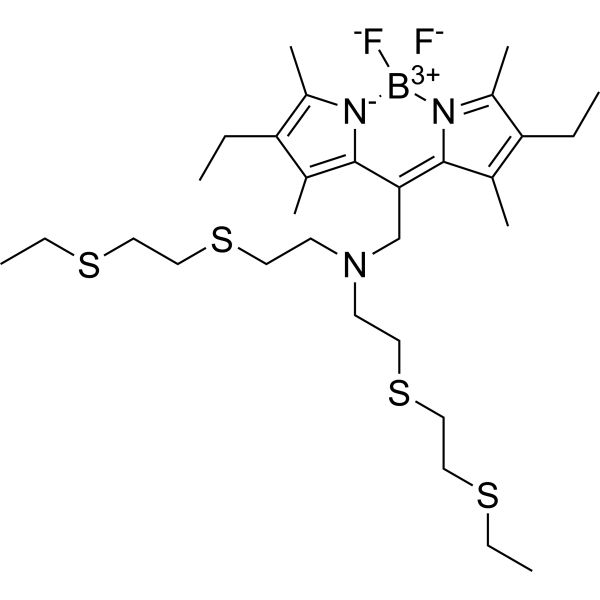
    Coppersensor-1 (CS1) is a membrane-permeable fluorescent dye. Coppersensor-1 has a picomolar affinity for Cu + with high selectivity over competing cellular metalions. Coppersensor-1 as a probe, can selective and sensitive detection of copper(I) ions (Cu +) in biological samples, including live cells. Coppersensor-1 can be used for the research of imaging of severe diseases such as cancer, cardiovascular disorders and neurogenerative diseases .
    Coppersensor 1
  • HY-Y0961

    Copper(I) iodide

    Environmental Pollutants Biochemical Assay Reagents Others
    Cuprous iodide (Copper(I) iodide) is a biochemical reagent that can be used as a biological material or organic compound for life science related research.
    Cuprous iodide
  • HY-W615104

    Biochemical Assay Reagents Others
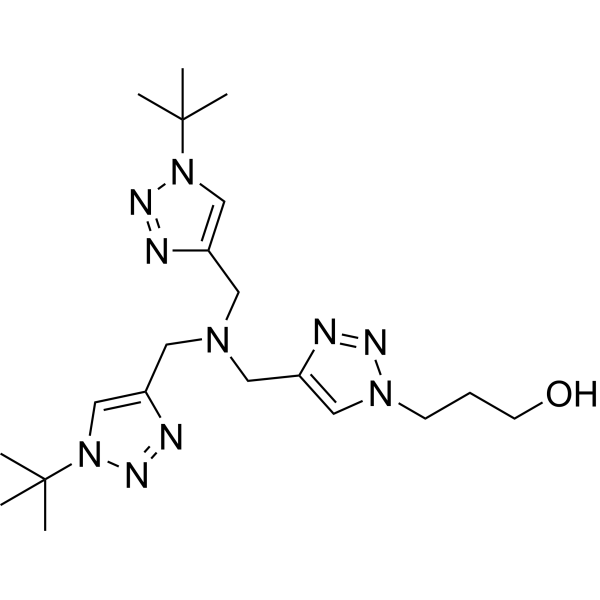
    BTTP is a tris(triazolylmethyl)amine-based ligand. BTTP can accelerate the copper(I)-catalyzed azide-alkyne cycloaddition (CuAAC), the prototypical reaction in click chemistry .
    BTTP
  • HY-Y0988

    Environmental Pollutants Biochemical Assay Reagents Others
    Copper(I) chloride is an inorganic chloride of copper. Copper(I) chloride exhibits ecotoxicity towards Grooved Carpet Shell with a LC50 of 3.7 mg/L .
    Copper(I) chloride
  • HY-W879007

    Fluorescent Dye Others
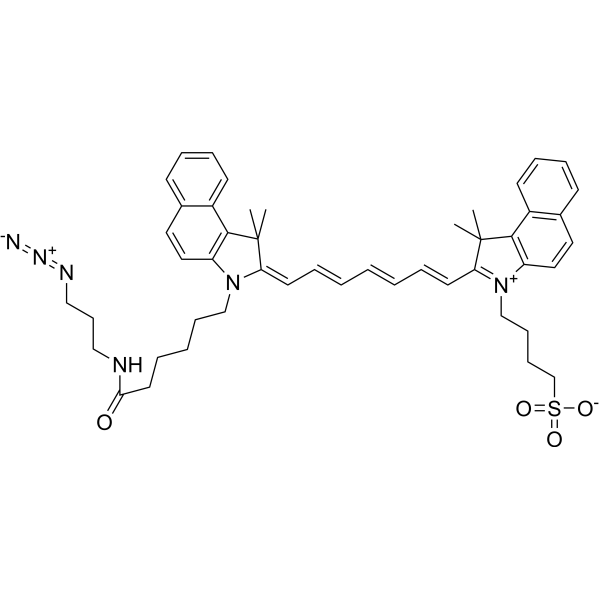
    ICG-azide, a near infrared (NIR) fluorescent dye, is a copper (I)-catalyzed azide-alkyne cycloaddition (CuAAC) reagent. ICG-azide can be readily incorporated into dye-stabilized nanoemulsions and facilitate the attachment of targeting ligands via click-chemistry in a simple, scalable, and reproducible reaction .
    ICG-azide
  • HY-W582504

    CuCl(TPP)3

    DNA Stain Bacterial Fungal Infection Cancer
    Chlorotris(triphenylphosphine)copper (CuCl(TPP)₃) is a DNA-targeted metal complex. Chlorotris(triphenylphosphine)copper involves non-covalent interactions (such as groove binding mode) through the copper(I) center to affect DNA function, showing inhibitory activity against bacteria, fungi, and tumor cells. Chlorotris(triphenylphosphine)copper is promising for research of antibacterial, antitumor, and antioxidant agents .
    Chlorotris(triphenylphosphine)copper
  • HY-D1726

    Deubiquitinase Cancer
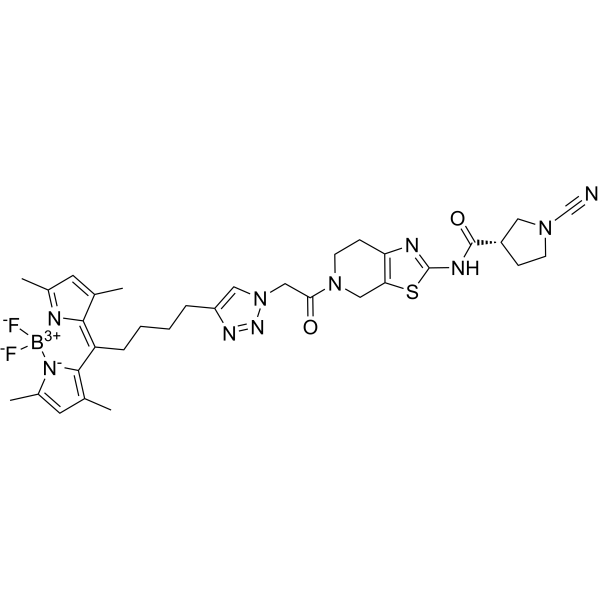
    8RK59, a Bodipy probe, is a potent UCHL1 (ubiquitin C-terminal hydrolase L1) inhibitor, with an IC50 close to 1 μM. 8RK59 could penetrate and label living cells. BodipyFL-alkyne is coupled to the azide of 8RK64 (HY-148254) using copper(I)-mediated click chemistry, resulting in compound 8RK59 .
    8RK59
  • HY-W075796

    Environmental Pollutants Drug Intermediate Others
    Copper (I) thiocyanate is a monovalent copper pseudohalide that exists in two crystalline forms, α and β, both containing bridging thiocyanate groups. Copper (I) thiocyanate can form coordination complexes with ligands such as triphenylphosphine and pyridine .
    Copper(I) thiocyanate
  • HY-W074006

    Biochemical Assay Reagents Others
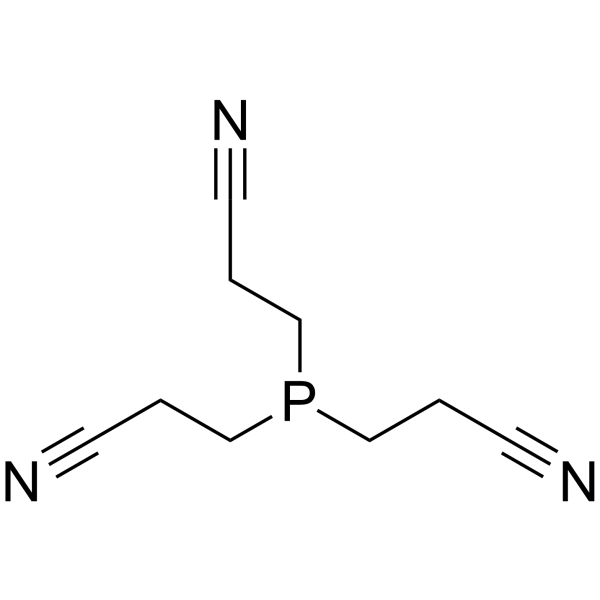
    Tris(2-cyanoethyl)phosphine is a protein crosslinker. Tris(2-cyanoethyl)phosphine can be used to synthesis copper(I) complexes which shows antitumour activity .
    Tris(2-cyanoethyl)phosphine
  • HY-Y0590

    Environmental Pollutants Reactive Oxygen Species (ROS) Glutathione Reductase (GR) Inflammation/Immunology
    Copper (I) oxide is an oxidative stress inducer and cytotoxic agent. Copper (I) oxide causes dose-dependent decrease in the viability of airway epithelial cells by impairing the activities of catalase and glutathione reductase, generating reactive oxygen species, and increasing the levels of 8-isoprostane and the ratio of oxidized glutathione. However, when combined with Resveratrol (HY-16561), the cytotoxic effect induced by Copper (I) oxide is significantly attenuated, and oxidative damage is effectively alleviated .
    Copper(I) oxide
  • HY-W615095

    Biochemical Assay Reagents Others
    Biotin-PEG2-alkyne is a short PEG linker featuring a biotin group and a terminal alkyne. Biotin is useful for affinity-based applications such as pull-down assays while terminal alkynes are used in copper (I) click chemistry with azides.
    Biotin-PEG2-alkyne
  • HY-W096068

    Biochemical Assay Reagents Others
    Propargyl-PEG5-Ms represents a bifunctional linker possessing a proparygyl group reactive towards azides in copper (I) click chemistry to form stable triazoles with the target compound as well as a mesyl group which is a good leaving group for nucleophilic reactions.
    Propargyl-PEG4-mesyl ester
  • HY-W075782

    MOFs Others
    Bis(N,N'-dimethylpiperazine)tetra[copper(I)iodide] is a metal-organic framework (MOF).
    BisN,N'-dimethylpiperazinetetra[copper(I)iodide]
  • HY-W035150

    Biochemical Assay Reagents Cancer
    Chloro[1,3-bis(2,6-diisopropylphenyl)imidazol-2-ylidene]copper(I) (Compound 1) is a NHC copper complex and anticancer agent. Chloro[1,3-bis(2,6-diisopropylphenyl)imidazol-2-ylidene]copper(I) exhibits cytotoxic activity against breast cancer, lung cancer, melanoma, and glioma cells .
    Chloro[1,3-bis(2,6-diisopropylphenyl)imidazol-2-ylidene]copper(I)
  • HY-D3230

    Fluorescent Dye Others
    FLCS1 is a BODIPY-based Fluorescent probe and selective copper (I) ion binder (λex = 630 nm, λemis = 660 nm). Binding of FLCS1 to copper (I) ions induces fluorescence turn-on. Addition of copper (I) to a methanolic solution of FLCS1 causes a slight red shift (4 nm) in the maximum absorption wavelength (λmax) in the UV-Vis spectrum .
    FLCS1
  • HY-W075780

    Copper, bis(1,4-diazabicyclo[2.2.2]octane-κN1)tetra-μ3-iodotetra

    MOFs Others
    Bis(1,4-diazabicyclo[2.2.2]octane)tetra(copper(I)iodide) (Copper, bis(1,4-diazabicyclo[2.2.2]octane-κN1)tetra-μ3-iodotetra) is a metal-organic framework (MOF).
    Bis(1,4-diazabicyclo[2.2.2]octane)tetra(copper(I)iodide)
  • HY-DY1087

    Fluorescent Dye Cancer
    Coppersensor 1 (solution) is a membrane-permeable fluorescent dye. Coppersensor-1 has a picomolar affinity for Cu + with high selectivity over competing cellular metalions. Coppersensor-1 as a probe, can selective and sensitive detection of copper(I) ions (Cu +) in biological samples, including live cells. Coppersensor-1 can be used for the research of imaging of severe diseases such as cancer, cardiovascular disorders and neurogenerative diseases .
    Solvent and concentration: DMSO: 2 mM
    Coppersensor 1 (solution)
  • HY-D3267

    Fluorescent Dye Others
    ACu1 is a copper (I)-selective two-photon fluorescent probe that enables the visual imaging of Cu + distribution in living cells and tissues .
    ACu1
  • HY-D3284

    Fluorescent Dye Others
    CSF1 is a silicon-rhodamine-based, fluorescence-activatable probe with selectivity for Cu +. CSF1 colocalizes with the endoplasmic reticulum in live cells .
    CSF1

Consulta en línea

Your information is safe with us. * Required Fields.

Saludo


Country or Region *

Nombre del solicitante *


Nombre de la Organizaciòn *

Department *


Direcciòn del E-mail *


Nombre del producto *

Cat. No.


Requested quantity *

Número de teléfono *


Observaciones

Consulta en línea

Inquiry Information

Nombre del producto:
Cat. No.:
Cantidad:
MCE Japan Authorized Agent:

