1. Search Result
Search Result
Results for "

SOCS-1

" in MedChemExpress (MCE) Product Catalog:

10

Inhibitors & Agonists

1

Peptides

1

Natural
Products

1

Recombinant Proteins

2

Antibodies

3

Oligonucleotides

Cat. No. Product Name Target Research Areas Chemical Structure
  • HY-P10373

    JAK IFNAR Interleukin Related Infection Inflammation/Immunology
    pJAK2(1001-1013) is a cell-penetrating peptide that corresponds to the activation loop of JAK2 tyrosine kinase and functions as a SOCS1/3antagonist. pJAK2 (1001-1013) blocks SOCS1-mediated negative regulation of immune function, and enhances the biological activity of cytokines such as IFNγ and IL6. pJAK2(1001-1013) inhibits the replication of a broad range of viruses and exerts dose-dependent protective efficacy against lethal viral infections. pJAK2(1001-1013) can be used for the study of immune regulation and infection [1] .
    pJAK2(1001-1013)
  • HY-RS17712

    Small Interfering RNA (siRNA) Others

    Socs1 Mouse Pre-designed siRNA Set A contains three designed siRNAs for Socs1 gene (Mouse), as well as a negative control, a positive control, and a FAM-labeled negative control.

    Socs1 Mouse Pre-designed siRNA Set A
    Socs1 Mouse Pre-designed siRNA Set A
  • HY-118828B
    12-Oxo phytodienoic acid (≥90%)
    1 Publications Verification

    12-OPDA (≥90%)

    NF-κB p38 MAPK TNF Receptor Interleukin Related NO Synthase Keap1-Nrf2 Neurological Disease Inflammation/Immunology
    12-Oxo phytodienoic acid (≥90%) (12-OPDA (≥90%)) is a plant lipid-derived anti-inflammatory compound. 12-Oxo phytodienoic acid (≥90%) induces the expression of SOCS-1 and inhibits LPS (HY-D1056)-induced activation of the NF-κB and p38 MAPK signaling pathways. 12-Oxo phytodienoic acid (≥90%) inhibits LPS-induced expression of IL-6 and TNF-α, and reduces LPS-induced NO production by decreasing iNOS levels. 12-Oxo phytodienoic acid (≥90%) induces activation of the Nrf2 signaling cascade. 12-Oxo phytodienoic acid (≥90%) can be used for the research of neurodegenerative diseases [1].
    12-Oxo phytodienoic acid (≥90%)
  • HY-N7700A
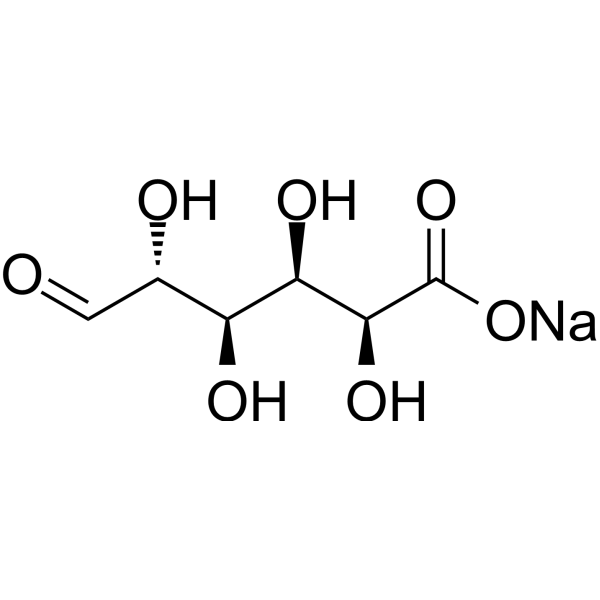
    Guluronic acid sodium
    1 Publications Verification

    G2013 sodium

    VEGFR Toll-like Receptor (TLR) COX NO Synthase NF-κB MMP Inflammation/Immunology Cancer
    Guluronic acid (G2013) sodium is an orally active oxidative stress regulator and anti-inflammatory agent that exerts pharmacological effects by down-regulating various pro-inflammatory and oxidative stress-related genes (such as TLR4, NF-κB, iNOS, etc.) and inhibiting the activities of COX-2, MMPs and VEGF. Low-dose Guluronic acid sodium up-regulates the expression of immunoregulatory genes SHIP1 and SOCS1, thereby effectively inhibiting cancer-related inflammation, tumor angiogenesis, cell adhesion and metastasis, while reducing the accumulation of immunosuppressive cells. Guluronic acid sodium significantly prolongs the survival time of tumor-bearing hosts within a concentration range without direct cytotoxicity, demonstrating favorable safety. Guluronic acid sodium has involved in the research of multiple sclerosis, ankylosing spondylitis, breast cancer and other inflammatory diseases [1] .
    Guluronic acid sodium
  • HY-N7700

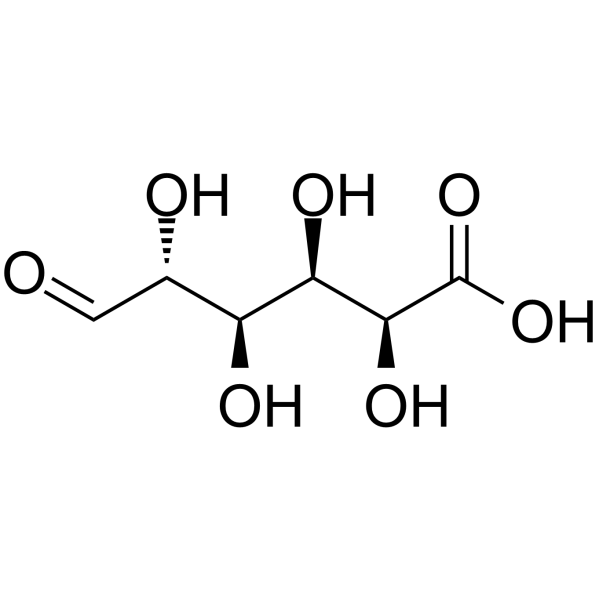
    G2013

    MMP COX VEGFR Toll-like Receptor (TLR) NF-κB NO Synthase Inflammation/Immunology Cancer
    Guluronic acid (G2013) is an orally active oxidative stress regulator and anti-inflammatory agent that exerts pharmacological effects by down-regulating various pro-inflammatory and oxidative stress-related genes (such as TLR4, NF-κB, iNOS, etc.) and inhibiting the activities of COX-2, MMPs and VEGF. Low-dose Guluronic acid up-regulates the expression of immunoregulatory genes SHIP1 and SOCS1, thereby effectively inhibiting cancer-related inflammation, tumor angiogenesis, cell adhesion and metastasis, while reducing the accumulation of immunosuppressive cells. Guluronic acid significantly prolongs the survival time of tumor-bearing hosts within a concentration range without direct cytotoxicity, demonstrating favorable safety. Guluronic acid has involved in the research of multiple sclerosis, ankylosing spondylitis, breast cancer and other inflammatory diseases [1] .
    Guluronic acid
  • HY-RS13552

    Small Interfering RNA (siRNA) Others

    SOCS1 Human Pre-designed siRNA Set A contains three designed siRNAs for SOCS1 gene (Human), as well as a negative control, a positive control, and a FAM-labeled negative control.

    SOCS1 Human Pre-designed siRNA Set A
    SOCS1 Human Pre-designed siRNA Set A
  • HY-172535

    Lipase Inflammation/Immunology Cancer
    Lipid OA2 dihydrochloride is an ionizable cationic lipid that can be used to prepare single-component lipid nanoparticles for siRNA delivery. Lipid OA2 dihydrochloride can effectively deliver SOCS1-siRNA to dendritic cells, silence the SOCS1 gene, and enhance their antigen-presenting ability and pro-inflammatory factor secretion capacity [1].
    Lipid OA2 dihydrochloride
  • HY-RS24177

    Small Interfering RNA (siRNA) Others

    Socs1 Rat Pre-designed siRNA Set A contains three designed siRNAs for Socs1 gene (Rat), as well as a negative control, a positive control, and a FAM-labeled negative control.

    Socs1 Rat Pre-designed siRNA Set A
    Socs1 Rat Pre-designed siRNA Set A
  • HY-124665

    TNF Receptor Interleukin Related Infection Metabolic Disease Inflammation/Immunology
    LMP-420 is a selective tumor necrosis factor-α (TNF-α) inhibitor. LMP-420 reduces the release of pro-inflammatory cytokines (e.g., IL-1β, IL-2), inducing the expression of anti-inflammatory cytokine IL-10 and anti-apoptotic molecules SOCS-1 and Mn-SOD. LMP-420 also downregulates chemokines (e.g., IP-10, MCP-1) to reduce immune cell infiltration. LMP-420 is promising for research of type 1 diabetes mellitus, inflammatory diseases (e.g., colitis), and HIV-Mycobacterium tuberculosis coinfection [1].
    LMP-420
  • HY-181653

    PROTACs E1/E2/E3 Enzyme DNA/RNA Synthesis JAK STAT Apoptosis Cancer
    PROTAC SKP2 Degrader-1 is a PROTAC degrader targeting SKP2, with a Kd value of 6.28 μM. PROTAC SKP2 Degrader-1 induces targeted degradation of SKP2 via the ubiquitin-proteasome system. PROTAC SKP2 Degrader-1 stabilizes the expression of SOCS1 and regulates the expression of immunoproteasomes through the JAK/STAT pathway, thereby inhibiting tumor cell proliferation. PROTAC SKP2 Degrader-1 is applicable for cancer-related research [1].
    PROTAC SKP2 Degrader-1

Inquiry Online

Your information is safe with us. * Required Fields.

Salutation


Country or Region *

Applicant Name *


Organization Name *

Department *


Email Address *


Product Name *

Cat. No.


Requested quantity *

Phone Number *


Remarks

Inquiry Online

Inquiry Information

Product Name:
Cat. No.:
Quantity:
MCE Japan Authorized Agent:

