



Guluronic acid sodium
Based on 1 publication(s) in Google Scholar
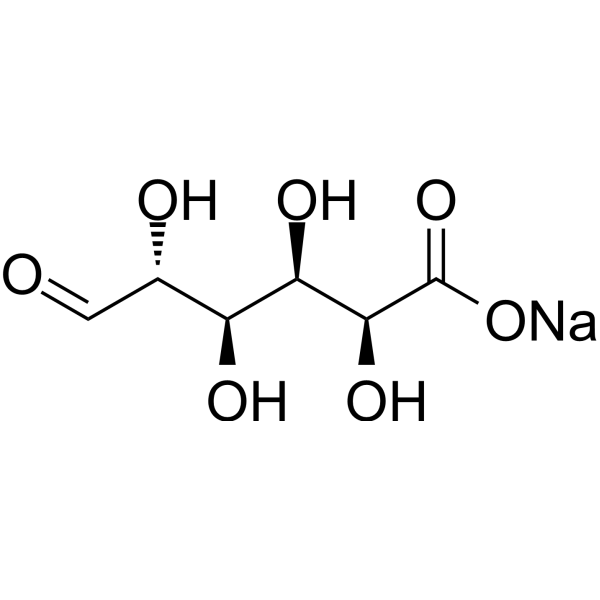
Guluronic acid (G2013) sodium is an orally active oxidative stress regulator and anti-inflammatory agent that exerts pharmacological effects by down-regulating various pro-inflammatory and oxidative stress-related genes (such as TLR4, NF-κB, iNOS, etc.) and inhibiting the activities of COX-2, MMPs and VEGF. Low-dose Guluronic acid sodium up-regulates the expression of immunoregulatory genes SHIP1 and SOCS1, thereby effectively inhibiting cancer-related inflammation, tumor angiogenesis, cell adhesion and metastasis, while reducing the accumulation of immunosuppressive cells. Guluronic acid sodium significantly prolongs the survival time of tumor-bearing hosts within a concentration range without direct cytotoxicity, demonstrating favorable safety. Guluronic acid sodium has involved in the research of multiple sclerosis, ankylosing spondylitis, breast cancer and other inflammatory diseases.
For research use only. We do not sell to patients.
- Purity : 98.0%
- Formula: C6H9NaO7
- Molecular Weight:216.12
-
Storage:
4°C, sealed storage, away from moisture and light
* In solvent : -80°C, 6 months; -20°C, 1 month (sealed storage, away from moisture and light)

To place orders, for customer services and technical support, please contact: MedChemExpress USA
Tel: 609-228-6898 E-mail: [email protected] [email protected]


-
 Biological Activity
-
Chemical Information
-
Solvent & Solubility
- Purity & Documentation
- References
-
 Help & FAQs


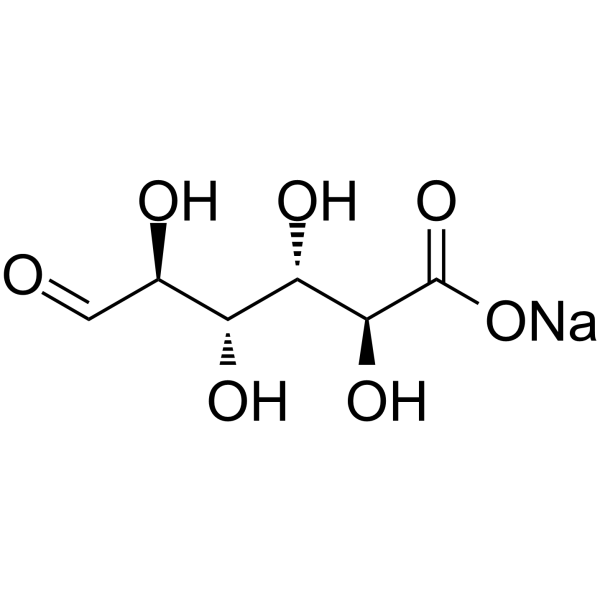
Publications Citing Use of MedChemExpress (MCE) Guluronic acid sodium
MoreAll VEGFR Isoforms
More

Biological Activity
Description
IC50 & Target
|
MMP-9 |
MMP-2 |
COX-2 |
TLR4 |
iNOS |
In Vitro
Guluronic acid sodium (G2013) (5-25 μg/well; 18 h following 4 h LPS pre-incubation) significantly suppresses LPS-induced mRNA expression of SOD2, GPX1, GST, and MPO in healthy human PBMCs; at 25 μg/well, it additionally significantly suppresses LPS-induced CAT and iNOS mRNA expression in these cells, while the 5 μg/well dose does not produce statistically significant reductions in CAT or iNOS mRNA expression[1].
Guluronic acid sodium (5 μg/well-15 μg/well; 24 h) in untreated HEK-Blue hTLR4 cells, at 5 μg/well (24 h) significantly reduces TLR4, MyD88, and NF-κB gene expression, and significantly increases SHIP1 and SOCS1 gene expression; at 15 μg/well (24 h), it significantly reduces TLR4, MyD88, and SOCS1 gene expression, with non-significant changes to SHIP1 and NF-κB[2].
Guluronic acid sodium (200 ng/ml-125 μg/ml; 24 h) has no cytotoxic effect on HEK-Blue hTLR4 cells at concentrations below 125 μg/ml, and exhibits an IC50 of 125 μg/ml for 24 h treatment[2].
Guluronic acid sodium (25-500 μg/ml; 48 h) dose-dependently inhibits the activity of MMP2 (22-31% reduction) and MMP9 (28-44% reduction) in 4T1 murine breast cancer cells[3].
Guluronic acid sodium (25-500 μg/ml; 24 h co-incubation) reduces LPS-induced PG2E production by ~66% in J774 murine macrophage cells[3].
MedChemExpress (MCE) has not independently confirmed the accuracy of these methods. They are for reference only.
-
Cell Line:HEK-Blue hTLR4 cells
-
Concentration:200 ng/ml, 1 μg/ml, 5 μg/ml, 25 μg/ml, 125 μg/ml
-
Incubation Time:24 h
-
Result:Showed no cytotoxic effect at concentrations below 125 μg/ml. Reduced cell viability to ~60% of the control at 125 μg/ml. Reached an IC50 of 125 μg/ml after 24 h treatment.
-
Cell Line:HEK-Blue hTLR4 cells (untreated condition)
-
Concentration:5 μg/well (low dose); 15 μg/well (high dose)
-
Incubation Time:24 h
-
Result:Decreased TLR4 gene expression by 65% (low dose) and 41% (high dose), compared to control.
Decreased MyD88 gene expression by 82% (low dose) and 47% (high dose), compared to control.
Increased SHIP1 gene expression by 62% (low dose) and decreased it by 27% (high dose, non-significant), compared to control. Increased SOCS1 gene expression by 72% (low dose) and decreased it by 29% (high dose), compared to control.
Decreased NF-κB gene expression by 69% (low dose) and 49% (high dose, non-significant), compared to control.
-
Cell Line:J774 murine macrophage cells
-
Concentration:25, 250, 500 μg/ml
-
Incubation Time:24 h (co-incubated with LPS)
-
Result:Reduced PGE2 levels by ~66% across all tested concentrations compared to LPS-only treated cells.
In Vivo
Guluronic acid (50 mg/kg; i.p.; every 2 days; day 6 to day 26 post-tumor inoculation) sodium and Guluronic acid (50 μg/ml; in vitro 48-hour pre-treatment of 4T1 cells) sodium inhibits cancer-related inflammation, reduces tumor growth by up to ~94.1%, eliminates metastasis in pre-treated cells, and prolongs survival in syngeneic murine breast cancer models[3].
MedChemExpress (MCE) has not independently confirmed the accuracy of these methods. They are for reference only.
-
Animal Model:Breast cancer model in BALB/c (female, 6-8 weeks old, 18-20 g, syngeneic breast cancer model induced by 5×10⁵ 4T1 cell injection into mammary fat pad)[4]
-
Dosage:50 mg/kg (therapeutic group); 50 μg/ml (cell line pre-treated group)
-
Administration:i.p.; every 2 days; day 6 to day 26 post-tumor inoculation (therapeutic group); in vitro pre-treatment of 4T1 cells before inoculation (cell line pre-treated group)
-
Result:Reduced tumor volume by ~61.4% (therapeutic group) and ~94.1% (cell line pre-treated group) on day 30 post-inoculation compared to controls.
Exhibited metastasis incidence of 80% lung, 60% lymph node, and 20% liver (therapeutic group); showed no detectable metastasis in any organs (cell line pre-treated group).
Reduced lung metastatic area to ~5% per section (therapeutic group) and 0% (cell line pre-treated group) compared to ~15% in controls.
Lowered serum levels of IL-1β and IL-6 significantly in both groups; left TNF-α levels unchanged.
Reduced white blood cell count and granulocyte-to-lymphocyte ratio in both groups.
Reduced frequency of regulatory T cells (Treg) significantly in tumor tissue and lymph nodes (therapeutic group).
Reduced myeloid-derived suppressor cells (MDSC) significantly in tumor tissue and spleen (therapeutic group).
Reduced tumor angiogenesis by ~59.8% (therapeutic group) and ~91.1% (cell line pre-treated group) compared to controls.
Lowered tumor tissue mRNA expression of COX-2, MMP2, MMP9, and VEGF significantly in both groups compared to controls.
Prolonged survival significantly, with 100% of mice in the cell line pre-treated group surviving up to day 90, and higher survival rate in the therapeutic group than in controls.


Chemical Information
-
Appearance Solid
-
Molecular Weight 216.12
-
Formula C6H9NaO7
-
Color White to light yellow
-
SMILES
O=C[C@@H]([C@@H]([C@H]([C@@H](C(O[Na])=O)O)O)O)O
-
Synonyms
G2013 sodium
-
Structure Classification
-
Initial Source
-
Shipping
Room temperature in continental US; may vary elsewhere.
-
Storage
4°C, sealed storage, away from moisture and light
* In solvent : -80°C, 6 months; -20°C, 1 month (sealed storage, away from moisture and light)


Publications (1)
-
Journal Impact Factor
-
Most Recent
-
Int J Biol Macromol
Quantitative and qualitative saccharide analysis of North Atlantic brown seaweed by gas chromatography/mass spectrometry and infrared spectroscopy. [Abstract]2024 Jan;254(Pt 3):127870. PMID: 37967607


Solvent & Solubility
In Vitro:
H2O : 62.5 mg/mL (289.19 mM; ultrasonic and warming and heat to 60°C)
Please refer to the solubility information to select the appropriate solvent. Once prepared, please aliquot and store the solution to prevent product inactivation from repeated freeze-thaw cycles.
Storage method and period of stock solution: -80°C, 6 months; -20°C, 1 month (sealed storage, away from moisture and light). When stored at -80°C, please use it within 6 months. When stored at -20°C, please use it within 1 month.
* Note: If you choose water as the stock solution, please dilute it to the working solution, then filter and sterilize it with a 0.22 μm filter before use.
Please refer to the solubility information to select the appropriate solvent. Once prepared, please aliquot and store the solution to prevent product inactivation from repeated freeze-thaw cycles.
Storage method and period of stock solution: -80°C, 6 months; -20°C, 1 month (sealed storage, away from moisture and light). When stored at -80°C, please use it within 6 months. When stored at -20°C, please use it within 1 month.
* Note: If you choose water as the stock solution, please dilute it to the working solution, then filter and sterilize it with a 0.22 μm filter before use.
Concentration (start) × Volume (start) = Concentration (final) × Volume (final)


Purity & Documentation
-
Data Sheet (286 KB)
-
SDS (252 KB)
- English - EN (252 KB)
- Français - FR (252 KB)
- Deutsch - DE (252 KB)
- Norwegian - NO (252 KB)
- Español - ES (252 KB)
- Swedish - SV (252 KB)
- Italian - IT (252 KB)
- Korean - KR (252 KB)
- Portuguese - PT (252 KB)
-
Handling Instructions (2659 KB)
References
[1]. Taeb M, et al. An in vitro evaluation of anti-aging effect of guluronic acid (G2013) based on enzymatic oxidative stress gene expression using healthy individuals PBMCs. Biomed Pharmacother. 2017;90:262-267. [Content Brief]
[2]. Mortazavi-Jahromi SS, et al. Effects of guluronic acid (G2013) on SHIP1, SOCS1 induction and related molecules in TLR4 signaling pathway. Int Immunopharmacol. 2018;55:323-329. [Content Brief]
[3]. Hosseini F, et al. Anti-inflammatory and anti-tumor effects of α-l-guluronic acid (G2013) on cancer-related inflammation in a murine breast cancer model. Biomed Pharmacother. 2018;98:793-800. [Content Brief]
[4]. Nazeri S, et al. The safety and efficacy of Guluronic acid (G2013) in ankylosing spondylitis: A randomized controlled parallel clinical trial. Pharmacol Rep. 2019;71(3):393-398. [Content Brief]


Complete Stock Solution Preparation Table
Please refer to the solubility information to select the appropriate solvent. Once prepared, please aliquot and store the solution to prevent product inactivation from repeated freeze-thaw cycles.
Storage method and period of stock solution: -80°C, 6 months; -20°C, 1 month (sealed storage, away from moisture and light). When stored at -80°C, please use it within 6 months. When stored at -20°C, please use it within 1 month.
| Optional Solvent | Concentration Solvent Mass | 1 mg | 5 mg | 10 mg | 25 mg |
|---|---|---|---|---|---|
| H2O | 1 mM | 4.6271 mL | 23.1353 mL | 46.2706 mL | 115.6765 mL |
| 5 mM | 0.9254 mL | 4.6271 mL | 9.2541 mL | 23.1353 mL | |
| 10 mM | 0.4627 mL | 2.3135 mL | 4.6271 mL | 11.5676 mL | |
| 15 mM | 0.3085 mL | 1.5424 mL | 3.0847 mL | 7.7118 mL | |
| 20 mM | 0.2314 mL | 1.1568 mL | 2.3135 mL | 5.7838 mL | |
| 25 mM | 0.1851 mL | 0.9254 mL | 1.8508 mL | 4.6271 mL | |
| 30 mM | 0.1542 mL | 0.7712 mL | 1.5424 mL | 3.8559 mL | |
| 40 mM | 0.1157 mL | 0.5784 mL | 1.1568 mL | 2.8919 mL | |
| 50 mM | 0.0925 mL | 0.4627 mL | 0.9254 mL | 2.3135 mL | |
| 60 mM | 0.0771 mL | 0.3856 mL | 0.7712 mL | 1.9279 mL | |
| 80 mM | 0.0578 mL | 0.2892 mL | 0.5784 mL | 1.4460 mL | |
| 100 mM | 0.0463 mL | 0.2314 mL | 0.4627 mL | 1.1568 mL |
* Note: If you choose water as the stock solution, please dilute it to the working solution, then filter and sterilize it with a 0.22 μm filter before use.


Guluronic acid sodium Related Classifications
HY-N7700A Related Classifications
 Powered by Bioz