11 Results for "

cobalt(II)

" in MedChemExpress (MCE) Product Catalog:
Products (11)

11 Results for "cobalt(II)" in MCE Product Catalog:

Cat. No.: HY-W073013
CAS No.: 14172-90-8
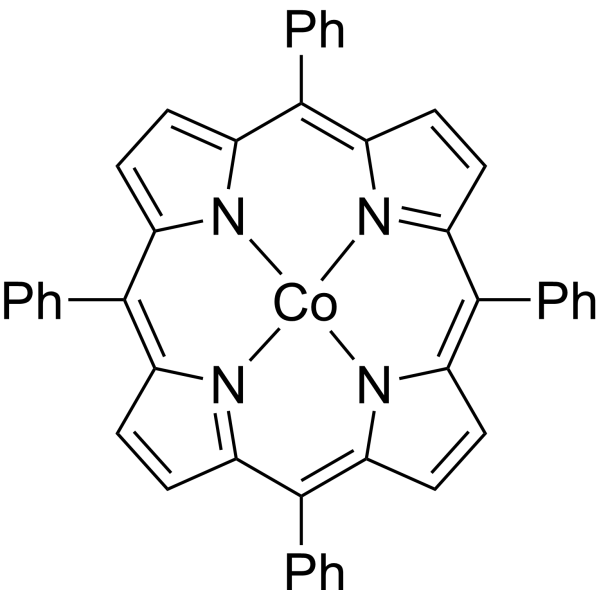
5,10,15,20-Tetraphenyl-21H,23H-porphine cobalt(II), commonly known as CoTPP or cobalt porphyrin, is a coordination compound. 5,10,15,20-Tetraphenyl-21H,23H-porphine cobalt(II) is widely used in various fields such as catalysis, sensing, and organic electronics because of its unique electronic and optical properties. An efficient catalyst for reactions including oxidation, reduction, and CH bond activation, moreover, it has been used as a fluorescent probe for detecting oxygen content in biological systems and as an active material in organic solar cells.
loading...
    loading...
Cat. No.: HY-18761
CAS No.: 3317-67-7
Synonyms: cobalt(II) phthalocyanine; Cobaltous phthalocyanine; Phthalocyanine cobalt complex
Target:  

MOFs

Research Areas:  

Others

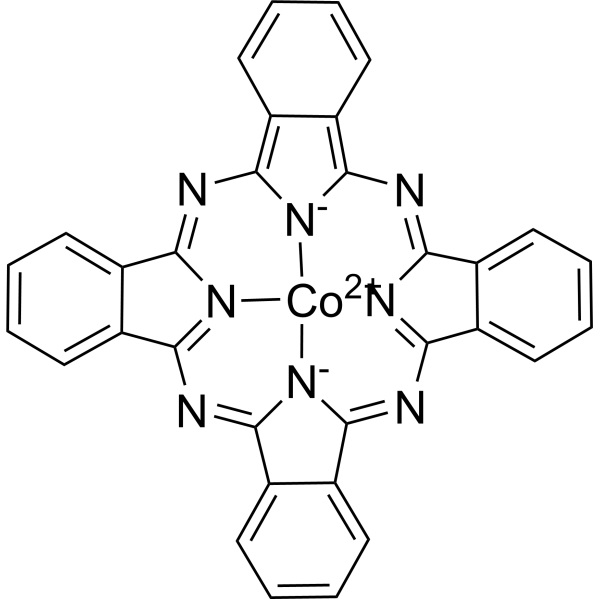
Cobalt phthalocyanine is a catalyst of redox reaction, catalyzes aerobic regenerations of aldehydes and ketones from aldoximes and ketoximes. Cobalt phthalocyanine can be used in the development of electrocatalysts .
loading...
    loading...
Cat. No.: HY-D2775
CAS No.: 3047612-66-5
Cobalt(II) ions probe 1 (Compound L) is a fluorescent sensor for Co 2+ detecting in biological environments. Cobalt(II) ions probe 1 can selectively bind with Co 2+ in the presence of other metal ions (Ex: 380 nm) .
loading...
    loading...
Cat. No.: HY-W088188
CAS No.: 14024-48-7
Synonyms: cobalt(II) acetylacetonate
Research Areas:  

Others

Co (acac)2 is an organometallic compound with catalytic activity, in which the central cobalt ion is chelated with acetylacetonate ligands. Co (acac)2 can serve as a precursor for thin films and nanomaterials, and is applicable to researches in organic synthesis, materials science, industrial applications, and other fields .
loading...
    loading...
Cat. No.: HY-D3247
Cobalt (II) plant dye (Compound 3) is a Cobalt (II) probe. Cobalt (II) plant dye is used for the selective detection of bioaccumulated Cobalt (II) ions in root and stem tissues of Hybanthus enneaspermus plants .
loading...
    loading...
Cat. No.: HY-W034798
CAS No.: 28903-71-1
Synonyms: Tetrakis(4-Methoxyphenyl)-21H,23H-Porphine cobalt(II)
Target:  

MOFs

Research Areas:  

Others

5,10,15,20-Tetrakis(4-methoxyphenyl)-21H,23H-porphine cobalt(II) (Tetrakis(4-Methoxyphenyl)-21H,23H-Porphine Cobalt(Ii)) is a metal-organic framework (MOF).
loading...
    loading...
Cat. No.: HY-Y1013
CAS No.: 20826-04-4
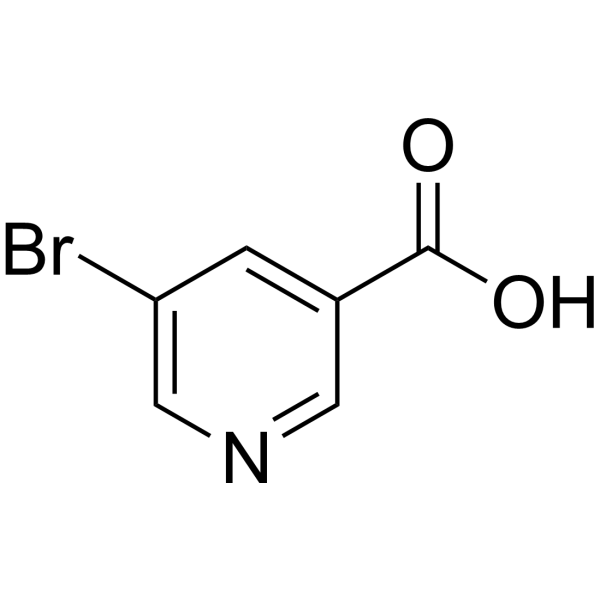
5-Bromonicotinic acid is a brominated pyridinecarboxylic acid derivative of nicotinic acid, which serves as a pharmaceutical intermediate for organic synthesis-related research. 5-Bromonicotinic acid can form metal-organic frameworks (MOFs) with cadmium (II), cobalt (II) and lanthanide (III) salts .
loading...
    loading...
loading...
    loading...
Cat. No.: HY-Y1013R
CAS No.: 20826-04-4
5-Bromonicotinic acid (Standard) is the analytical standard of 5-Bromonicotinic acid (HY-Y1013). This product is intended for research and analytical applications. 5-Bromonicotinic acid is a brominated pyridinecarboxylic acid derivative of nicotinic acid, which serves as a pharmaceutical intermediate for organic synthesis-related research. 5-Bromonicotinic acid can form metal-organic frameworks (MOFs) with cadmium (II), cobalt (II) and lanthanide (III) salts .
loading...
    loading...
Cat. No.: HY-W543267
CAS No.: 1167993-47-6
Target:  

MOFs Drug Intermediate

Research Areas:  

Others

1,3,5-Tri (1H-1,2,3-triazol-5-yl) benzene is a tritopic triazole-bridged ligand (H3BTTri) that forms a sodalite-type metal-organic framework with coordinatively unsaturated cobalt (II) centers. This framework exhibits selective O2-binding capacity over N2. 1,3,5-Tri (1H-1,2,3-triazol-5-yl) benzene can be used for the synthesis of metal-organic framework (MOF)-related materials .
loading...
    loading...
Cat. No.: HY-W008952
CAS No.: 81741-28-8
Tributyltetradecyl phosphonium chloride is a quaternary phosphonium salt cation. Tributyltetradecyl phosphonium chloride can form an acidic aqueous biphasic system with acid and water, exhibits temperature-induced phase separation behavior with a lower critical solution temperature, enables the partitioning of Co 2+, Fe 3+, Pt 4+ and Ni 2+ between the two phases, and also promotes the separation of Co 2+ and Ni 2+ .
loading...
    loading...
  • 1

