8 Results for "

esterase assays

" in MedChemExpress (MCE) Product Catalog:
Products (8)

8 Results for "esterase assays" in MCE Product Catalog:

1
1 Cited Publications
Cat. No.: HY-124298
CAS No.: 168482-84-6
Purity:  99.00%
Target:  

Fluorescent Dye

Research Areas:  

Others

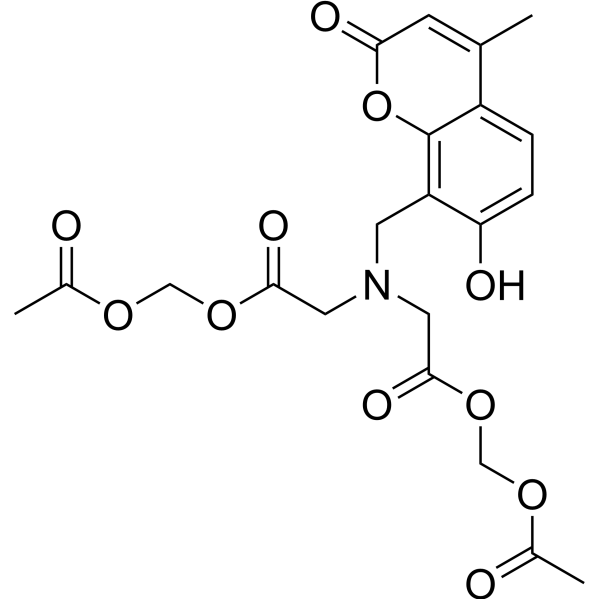
Calcein Blue AM is a cell staining agent. Calcein Blue AM serves as a substrate for intracellular esterases, which hydrolyze its acetoxymethyl (AM) ester group to convert the non-fluorescent reagent into fluorescent Calcein Blue. Calcein Blue AM passively penetrates the plasma membrane of both live and dead cells; it is converted into a polar fluorescent product and retained in the cytoplasm of live cells, whereas dead cells cannot retain the dye. Calcein Blue AM exhibits significant dye leakage, and its fluorescence intensity gradually decreases over time. Calcein Blue AM can be used for endpoint-based cell viability assays and short-term cell tracking experiments with a duration of no more than 4 hours.
loading...
    loading...
Cat. No.: HY-W014449
CAS No.: 2635-84-9
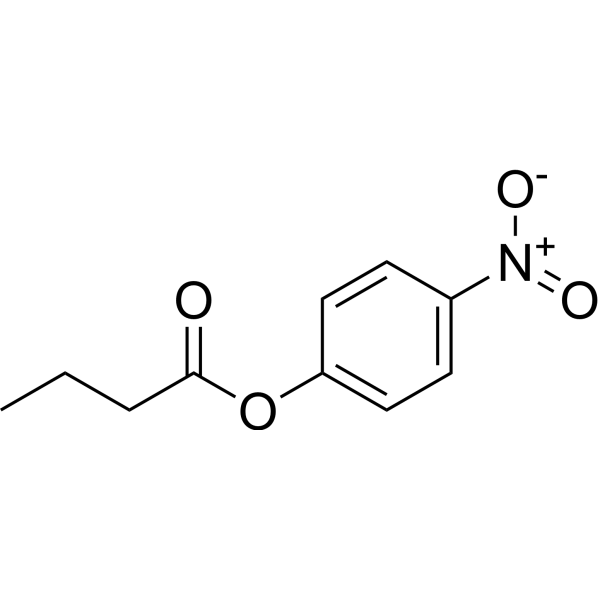
4-Nitrophenyl butyrate consists of butyric acid chains esterified with 4-nitrophenol groups, thus giving it a yellow color. This compound is commonly used as a substrate in enzyme assays to measure esterase and lipase activity. When these enzymes cleave the ester bond, the nitrophenol group is released and the color changes from yellow to orange. Thus, the rate of color change can be used to determine enzyme activity. In addition, 4-Nitrophenyl butyrate can also be used as organic synthesis reagent and dye intermediate.
loading...
    loading...
Cat. No.: HY-D1678
CAS No.: 164256-07-9
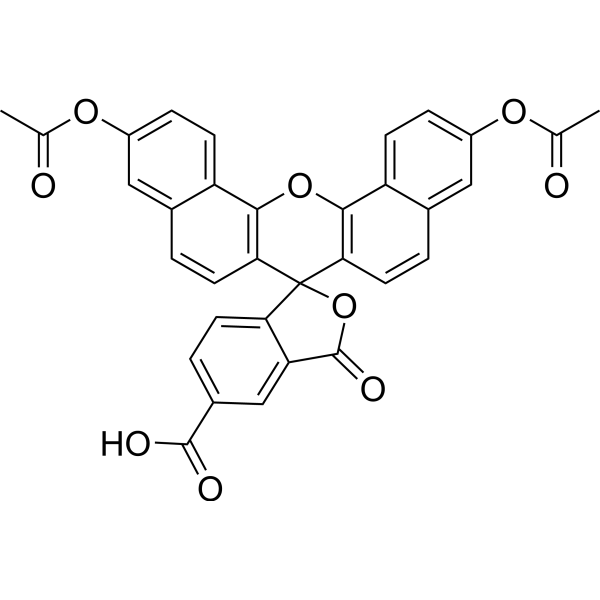
5(6)-Carboxynaphthofluorescein diacetate is a fluorescent substrate for esterase assays that can be cleaved by intracellular esterases, producing red fluorescence to measure enzyme activity (Ex = 590 nm; Em = 645 nm) .
loading...
    loading...
Cat. No.: HY-W099563
CAS No.: 14617-86-8
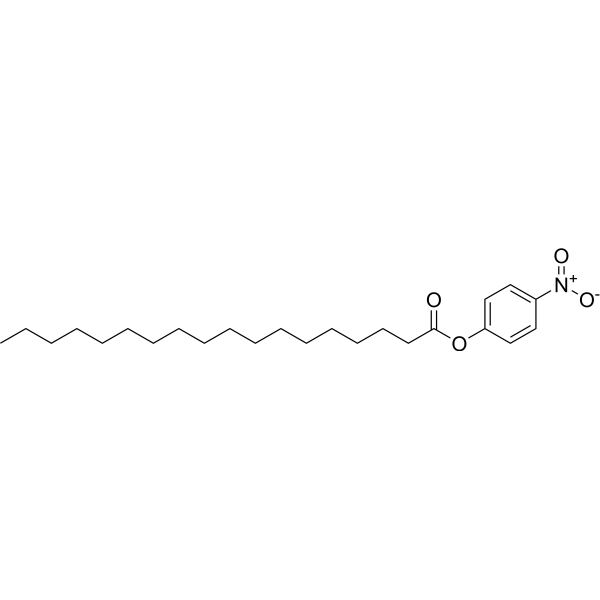
4-Nitrophenyl stearate, which is an ester formed by the condensation of stearic acid and 4-nitrophenol, is commonly used as a substrate for enzymatic assays, where the hydrolysis of ester bonds by esterase and lipase can be measured by absorbance or ratio In addition, 4-Nitrophenyl stearate has been used as a model compound to study the enzymatic activity and selectivity of lipases and esterases from various sources. The long hydrophobic tail of the molecule makes it suitable for use in lipophilic Good solubility in the environment makes it a useful probe for studying lipid metabolism.
loading...
    loading...
Cat. No.: HY-138959
CAS No.: 1956-10-1
Synonyms: p-Nitrophenyl caprylate
Target:  

Lipase

Research Areas:  

Others

4-Nitrophenyl octanoate (p-Nitrophenyl caprylate) is an aromatic ester compound which can be used as a substrate for pancreatic lipase. 4-Nitrophenyl octanoate contains an ester bond that can be hydrolyzed under the action of lipase, releasing p-nitrophenol as a yellow product. 4-Nitrophenyl octanoate can be used to assay the activities of lipases and esterases .
loading...
    loading...
Cat. No.: HY-130431
CAS No.: 83792-61-4
Target:  

Parasite

Research Areas:  

Infection

Vinclozolin M2 is an active metabolite of vinclozolin. It is formed from vinclozolin by successive esterase activity and decarboxylation of vinclozolin in C. elegans and by decarboxylation in human liver microsomes. Vinclozolin M2 is an antagonist of the mineralocorticoid receptor (IC50=1,400 nM) and androgen receptor (IC50=0.17 nM) in reporter assays using MCF-7 cells.
loading...
    loading...
Cat. No.: HY-187344
GLP-1R prodrug-1 is a GLP-1R agonist prodrug. GLP-1R prodrug-1 lacks direct GLP-1R agonistic activity. GLP-1R prodrug-1 is slowly converted into its active free acid metabolite GLP-1R agonist 45 (HY-187343) in plasma via esterase-mediated hydrolysis. GLP-1R prodrug-1 can be used in the research of type 2 diabetes and obesity .
loading...
    loading...
Cat. No.: HY-D3431
CFSE-Tz is a fluorescent bioorthogonal probe constructed based on the IEDDA reaction, which is mainly used for visual tracing of amino acid uptake in living cells. The tetrazine group within the CFSE-Tz molecule quenches CFSE fluorescence via photoinduced electron transfer; after the probe specifically undergoes a bioorthogonal reaction with trans-cyclooctene-modified amino acids, the quenching effect is eliminated, and a green fluorescent signal is released, thereby dynamically monitoring the intracellular amino acid uptake process. CFSE-Tz can be applied to in vitro single-cell fluorescence imaging and studies related to amino acid metabolism in tumor cells (Ex = 495 nm, Em = 519 nm) [1] [2].
loading...
    loading...

