15 Results for "

eye inflammation

" in MedChemExpress (MCE) Product Catalog:
Products (15)

15 Results for "eye inflammation" in MCE Product Catalog:

5
5 Cited Publications
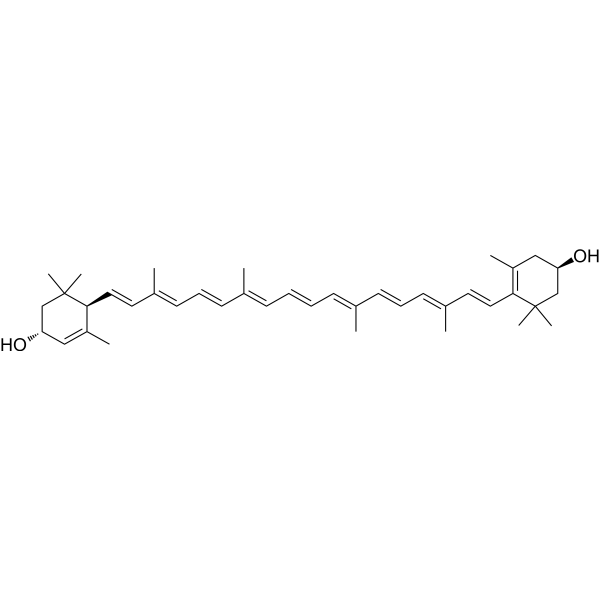
Cat. No.: HY-N6947
CAS No.: 127-40-2
Synonyms: Xanthophyll
Lutein (Xanthophyll) is a carotenoid with reported anti-inflammatory properties. A large body of evidence shows that lutein has several beneficial effects, especially on eye health . Lutein exerts its biological activities, including anti-inflammation, anti-oxidase and anti-apoptosis, through effects on reactive oxygen species (ROS) . Lutein is able to arrive in the brain and shows antidepressant-like and neuroprotective effects. Lutein is orally active .
loading...
    loading...
Cat. No.: HY-76025S
CAS No.: 4165-56-4
Synonyms: p-Dibromobenzene-d4
1,4-Dibromobenzene-d4 is a deuterium labeled 1,4-Dibromobenzene. 1,4-Dibromobenzene is used as a fumigant and as a chemical intermediate for pharmaceuticals. Inhalation exposure gives rise to dizziness and chokingwhereas contact with skin or eye produces inflammation and burning in humans .
loading...
    loading...
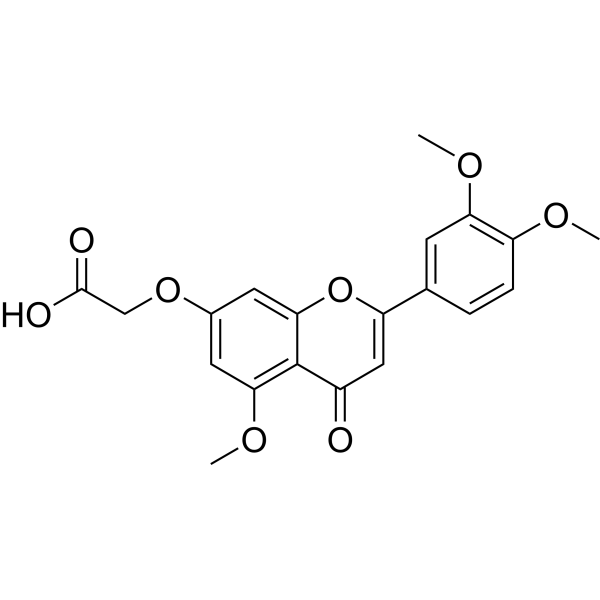
Cat. No.: HY-106449
CAS No.: 203191-10-0
Purity:  ≥98.0%
Synonyms: DA-6034 free acid
Recoflavone (DA-6034 (free acid)), a synthetic derivative of the flavonoid Eupatilin (HY-N0783), is orally active. Recoflavone can inhibit the NF-κB pathway and induce [Ca( 2+)]i increase in epithelial cells. Recoflavone exhibits activities such as anti-inflammation, anti-tumor effects, protection of gastric and intestinal mucosa, and promotion of secretion in the ocular surface and salivary glands. Recoflavone can be used for the research of diseases such as dry eye, gastric injury, and intestinal injury .
loading...
    loading...
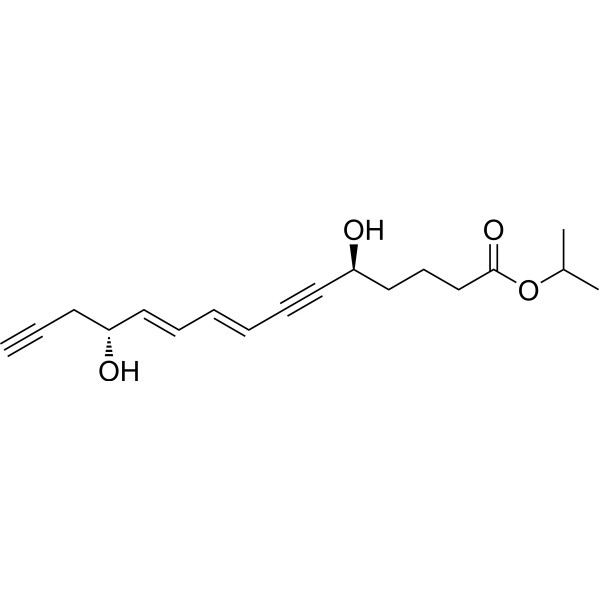
Cat. No.: HY-17639
CAS No.: 1251537-11-7
Synonyms: RX-10045
Research Areas:  

Inflammation/Immunology

Navamepent is an analog of naturally occurring resolvin E1 (a major dietary omega-3 polyunsaturated fatty-acid metabolite) with potent anti-inflammatory and cell survival benefits. Navamepent is highly effective against dry eye and goblet cell loss thereby accelerating tear production. Also, Navamepent can reduce corneal inflammation, epithelial damage, and accelerate corneal tissue repair. In addition, Navamepent can inhibit the release of several key proinflammatory mediators from corneal epithelial cells. Navamepent is a click chemistry reagent, it contains an Alkyne group and can undergo copper-catalyzed azide-alkyne cycloaddition (CuAAc) with molecules containing Azide groups.
loading...
    loading...
Cat. No.: HY-124404
CAS No.: 82337-46-0
Purity:  ≥99.0%
12(R)-HETE is a CYP-dependent arachidonic acid metabolite that acts as a proinflammatory lipid mediator. 12 (R)-HETE widely exists in various tissues including the eye, skin and liver. In the cornea, 12(R)-HETE is metabolized via pathways such as β-oxidation into the precursor of 12(R)-HETrE. Without direct receptor binding, 12(R)-HETE indirectly activates AHR-mediated target gene transcription, while inhibiting the enzymatic activity of Na+,K+-ATPase and the intracellular calcium elevation induced by TP agonists. 12(R)-HETE also possesses multiple physiological effects such as chemotaxis, proangiogenesis, vasodilation, natriuresis, diuresis and intraocular pressure reduction, and can be widely used in studies related to psoriasis, inflammatory skin diseases and ocular inflammation .
loading...
    loading...
Cat. No.: HY-A0288
CAS No.: 129260-79-3
Research Areas:  

Inflammation/Immunology

Loteprednol is a synthetic corticosteroid that belongs to a family of glucocorticoids. Loteprednol has anti-inflammatory, antiallergic and immunosuppressive activities. Loteprednol can be used to study eye inflammation .
loading...
    loading...
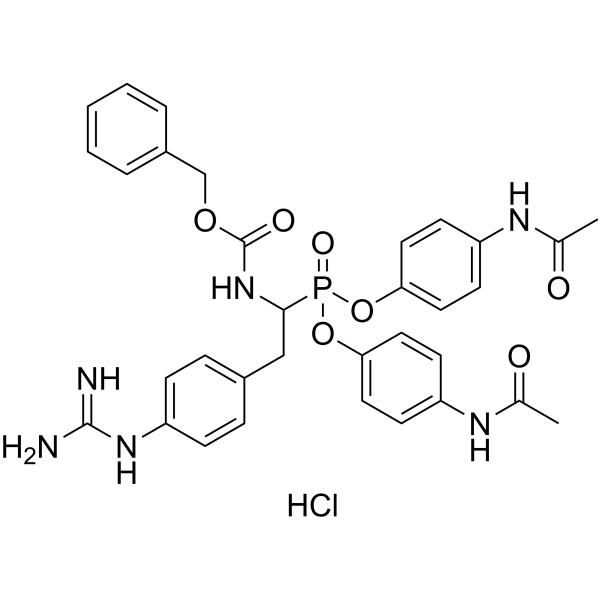
Cat. No.: HY-151611
CAS No.: 2842774-51-8
Target:  

Ser/Thr Protease

Research Areas:  

Inflammation/Immunology

UAMC-00050 is a potent trypsin-like serine protease inhibitor. UAMC-00050 can be used in research of dry eye syndrome and ocular inflammation .
loading...
    loading...
Cat. No.: HY-P991255

Target:  

IGF-1R

Research Areas:  

Inflammation/Immunology

VRDN-002 is a human monoclonal antibody (mAb) targeting IGF1R/CD221. VRDN-002 reduces inflammation and proptosis in thyroid eye disease (TED). VPI-2690B can be used in Graves ophthalmopathy research .
loading...
    loading...
Cat. No.: HY-W795259
CAS No.: 66254-56-6
Target:  

MMP

L-Val-P is a potent leucine aminopeptidase (LAP) inhibitor with a Ki of 0.15 μM. L-Val-P is promising for research of HIV infection, inflammation, eye lens cataract and cancer .
loading...
    loading...
Cat. No.: HY-151611A
CAS No.: 934622-26-1
UAMC-00050 free base is a potent trypsin-like serine protease inhibitor. UAMC-00050 free base can be used in research of dry eye syndrome and ocular inflammation .
loading...
    loading...
Cat. No.: HY-N20731
CAS No.: 593254-83-2
Asiaticoside F is a triterpenoid glycoside found in Centella asiatica. Asiaticoside F can be used in studies related to skin diseases, diarrhea, eye diseases, inflammation, asthma, leprosy and hypertension .
loading...
    loading...
Cat. No.: HY-N17566
CAS No.: 83475-36-9
Eukovoside is a cinnamic acid derivative found in Euphrasia regelii with anti-inflammatory, antioxidant, antibacterial, antiallergic, and antihistamine activity. Eukovoside can be used for the research of hyperglycemic diseases, eye inflammation, upper respiratory passages inflammation, hay fever, conjunctivitis, colds, influenza, sinusitis .
loading...
    loading...
Cat. No.: HY-106449R
CAS No.: 203191-10-0
Synonyms: DA-6034 free acid (Standard)
Recoflavone (Standard) is the analytical standard of Recoflavone (HY-106449). This product is intended for research and analytical applications. Recoflavone (DA-6034 (free acid)), a synthetic derivative of the flavonoid Eupatilin (HY-N0783), is orally active. Recoflavone can inhibit the NF-κB pathway and induce [Ca(2+)]i increase in epithelial cells. Recoflavone exhibits activities such as anti-inflammation, anti-tumor effects, protection of gastric and intestinal mucosa, and promotion of secretion in the ocular surface and salivary glands. Recoflavone can be used for the research of diseases such as dry eye, gastric injury, and intestinal injury .
loading...
    loading...
Cat. No.: HY-160906A
Synonyms: GSSSG TFA
Glutathione trisulfide TFA (GSSSG TFA) is an orally active, blood-brain barrier permeable neuroprotective agent. Glutathione trisulfide TFA inactivates intracellular tyrosinase, regulates the expression of Cars2, Cbs, MITF and TYR, inhibits α-MSH (HY-P0252)-induced melanogenesis, and restores intracellular persulfide levels reduced by α-MSH. Glutathione trisulfide TFA scavenges free radicals, quenches ROS, reduces Paclitaxel (HY-B0015)-induced superoxide production, upregulates the expression of antioxidant protein genes, and inhibits oxidative stress-induced cell death. Glutathione trisulfide TFA promotes ERK1/2 activation, prevents NF-κB p65 activation, inhibits TAK1 phosphorylation, reduces pro-inflammatory cytokine expression, and blocks microglial activation. Glutathione trisulfide TFA can be used in research related to dry age-related macular degeneration, inflammation-associated eye diseases, Alzheimer's disease, Parkinson's disease, etc.
loading...
    loading...
Cat. No.: HY-160906
CAS No.: 32607-79-7
Synonyms: GSSSG
Glutathione trisulfide (GSSSG) is an orally active, blood-brain barrier permeable neuroprotective agent. Glutathione trisulfide inactivates intracellular tyrosinase, regulates the expression of Cars2, Cbs, MITF and TYR, inhibits α-MSH (HY-P0252)-induced melanogenesis, and restores intracellular persulfide levels reduced by α-MSH. Glutathione trisulfide scavenges free radicals, quenches ROS, reduces Paclitaxel (HY-B0015)-induced superoxide production, upregulates the expression of antioxidant protein genes, and inhibits oxidative stress-induced cell death. Glutathione trisulfide promotes ERK1/2 activation, prevents NF-κB p65 activation, inhibits TAK1 phosphorylation, reduces pro-inflammatory cytokine expression, and blocks microglial activation. Glutathione trisulfide can be used in research related to dry age-related macular degeneration, inflammation-associated eye diseases, Alzheimer's disease, Parkinson's disease, etc.
loading...
    loading...
  • 1

