4 Results for "

halogenation

" in MedChemExpress (MCE) Product Catalog:
Products (4)

4 Results for "halogenation" in MCE Product Catalog:

Cat. No.: HY-W011168
CAS No.: 13389-03-2
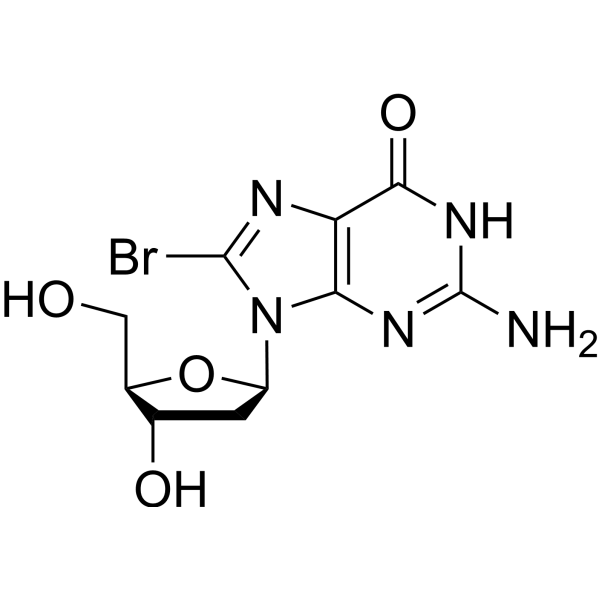
8-Bromo-2'-deoxyguanosine is an inflammation-related DNA halogenated adduct and an early biomarker of inflammation-induced oxidative tissue damage. The formation of 8-Bromo-2'-deoxyguanosine precedes that of oxidative and nitrative products, and it can be generated via the MPO-H2O2-Cl --Br - system. 8-Bromo-2'-deoxyguanosine serves as the immunogen for preparing the monoclonal antibody mAb8B3, which can be used to detect early DNA modifications in preclinical models; its urinary level also increases significantly in inflammatory disease models. 8-Bromo-2'-deoxyguanosine can also be produced in the dermis of UV-B irradiated mice, and the extract of Coprinus comatus significantly reduces its level. 8-Bromo-2'-deoxyguanosine finds applications in studies related to inflammatory diseases, diabetes, hepatocellular carcinoma, and UV-B induced skin inflammation .
loading...
    loading...
Cat. No.: HY-W023557
CAS No.: 1072-87-3
Synonyms: 3-Methylmaleimide; 2-Methylmaleimide
Target:  

Drug Intermediate

Research Areas:  

Others

Citraconimide is a 3-methylmaleimide derivative. Citraconimide has thiol affinity and can undergo highly regioselective addition with a variety of alkyl thiols. Citraconimide derivatives show growth inhibitory activity against HeLa cells. Citraconimide can be modified by N-substitution, halogenation and other reactions for use in bioactive molecule design and drug development research .
loading...
    loading...
Cat. No.: HY-N16646
CAS No.: 1622947-22-1
Micrometam A is a phenethylamine derivative found in Micromelum falcatum. Micrometam A exhibits anti-halogenation activity with a LD50 of 18.5 μg/mL .
loading...
    loading...
Cat. No.: HY-W1058183
CAS No.: 70380-30-2
Research Areas:  

Cancer

1-Benzyl-4-(bromomethyl)-1H-1,2,3-triazole is a bromomethyl derivative that inhibits DNA synthesis in tumor cells and promotes the release of radioactivity from labeled nucleic acids. 1-Benzyl-4-(bromomethyl)-1H-1,2,3-triazole inhibits the growth of cancer cells in vitro with an ED50 of 2 μg/mL. It can be used in cervical cancer-related research .
loading...
    loading...

