8 Results for "

histone H3 hyperacetylation

" in MedChemExpress (MCE) Product Catalog:
Products (8)

8 Results for "histone H3 hyperacetylation" in MCE Product Catalog:

Cat. No.: HY-171140
Research Areas:  

Cancer

PROTAC HDAC6 degrader 3 is a selective HDAC6 PROTAC degrader with an IC50 of 0.686 μM and shows high selectivity for HDAC6 over HDAC1-4. PROTAC HDAC6 degrader 3 recruits cereblon (CRBN) to trigger HDAC6 ubiquitination and subsequent proteasomal degradation. PROTAC HDAC6 degrader 3 selectively elevates acetylated α-tubulin levels in cancer cells, and does not induce histone H3 hyperacetylation or obvious loss of cell viability. PROTAC HDAC6 degrader 3 is applicable for research on multiple myeloma .
loading...
    loading...
Cat. No.: HY-171139
Research Areas:  

Cancer

PROTAC HDAC6 degrader 2 is a non‑hydroxamate selective HDAC6 PROTAC degrader with an IC50 of 0.643 μM and shows high selectivity for HDAC6 over HDAC1-4. PROTAC HDAC6 degrader 2 recruits VHL E3 ubiquitin ligase to trigger HDAC6 ubiquitination and subsequent proteasomal degradation. PROTAC HDAC6 degrader 2 selectively elevates acetylated α-tubulin levels in cancer cells, and does not induce histone H3 hyperacetylation or obvious loss of cell viability. PROTAC HDAC6 degrader 2 is applicable for research on multiple myeloma .
loading...
    loading...
Cat. No.: HY-178773
CAS No.: 858032-59-4
Target:  

Sirtuin Apoptosis

Research Areas:  

Infection

SIRT2-IN-18 (Compound 8) is a SIRT2 inhibitor with IC50s of 5.3  and 12.3 μM for SmSIRT2 and hSIRT2, respectively. SIRT2-IN-18 shows potent antischistosomal activities against both Liberian and Puerto Rican strains of Schistosoma mansoni and reduces schistosomula and adult worm pair viability, pairing, and egg production, with low cytotoxicity in mammalian cells. SIRT2-IN-18 increases histone H3 hyperacetylation and induces cytochrome c-mediated apoptosis .
loading...
    loading...
Cat. No.: HY-169922
Target:  

HDAC Parasite Caspase

Research Areas:  

Cancer

HDAC-IN-82 (Compound 18b) is a histone deacetylase (HDAC) inhibitor with selective antiplasmodial and anticancer activity. HDAC-IN-82 shows potent antiproliferative activity and caspase 3/7 activation in cancer cells. HDAC-IN-82 causes hyperacetylation of histone H3 and α-tubulin .
loading...
    loading...
Cat. No.: HY-121512
CAS No.: 617690-98-9
Target:  

HDAC Apoptosis

Research Areas:  

Cancer

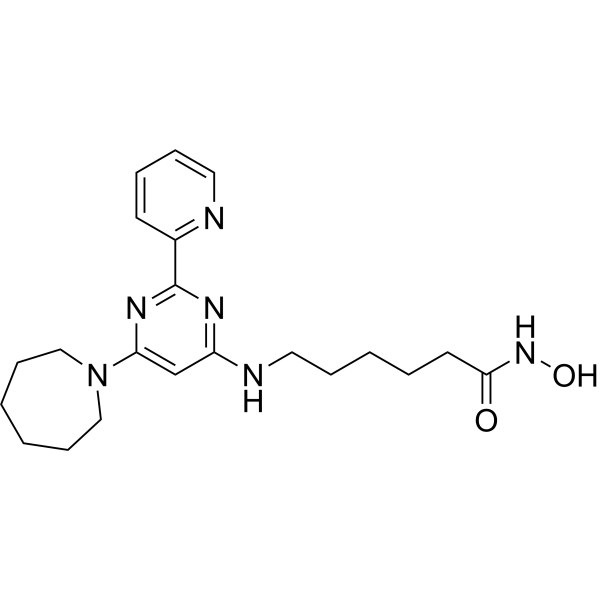
SK-7041 is a HDAC inhibitor with the IC50 of 172 nM. SK-7041 induces the hyperacetylation of histones H3 and H4 .SK-7041 inhibits tumor cell growth in vivo and in vitro, induces cell apoptosis, and arrests cell cycle at the G1 phase .
loading...
    loading...
Cat. No.: HY-156094
CAS No.: 2883046-06-6
Research Areas:  

Cancer

JMJD3/HDAC-IN-1 (compound A5b) is a dual inhibitor targeting Jumonji domain-containing protein demethylase 3 (JMJD3) and histone deacetylase (HDAC1, IC50=16 nM). JMJD3/HDAC-IN-1 promotes hypermethylation of histone H3K27 and hyperacetylation of H3K9, and also cleaves caspase-7 and PARP to induce apoptosis. JMJD3/HDAC-IN-1 effectively inhibits cancer cell cloning, migration, and invasion .
loading...
    loading...
Cat. No.: HY-116267
CAS No.: 1326750-61-1
Research Areas:  

Cancer

MHY219 is a histone deacetylase (HDAC) inhibitor with an IC50 of 0.276 μM. MHY219 inhibits total HDAC enzyme activity, increases histone H3 and H4 hyperacetylation. MHY219 induces cance cells phase arrest, apoptosis and inhibits proliferationin. MHY219 increases cleavage of PARP, Bax, cytochrome c levels, androgen receptor expression and decreases Bcl-2 expression. MHY219 can be used for the research of prostate cancer .
loading...
    loading...
Cat. No.: HY-184389
Research Areas:  

Inflammation/Immunology

PROTAC HDAC6 degrader 10 is a highly efficient, safe and selective HDAC6 PROTAC degrader with a pIC50 of 8.75 and a pDC50 of 9.2 in BEAS-2B cells. PROTAC HDAC6 degrader 10 recruits cereblon to form a ternary complex with HDAC6, thereby achieving the degradation of HDAC6. PROTAC HDAC6 degrader 10 significantly induces hyperacetylation of α-tubulin without affecting the acetylation of H3, and achieves sustained HDAC6 knockdown in mouse lung tissues. PROTAC HDAC6 degrader 10 exhibits high bioavailability after subcutaneous administration in mice. PROTAC HDAC6 degrader 10 enables the study of HDAC6 pharmacology via chemical knockdown of HDAC6 in vitro and in vivo, and can be used for research on pulmonary diseases .
loading...
    loading...

