6 Results for "

laser frequency doubling

" in MedChemExpress (MCE) Product Catalog:
Products (6)

6 Results for "laser frequency doubling" in MCE Product Catalog:

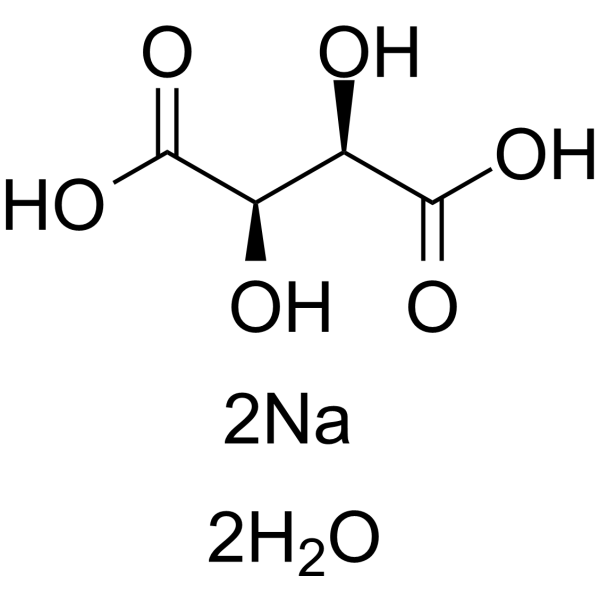
Cat. No.: HY-D0850
CAS No.: 6106-24-7
Synonyms: Sodium tartrate dibasic dihydrate; Sodium tartrate dihydrate
Tartaric acid disodium dehydrate (L-(+) -tartaric acid) is an orally active weak organic acid that can be isolated from grapes. Tartaric acid disodium dehydrate has vasodilatory and antihypertensive effects. Tartaric acid disodium dehydrate can be used as flavorings and antioxidants in a range of foods and beverages. Tartaric acid disodium dehydrate can be used in laser frequency doubling and optical limiting applications .
loading...
    loading...
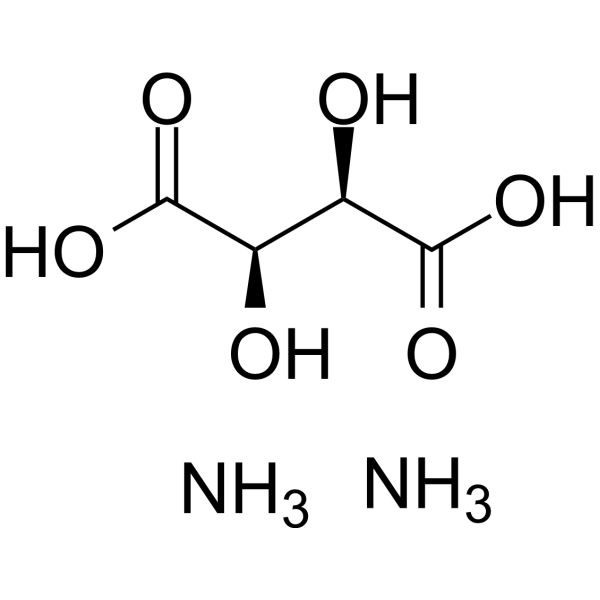
Cat. No.: HY-W109973
CAS No.: 3164-29-2
Synonyms: L-(+)-Tartaric acid diammonium
L-Tartaric acid diammonium (L-(+) -tartaric acid) is an orally active weak organic acid that can be isolated from grapes. L-Tartaric acid diammonium has vasodilatory and antihypertensive effects. L-Tartaric acid diammonium can be used as flavorings and antioxidants in a range of foods and beverages. L-Tartaric acid diammonium can be used in laser frequency doubling and optical limiting applications .
loading...
    loading...
Cat. No.: HY-Y0293R
CAS No.: 87-69-4
Synonyms: L-(+)-Tartaric acid (Standard)
L-Tartaric acid (Standard) is the analytical standard of L-Tartaric acid. This product is intended for research and analytical applications. L-tartaric acid (L-(+) -tartaric acid) is an orally active weak organic acid that can be isolated from grapes. L-Tartaric acid has vasodilatory and antihypertensive effects. L-Tartaric acid can be used as flavorings and antioxidants in a range of foods and beverages. L-Tartaric acid can be used in laser frequency doubling and optical limiting applications .
loading...
    loading...
Cat. No.: HY-D0850R
CAS No.: 6106-24-7
Synonyms: Sodium tartrate dibasic dihydrate (Standard); Sodium tartrate dihydrate (Standard)
Tartaric acid (disodium dihydrate) (Standard) is the analytical standard of Tartaric acid (disodium dihydrate). This product is intended for research and analytical applications. Tartaric acid disodium dehydrate (L-(+) -tartaric acid) is an orally active weak organic acid that can be isolated from grapes. Tartaric acid disodium dehydrate has vasodilatory and antihypertensive effects. Tartaric acid disodium dehydrate can be used as flavorings and antioxidants in a range of foods and beverages. Tartaric acid disodium dehydrate can be used in laser frequency doubling and optical limiting applications [4].
loading...
    loading...
Cat. No.: HY-D2738
CAS No.: 2791287-15-3
BP Fluor 532 NHS ester is an amine reactive, yellow-emitting dye routinely used to label proteins or antibodies through primary amines (Lys), amine-modified oligonucleotides, and other amine-containing biomolecules. The labeling occurs most efficiently at pH 7-9 and forms a stable, covalent amide bond. BP Fluor 532 is a bright yellow-fluorescent dye with pH insensitive emission from pH 4 to pH 10. The excitation of BP Fluor 532 is ideally suited for the frequency-doubled Nd:YAG laser line. BP Fluor 532 can be conjugated to a variety of antibodies, peptides, proteins, tracers, and amplification substrates, and is often used for the generation of stable signals in imaging and flow cytometry.
loading...
    loading...
Cat. No.: HY-D2763
CAS No.: 890928-51-5
BP Fluor 532 maleimide is a photostable, bright yellow-fluorescent dye with pH insensitive emission from pH 4 to pH 10. The excitation of BP Fluor 532 is ideally suited for the frequency-doubled Nd:YAG laser line. BP Fluor 532 dye can be conjugated to a variety of antibodies, peptides, proteins, tracers, and amplification substrates, and is often used for the generation of stable signals in imaging and flow cytometry. Maleimide is the most popular sulfhydryl-reactive group for conjugating the dye to a thiol group on a protein, oligonucleotide thiophosphate, or low molecular weight ligand. The maleimide group specifically and efficiently reacts with reduced thiols (sulfhydryl groups, –SH) at pH 6.5 to 7.5 to form a stable thioether bond. The resulting conjugates exhibit brighter fluorescence and greater photostability than the conjugates of many other spectrally similar fluorophores.
loading...
    loading...

