1. Search Result
Search Result
Results for "

mammosphere

" in MedChemExpress (MCE) Product Catalog:

10

Inhibitors & Agonists

1

Fluorescent Dyes

2

Natural
Products

Cat. No. Product Name Target Research Areas Chemical Structure
  • HY-16031

    NSC710464 free base

    Aryl Hydrocarbon Receptor Integrin Drug Intermediate DNA/RNA Synthesis Cancer
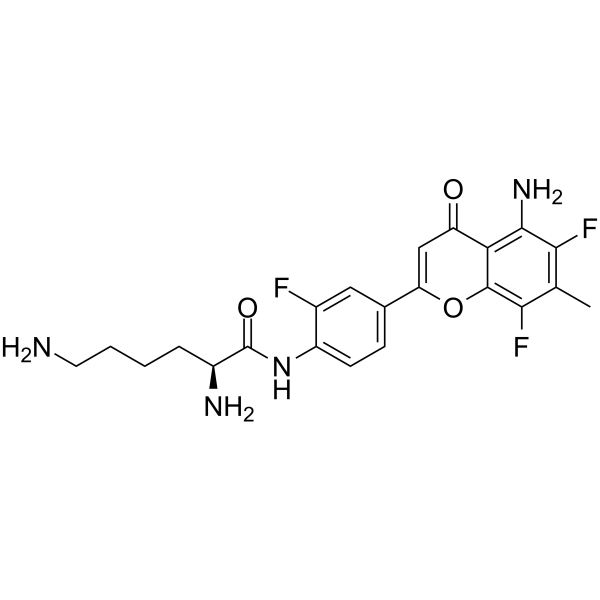
    AFP464 (NSC710464) free base is a prodrug of Aminoflavone (HY-132974) and an agonist of the aryl hydrocarbon receptor (AhR). AFP464 free base downregulates the expression of α6-integrin (α6-integrin), inhibits breast tumor growth, reduces the population of tumor-initiating cells, disrupts mammosphere structure, induces the formation of mucin lake clusters, triggers DNA damage, and exerts antiproliferative activity. AFP464 free base is rapidly converted to Aminoflavone by nonspecific esterases in plasma and cell culture media. AFP464 free base is applicable to research related to breast cancer .
    AFP464 free base
  • HY-16031B

    NSC710464 dihydrochloride

    Aryl Hydrocarbon Receptor Integrin Drug Intermediate DNA/RNA Synthesis Cancer
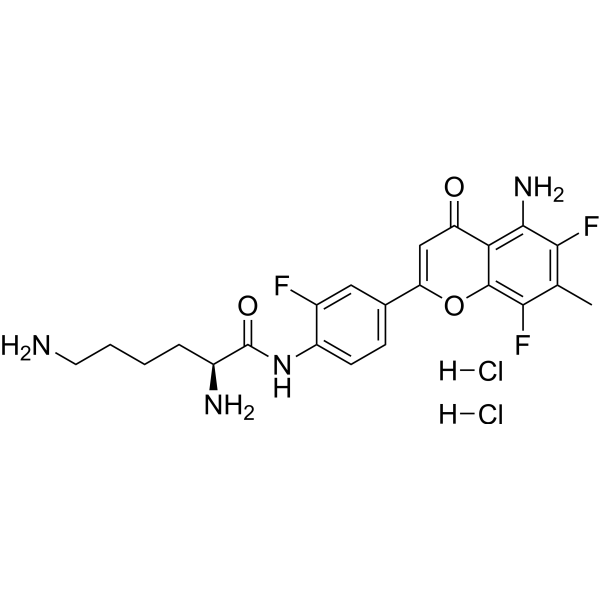
    AFP464 (NSC710464) dihydrochloride is a prodrug of Aminoflavone (HY-132974) and an agonist of the aryl hydrocarbon receptor (AhR). AFP464 dihydrochloride downregulates the expression of α6-integrin (α6-integrin), inhibits breast tumor growth, reduces the population of tumor-initiating cells, disrupts mammosphere structure, induces the formation of mucin lake clusters, triggers DNA damage, and exerts antiproliferative activity. AFP464 dihydrochloride is rapidly converted to Aminoflavone by nonspecific esterases in plasma and cell culture media. AFP464 dihydrochloride is applicable to research related to breast cancer .
    AFP464 dihydrochloride
  • HY-N15201

    STAT Cancer
    Betavulgarin is an anticancer agent. Betavulgarin can be isolated from Sugar Beet (Beta vulgaris). Betavulgarin suppresses the proliferation, migration, colony formation, and mammosphere formation of breast cancer cells, and reduces the size of the CD44 +/CD24 subpopulation and the expression of the self-renewal- related genes C-Myc, Nanog and Oct4. Betavulgarin promotes BCSCs death through the regulation of Stat3/Sox2 signaling .
    Betavulgarin
  • HY-B1460B

    (±)-Sulconazole

    Fungal Cancer
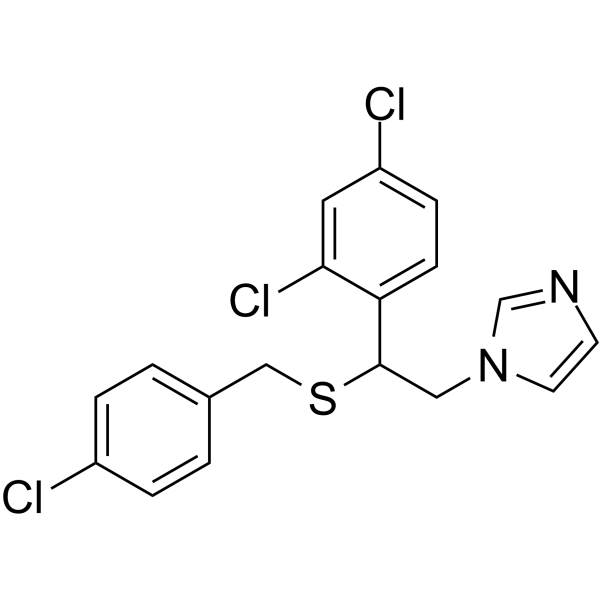
    Sulconazole is a potent antifungal agent in the imidazole class. Sulconazole blocks the NF-κB/IL-8 signaling pathway and CSC (Cancer stem cells) formation. Sulconazole inhibits tumor growth, and can be used for breast cancer research .
    Sulconazole
  • HY-164480

    IKK NF-κB Inflammation/Immunology Cancer
    GTCpFE inhibits IKKα/β in the NF-κB pathway with anti-inflammatory activities and blocks p65 nuclear entry, which consists of Dimethyl fumarate (DMF) (HY-17363) linked to Aspirin (ASA) (HY-14654). GTCpFE exhibits selective anti-cancer stem-like cell (CSC) activity by reducing mammosphere growth and the CD44 + CD24 - immunophenotype. GTCpFE inhibits breast cancer stem cells, an important NFκB- and PGE2-dependent phenotype in aggressive cancers .
    GTCpFE
  • HY-167854

    Aurora Kinase Apoptosis IGF-1R Cancer
    KW-2450 Free base is a potent multikinase inhibitor targeting Aurora A and B kinases, demonstrating significant antitumor activity against triple-negative breast cancer (TNBC). KW-2450 Free base effectively reduces cell viability, promotes apoptosis, and inhibits colony formation and mammosphere formation in TNBC cells. KW-2450 Free base significantly suppresses the growth of TNBC xenografts, leading to tetraploid accumulation followed by apoptosis or the survival of octaploid cells. KW-2450 Free base enhances the efficacy of combination therapy with the MEK inhibitor selumetinib, resulting in a synergistic antitumor effect in TNBC models. KW-2450 Free base also acts as an orally bioavailable inhibitor of IGF-1R and IR tyrosine kinases, contributing to its potential antineoplastic activity by inhibiting tumor cell proliferation and inducing apoptosis.
    KW-2450 free base
  • HY-16031A

    NSC710464

    Aryl Hydrocarbon Receptor Integrin Drug Intermediate DNA/RNA Synthesis Cancer
    AFP464 (NSC710464) is a prodrug of Aminoflavone (HY-132974) and an agonist of the aryl hydrocarbon receptor (AhR). AFP464 downregulates the expression of α6-integrin (α6-integrin), inhibits breast tumor growth, reduces the population of tumor-initiating cells, disrupts mammosphere structure, induces the formation of mucin lake clusters, triggers DNA damage, and exerts antiproliferative activity. AFP464 is rapidly converted to Aminoflavone by nonspecific esterases in plasma and cell culture media. AFP464 is applicable to research related to breast cancer .
    AFP464
  • HY-N19791

    NF-κB Fungal Interleukin Related Infection Cancer
    6-Methoxymellein, a phytoalexin, is a NF-κB inhibitor. 6-Methoxymellein reduces nuclear localization and DNA binding activity of NF-κB p65 and p50 subunits. 6-Methoxymellein decreases mRNA transcription and secretion of IL-6 and IL-8. 6-Methoxymellein reduces the proportion of CD44 +/CD24 breast cancer cells, decreases expression of c-Myc, Sox-2 and Oct4, inhibits proliferation and migration of breast cancer cells, and reduces mammosphere growth. 6-Methoxymellein inhibits fungal growth of Trichophyton rubrum and Botrytis cinerea, and inhibits Trichophyton rubrum biofilm formation via hyphal disintegration. 6-Methoxymellein can be used for the research of breast cancer, tinea corporis, and carrot post-harvest storage rot .
    6-Methoxymellein
  • HY-183102

    Aurora Kinase Apoptosis Cancer
    ATC12 is a Aurora-A kinase inhibitor. ATC12 binds to Aurora-A and competes with TPX2 for binding to disrupt the Aurora-A/TPX2 interaction. ATC12 inhibits cancer cell proliferation, induces apoptosis and cellular senescence. ATC12 can be used in the research of breast cancer .
    ATC12
  • HY-D3185

    Fluorescent Dye Aldehyde Dehydrogenase (ALDH) Cancer
    AlDeSense AM is a cell-permeable ALDH1A1-selective fluorescent reporter. AlDeSense AM is oxidized by ALDH1A1, which eliminates photoinduced electron transfer quenching and enhances the fluorescent signal. AlDeSense AM can be used to detect cells with cancer stem cell properties, as well as to monitor the plasticity of cancer stem cells in cell culture systems and animal models. AlDeSense AM is applicable to the study of cancers associated with cancer stem cells, including chronic myeloid leukemia, melanoma, and breast cancer .
    AlDeSense AM

Inquiry Online

Your information is safe with us. * Required Fields.

Salutation


Country or Region *

Applicant Name *


Organization Name *

Department *


Email Address *


Product Name *

Cat. No.


Requested quantity *

Phone Number *


Remarks

Inquiry Online

Inquiry Information

Product Name:
Cat. No.:
Quantity:
MCE Japan Authorized Agent:

