
1. Search Result
Search Result
Results for "

microbial degradation

" in MedChemExpress (MCE) Product Catalog:

15

Inhibitors & Agonists

2

Biochemical Assay Reagents

1

Peptides

5

Natural
Products

Art. -Nr. Produktname Target Forschungsgebiete Chemical Structure
  • HY-E70005D

    Collagenase, Type IV

    MMP Others
    Collagenase, Type IV (EC 3.4.24.3) is a microbially derived matrix metalloproteinases (MMPs) and zinc peptidase. Collagenase, Type IV degrades type IV collagen and type VII collagen, the main components of the basement membrane, and can also decompose basement matrix and elastin.

    Collagenase IV, Clostridium histolytica
  • HY-N2406
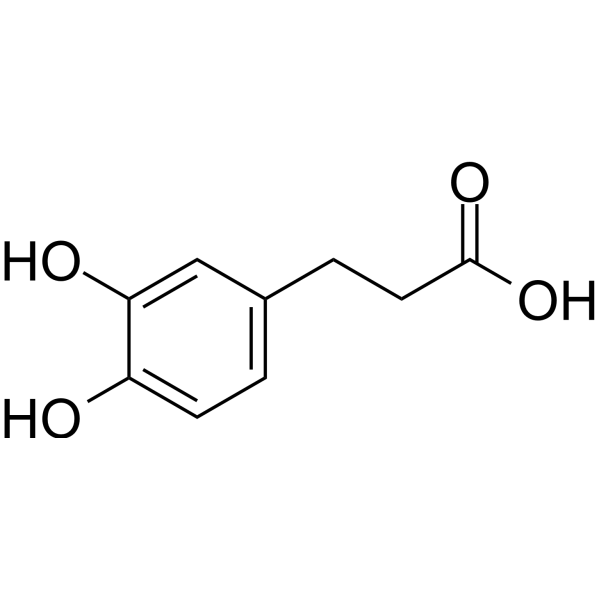
    Dihydrocaffeic acid
    2 Publications Verification

    3,4-Dihydroxy-benzenepropanoic acid

    p38 MAPK Endogenous Metabolite Reactive Oxygen Species (ROS) NO Synthase Inflammation/Immunology
    Dihydrocaffeic acid is a microbial metabolite of flavonoids. Dihydrocaffeic acid scavenges intracellular ROS and increases nitric oxide synthase activity. Dihydrocaffeic acid reduces phosphorylation of MAPK p38 and prevent UVB-induced skin damage. Dihydrocaffeic acid has antioxidant, anti-inflammatory and anti-cartilage degradation activities .
    Dihydrocaffeic acid
  • HY-W099580

    n-Hexadecane; Cetane

    Environmental Pollutants Others
    Hexadecane (n-Hexadecane; Cetane) is a long-chain n-alkane, oil component, and model hydrophobic compound. Hexadecane acts as a substrate for microbial degradation.Hexadecane induces microbial biosurfactant and bioemulsifier synthesis .
    Hexadecane
  • HY-N15135

    Interleukin Related Toll-like Receptor (TLR) Fungal Metabolic Disease
    Arabinoxylan Medium viscosity is an orally active Dectin-1 splice variant modulator, glucose absorption inhibitor, and chyme viscosity enhancer. Arabinoxylan Medium viscosity inhibits particulate β-glucan-induced Dectin-1A activation and mildly suppresses Dectin-1B activation. In human dendritic cells stimulated with particulate β-glucan, Arabinoxylan Medium viscosity reduces the production of IL-10 and TNF-α, and increases the production of IL-4 and IL-23. Arabinoxylan Medium viscosity also supports antifungal immune responses without activating TLR2, TLR4 or TLR5, and does not induce cytokine production when used to stimulate human dendritic cells alone. Arabinoxylan Medium viscosity increases small intestinal chyme viscosity, gets degraded in the large intestine to produce short-chain fatty acids, reduces glucose absorption and insulin response, and improves glucose homeostasis. Arabinoxylan Medium viscosity supports microbial fermentation and the growth of beneficial microbiota in the gastrointestinal tract, prevents bile acid reabsorption, and delays starch digestion. Arabinoxylan Medium viscosity can be used in research related to type 2 diabetes, impaired glucose tolerance, and metabolic syndrome .
    Arabinoxylan (Medium viscosity)
  • HY-W016103

    Bacterial Drug Intermediate Infection
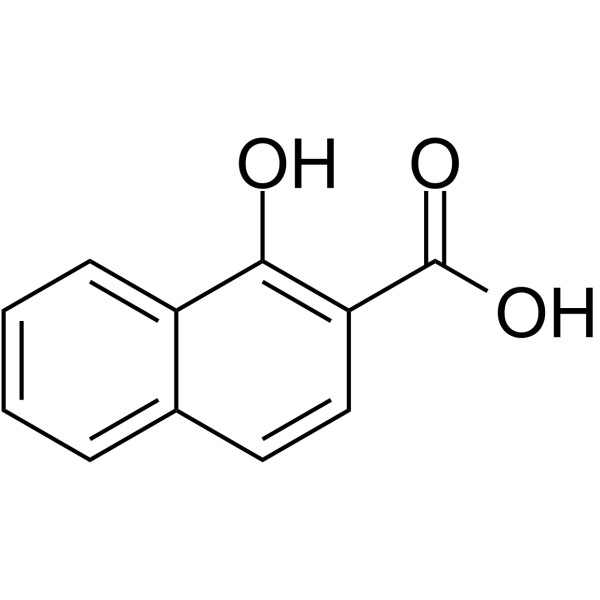
    1-Hydroxy-2-naphthoic acid is a ubiquitous bicyclic intermediate metabolite in the microbial degradation process of polycyclic aromatic hydrocarbons (PAHs). 1-Hydroxy-2-naphthoic acid can be converted into 1,2-naphthalenediol, which enters the naphthalene degradation pathway and participates in the tricarboxylic acid (TCA) cycle to achieve complete mineralization .
    1-Hydroxy-2-naphthoic acid
  • HY-W105775

    Ammonium succinate

    Environmental Pollutants Biochemical Assay Reagents Others
    Diammonium succinate (Ammonium succinate) is a hydrophobic hydrocarbon compound that can be used to study its interaction with microbial cells, especially the mechanisms of degradation and bioavailability. Diammonium succinate is a biomaterial or organic compound that can be used as a biomaterial or organic compound related to life science research.
    Diammonium succinate
  • HY-P2890A

    Endogenous Metabolite Others
    Laccase, Recombinant Microbial (High activity) is a multicopper oxidase. Laccase, Recombinant Microbial (High activity) catalyzes the oxidation of multiple substrates, including phenolic compounds, polyphenolic compounds, lignin, etc. Laccase, Recombinant Microbial (High activity) is involved in the lignin degradation, cell wall synthesis, pigment synthesis, and antioxidant/immune defense. Laccase, Recombinant Microbial (High activity) can be used in paper/textile/food industry, bioremediation, biomedicine and agriculture .
    Laccase, Recombinant Microbial (High activity)
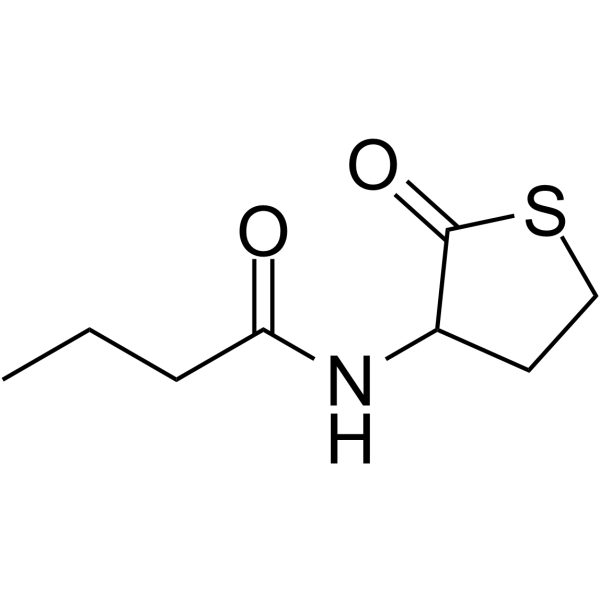
  • HY-W141788

    Bacterial Infection
    N-Butyryl-DL-homocysteine thiolactone is an N-acyl homoserine lactone (AHL) analogue. AHLs are potent inhibitors of biofilm formation and virulence factors, and has been used for degrading microbial communities, reducing bacterial pathogenicity .
    N-Butyryl-DL-homocysteine thiolactone
  • HY-N2406R

    3,4-Dihydroxy-benzenepropanoic acid (Standard)

    Reference Standards p38 MAPK Endogenous Metabolite Reactive Oxygen Species (ROS) NO Synthase Inflammation/Immunology
    Ditalimfos (Standard) is the analytical standard of Ditalimfos. This product is intended for research and analytical applications. Ditalimfos is an organophosphate fungicide. Ditalimfos is mainly used in agriculture to control fungal diseases of crops. Ditalimfos can be used for fungal resistance studies and risk assessment of residues in the environment .
    Dihydrocaffeic acid (Standard)
  • HY-W016103R

    Reference Standards Drug Intermediate Bacterial Infection
    1-Hydroxy-2-naphthoic acid (Standard) is an analytical standard for 1-Hydroxy-2-naphthoic acid (HY-W016103). This product is intended for research and analytical applications. 1-Hydroxy-2-naphthoic acid is a ubiquitous bicyclic intermediate metabolite in the microbial degradation process of polycyclic aromatic hydrocarbons (PAHs). 1-Hydroxy-2-naphthoic acid can be converted into 1,2-naphthalenediol, which enters the naphthalene degradation pathway and participates in the tricarboxylic acid (TCA) cycle to achieve complete mineralization.
    1-Hydroxy-2-naphthoic acid (Standard)
  • HY-W719881

    Herbicide Others
    Isocarbamid is an imidazolinone herbicide. Isocarbamid is sensitive to changes in soil temperature, and its degradation is highly dependent on microbial activity; therefore, low temperatures significantly slow down or even completely inhibit its degradation .
    Isocarbamid
  • HY-W713147

    Herbicide Others
    Thiencarbazone-methyl is a triazole herbicide and also a substrate for microbial degradation. Thiencarbazone-methyl can be degraded by specific fungi and strains. Thiencarbazone-methyl has intrinsic toxicity to the bladder and urinary function. Thiencarbazone-methyl possesses herbicidal activity and can be applied to corn, wheat, lawns and ornamental plants .
    Thiencarbazone-methyl
  • HY-W042298

    Environmental Pollutants Others
    Triisobutyl phosphate is an environmental pollutant that undergoes biodegradation. TiBP can be degraded in activated sludge via hydrolysis, dehydrogenation and hydroxylation, a process mediated by an acclimated microbial community with Pseudomonas as the key strain, and enhanced by TiBP-induced enzymatic activity. TiBP exerts toxic effects on zebrafish embryos .
    Triisobutyl phosphate
  • HY-W040279

    Herbicide Acetolactate Synthase (ALS) Others
    Prosulfuron is a fluorinated sulfonylurea herbicide with a reported acute oral LD50 of 546 mg/kg in female rats. Prosulfuron acts by inhibiting acetolactate synthase (ALS) to block the biosynthesis of branched-chain amino acids (valine, leucine and isoleucine) in plants, thereby suppressing weed growth. Prosulfuron may disrupt the soil microbial community balance in alkaline soils with minimal chemical degradation. Prosulfuron has low toxicity to humans and mammals, and can be used for the research of broadleaf weed control in maize and sweet corn .
    Prosulfuron
  • HY-W588214

    Insecticide Cholinesterase (ChE) Infection
    Phorate sulfone, Phorate metabolite, is an insecticide. Phorate sulfone shows inhibitory activity aainst acetylcholinesterase with an IC50 of 40 μM, leading to acetylcholine accumulation at cellular and subcellular levels. Phorate sulfone can be used for the research of severe phorate poisoning .
    Phorate sulfone

Online-Anfrage

Your information is safe with us. * Required Fields.

Anrede


Country or Region *

Name des Antragstellers *


Name der Organisation *

Department *


E-Mail-Addresse *


Produktname *

Art. -Nr.


Requested quantity *

Telefonnummer *


Bemerkungen

Online-Anfrage

Inquiry Information

Produktname:
Art. -Nr.:
Menge:
MCE Japan Authorized Agent:

